 |
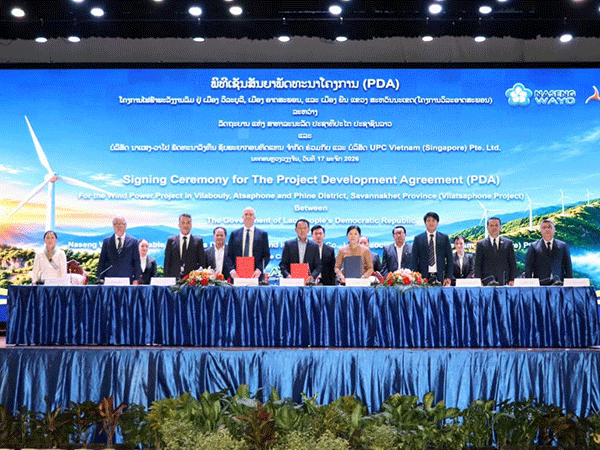
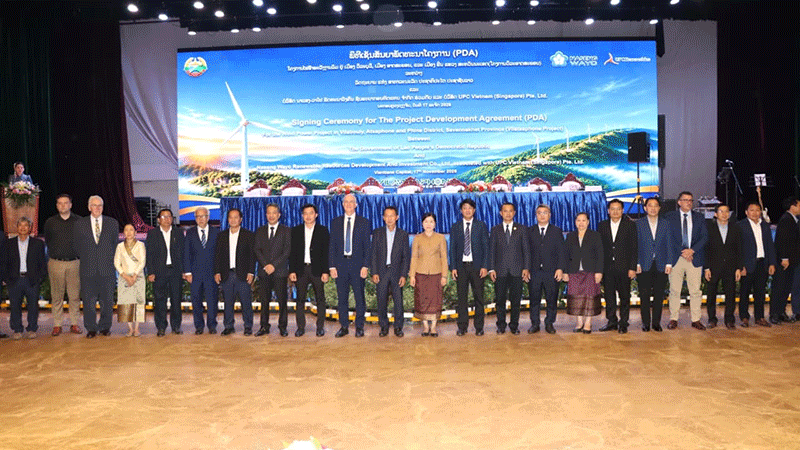
Representatives of the Lao government and project developers attend a signing ceremony for the Vilatsaphone Wind Power Project Development Agreement in Vientiane on Tuesday.
|
Laos inks development agreement
on 1,275MW Vilatsaphone wind farm
The Lao government and two project developers signed a Project Development Agreement (PDA) on Tuesday for the proposed 1,275-megawatt Vilatsaphone Wind Power Project in Savannakhet province.
The agreement marks the start of a two-year feasibility study of the project, which is intended to supply clean electricity to regional markets.
The government signed the agreement with Naseng-Wayo Renewable Resources Development & Investment Co., Ltd. and UPC Vietnam (Singapore) Pte. Ltd. at the Landmark Hotel in Vientiane.
Mrs Phonevanh Outhavong, Vice Chair of the Investment Promotion and Management Committee, was present at the ceremony alongside representatives of the National Assembly, ministries, and other government agencies.
Managing Director of Naseng-Wayo, Mr Khamsavath Bounvilay, said the agreement gives the developers 24 months from the signing date to carry out feasibility studies and prepare the project for future investment decisions.
The study area spans Vilabouly, Atsaphone and Phine districts. The project’s final capacity and layout will depend on wind measurements, site conditions, environmental and social impact assessment findings, grid connection capacity, and opportunities to sell electricity.
 |
Wind power for regional markets
Group Chief Executive Officer of UPC Group, Mr Andrew Sutherland, said the project would help Laos expand its clean electricity exports by supplying wind power to regional markets.
He said it would also support the country’s ambition to become the “Green Battery of Southeast Asia”.
Mr Sutherland said the project could attract long-term foreign investment and generate royalties and tax revenues for Laos over an anticipated 25-year operating period.
If the project goes ahead, the developers expect it to create hundreds of skilled employment opportunities across construction and operations and increase demand for local goods and services.
UPC also plans to support community infrastructure through its corporate social responsibility programme.
Vice Chair of the Athsaphon District Administration Committee, Mr Khongma Vaokhongkhoun, said the district is home to more than 68,000 people living in 70 villages.
He said he hoped the project would create jobs for local residents and help improve roads and electricity infrastructure.
Biodiversity and community concerns to guide project design
The developers will work with the Ministry of Agriculture and Environment, forestry authorities and protected area managers to survey the study area and identify environmentally sensitive sites.
The findings will guide the placement of turbines, roads and other facilities, with priority given to avoiding or minimising impacts during design.
The developers will undertake environmental and social impact assessments in accordance with Lao law and take into account relevant international financing standards.
They will also consult local communities on land use, livelihoods, cultural concerns, safety and other issues that could affect people’s daily life.
Naseng-Wayo will lead local coordination, drawing on its knowledge of the project area. UPC will contribute renewable energy development experience and access to international technical expertise and financing resources.
Over the next two years, the developers will analyse wind measurements, estimate electricity generation, and carry out topographic and geological surveys to inform the feasibility study and basic design.
The studies will also assess turbine and access road options, along with grid connection, transmission, and electricity sales arrangements.
The choice of connection points and export markets will depend on the study findings and the relevant agreements and approvals.
By Times Reporters
(Latest Update November 20, 2026)
|

