Australia the cornerstone of Laos’ land bridge transformation
Laos now has a high-speed railway, an expressway and bridges to connect with neighbouring countries. With the emergence of new and improved transport infrastructure, this landlocked nation is on track to becoming a land bridge in the Mekong region. This development milestone will shape the future of the Lao economic progress, as well as its relationships with its neighbours and the world.
But this massive change may not have taken shape and look like as we see today without a strategic Australian aid to construct the first Lao-Thai Friendship Bridge across the Mekong 28 years ago.
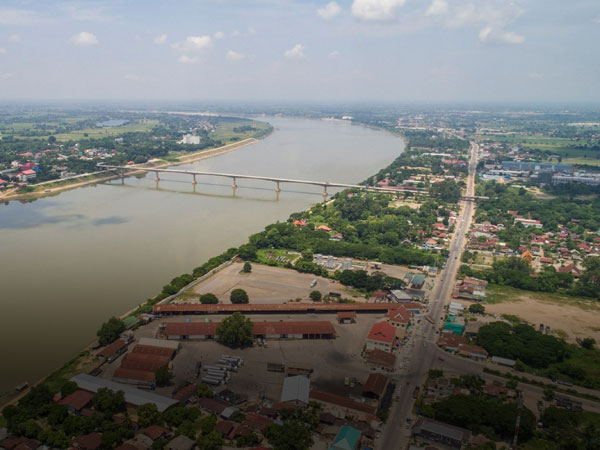 |
| The first Lao-Thai Friendship Bridge is not only a symbol of Lao-Thai and Australian cooperation but is also the cornerstone of Laos’ success in transforming itself from landlocked into a regional land bridge. --Photo Phoonsab Thevongsa |
The opening of the bridge, which spans 1,170 metres across the Mekong River from Vientiane to Nong Khai on April 24, 1994, not only marked the start of Laos’ land connectivity with Thailand but kicked off a new era in Lao development, regional peace and international cooperation, with Australia as one of key players.
Back in 1993, Laos was still a remote and isolated nation with no land crossing to Thailand or a direct gateway to the international community. Outside of Laos, this landlocked nation was something of a mystery.
However, since the opening the Australia-funded Mekong bridge linking Laos and Thailand, things have changed dramatically.
More and more foreign tourists especially from neigbouring countries are coming to Laos thanks to the improved road connectivity with the region.
Data from the National Statistics Bureau shows that international arrivals have continued to rise since the first Lao-Thai friendship bridge was opened for public, climbed from 2 million in 2011 to 4 million in 2019, before dropping to just 500,000 in 2020 due to the Covid-19 pandemic.
In 1997, Laos became a member of Asean - a significant milestone in the government’s foreign policy. Currently, the Lao government is making further efforts to integrate its economy into the regional and global economies. With this policy in place, domestic and foreign investments continue to rise. As a result of the economic trickle down, a large proportion of population have been freed from the poverty.
Laos has emerged as a regional logistics centre thanks to the ongoing development of dry ports in Vientiane and other parts of the country to facilitate the cross-border shipment of goods.
Thanks to the successful operation and benefits delivered by the Australia-funded Lao-Thai friendship bridge to Laos and the region, it is probably safe to say this Australia funded bridge was a game changer.
Following the opening the first Lao-Thai bridge, Laos has built four other bridges across the Mekong to forge even closer connections with Thailand. These have also enabled Laos to serve as a land bridge between Thailand and Vietnam and between Thailand and China.
The second “friendship” bridge opened in 2006, connecting Savannakhet with the neighbouring Thai province of Mukdahan. The third Lao-Thai bridge connected Khammuan province with the neighbouring Thai province of Nakhon Phanom and opened to traffic in 2011. These two bridges transformed central and southern Laos into a land bridge. The fourth friendship bridge between Bokeo and Chiang Rai provinces, which also enables transit between Thailand and China, opened in 2013.
Laos and Thailand are now building a fifth friendship bridge between Borikhamxay province and the Thai province of Bueng Kan. This bridge, which will enable transit between Thailand and Vietnam, is scheduled to open next year. To further strengthen transport connectivity between Laos and Thailand, the two governments are planning to build even more bridges.
Having realised the strategic importance of Laos’ geographic location as a land bridge, China has built the Laos-China railway from Yunnan province to Vientiane and plans to extend it further south to Thailand, Malaysia and Singapore. Laos has gained access to Chinese market, the second largest economy in the world.
Recently, the Lao government authorised local companies to carry out a feasibility study on the construction of a railway from central Laos to central Vietnam. In addition, a feasibility study is being carried out on the construction of an expressway linking Vientiane and Hanoi.
With so many infrastructure development initiatives operational, under construction or in the planning stage, Laos will definitely become a regional land bridge, ending hundreds of years of isolation because of its landlocked status.
According to the Australian Embassy to Laos, the Australian government remains committed to infrastructure development in Laos so that the country is well placed to serve as a transit point and direct connection with neighbouring nations.
In July this year, Australia signed an agreement with the Ministry of Public Works and Transport to provide Laos with a new funding package to further support Laos’ efforts to transform itself into a regional land bridge.
The A$10 million aid, provided under Australia’s Southeast Asia Regional Economic Corridor and Connectivity (SEARECC) programme, will help to improve transport connectivity, cross-border trade, and logistics along an east-west corridor in northern Laos, which will further strengthen infrastructure and Laos’ capacity to serve as a land bridge.
Data from the Embassy shows that apart from the A$42 million grant provided for the construction of the first Lao-Thai Friendship Bridge in the 1990s, from 2007-2014 Australia provided A$18 million funding to improve the national road No 13, an arterial road that runs from the south to the north of Laos. This friendly nation also provided large amount of fund for other infrastructure projects including irrigations and river embarkment.
International economists including from World Bank have expressed confidence that if these transport links are well managed, Laos will benefit from its role as a logistics centre and regional transport hub. Tourism and export of agriculture produces are expected to grow over coming years due to the improved transportation system in Laos.
Given Australia’s past support for infrastructure development and the country’s new commitment to help Laos to become a land bridge, it is not an overstatement to say that Australia is a cornerstone and key player in helping Laos to transform itself from the landlocked into land bridge nation.
Without the first Lao-Thai Friendship Bridge, Laos may not have had a strong foundation to expand its transportation networks to connect neigbouring countries as we see today.
As Laos moves further along the path to becoming a regional logistics hub, the people of Laos are hopeful that Australia will continue to support Laos as it faces new emerging challenges.
In the future, it will be essential to enhance the capacity of Laos to maximise the benefits of its status as a regional land bridge, so that the quality of life of the Lao people continues to gradually improve in the years to come.
About the author: Ekaphone is a senior journalist and editor at the Vientiane Times. He is also an Australia Award Alumni with a Master Degree of Public Administration (Management) from Flinders University, Adelaide. Ekaphone was also the first Lao visiting journalism scholar at the Walter Cronkite School of Journalism and Mass Communication in Phoenix, Arizona, USA.
By Ekaphone Phouthonesy
(Latest Update July 28, 2022)
|

