The housewarming ceremony: a charming Lao custom
A housewarming is a delightful and charming ceremony that is regularly practised in Laos today after being passed down through the generations for as long as anyone can remember.
The function of this ritual is to ask the spirits that surround the house and live nearby to safeguard the new house and its occupants.
This happens when a person builds a new house or buys a house, and the housewarming ceremony, known as Kheun Heuan Mai, will be held as soon as possible to bless the new home before the family moves in.
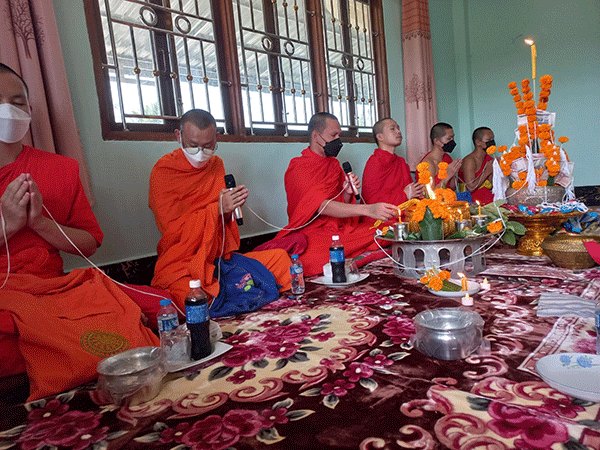 |
| Monks bestow blessings at a housewarming ceremony. --Photo Bounthong |
The homeowner will ask monks and local elders to determine a suitable day for the ceremony, as they are the ones who know the most propitious days in the lunar calendar.
After an appropriate day has been named, the new homeowners invite their relatives and friends to attend the housewarming and enjoy an occasion that serves to strengthen family and community bonds.
Monks and respected elders in the community play an important role in the housewarming ceremony, which is led by a morphon. Usually the host invites an odd number of monks, such as 5, 7 or 9, because odd numbers are considered lucky in Laos.
In the early morning of the designated day, at about 5am, the senior morphon will gather the host and his family members to take part in rituals to please the spirits by bringing baskets of offerings to the new house.
After this ceremony, monks will arrive at the house to perform a Buddhist ritual aimed at bestowing good fortune and prosperity on the new dwelling and its inhabitants. This includes including sprinkling holy water on the hosts and guests and throughout the new house.
The next step in the proceedings is the offering of food to the monks by the host, followed by the presentation of gifts such as flowers, candles and incense sticks along with everyday essentials including drinking water, soap, detergent and toothbrushes.
The host usually also gives the monks a sealed envelope containing a monetary contribution towards the cost of water and electricity used by their temple.
After this, the senior morphon will perform the Baci-soukhuan ceremony, which has been carried out for hundreds of years.
“The Baci-soukhuan, or good luck ceremony, is an ancient ritual designed to ensure good health, happiness and good luck,” village elder Oudone Vongxay said.
Lao people also hold a Baci-soukhuan ceremony on other important occasions such as Lao New Year, the arrival of a new baby, a wedding, the start of a person’s long journey, or simply to welcome guests to a home.
This ceremony usually starts in the early morning and continues until noon.
The centrepiece of every Baci-soukhuan ceremony is the phakhuan, a pyramid-shaped ornamental structure usually handmade by women. In towns, they can be purchased at markets.
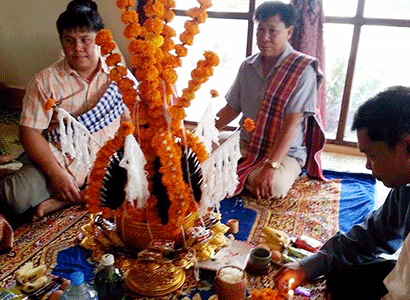 |
| The Baci-soukhuan housewarming ceremony. --Photo Phonesavanh Vongxay/Sang |
This phakhuan is made from banana tree stems studded with orange marigolds, banknotes, and sticks of white thread which will later be used as wrist ties. The phakhuan is surrounded by a boiled chicken, boiled eggs and glasses of locally-brewed alcohol.
The morphon starts the proceedings by lighting a candle at the top of the makbeng (a handmade decoration made of banana leaves and flowers) and asks the host and other participants who will receive blessings to lay their hands palm down on the edge of the phakhuan.
The participants, who are seated on the floor, stay silent as they each hold a white thread between their hands in prayer, while the morphon chants to invoke the spirits to bring health, happiness and good luck.
The long white threads link each of the participants to the phakhuan, while the morphon utters the words “Hai kuad nee, Dee kuad khao”, calling for bad luck to disappear and good luck to come.
As the morphon speaks these words, grains of rice are thrown into the air and rain down on everyone’s head. The rice represents the arrival of the spirits and good luck.
After the morphon has finished the ceremony, he places an egg in the hands of the honoured guest before tying a white blessing string around his or her wrist. Then everyone joins in, wishing good luck while tying strings around the wrists of the honoured guest and hosts as well as amongst themselves.
At the conclusion of the string-tying ceremony, attendees are invited to stay on to eat, drink and dance the lamvong.
The phakhuan is kept until it dries out, or for at least for three days, before it is thrown away, in order to preserve good luck. Similarly, the cotton strings that are bound around everyone’s wrists must also remain in place for three days.
By Khonsavanh Latsaphao
(Latest Update November 30, 2022)
|

