Which critical issues must the government tackle to ensure Laos graduates from Least Developed Country status?
As Laos sets its sights on graduating from Least Developed Country status in 2026, this week’s National Party Congress has highlighted the hurdles that must be overcome. From eradicating corruption to bolstering productivity, Congress delegates shared insights on the “bottlenecks” that must be cleared.
 |
| |
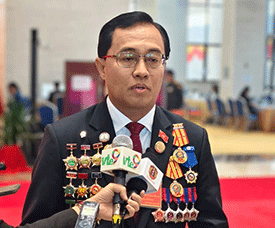
Mr Leklay Sivilay, Minister of Public Works and Transport: Infrastructure is the artery of our economy, but we must ensure its development is transparent and efficient. The government should strictly monitor budget usage to prevent waste and leakages. In the Ministry of Public Works and Transport, our slogan for the next five years concerning infrastructure is “modern, durable, safe, and connected”. We have seen the success of the Laos-China Railway, which transformed us from being merely landlocked to a regional land link. Moving forward, we must expand this link to include Thailand and Vietnam. Where there are roads, there is development. And by cracking down on corruption in infrastructure projects and focusing on high-quality connectivity, we pave the way for Laos to join the ranks of developed nations.
Dr Phayvanh Keopaseuth, Deputy Minister of Health: Health is a non-negotiable pillar of development. A country cannot be developed if its people are physically compromised. We must address the high rate of stunting and malnutrition in children under five, which remains a challenge in many areas. Our ministry is considering innovative solutions, such as a pilot project to fortify rice with essential vitamins. Beyond nutrition, we must improve access to healthcare at the grassroots level. A healthy workforce is more productive and, by ensuring that health services are fair and accessible, we can build the foundations of an advanced society.
Mr Khanonglith Sisomboun, delegate from the Lao Front for National Development: In my view, the most urgent need is to develop human capital. We must build a workforce that can effectively implement the Party’s policies. Furthermore, the government must proactively clear “policy bottlenecks” that hinder economic growth. This includes a rapid transition to a digital economy and modernising administrative mechanisms. If we provide a convenient, transparent environment for investors through digital tools, the economy will naturally flourish. Lastly, we cannot ignore the “cancer” of corruption. Misuse of power by officials creates an impasse to development; without tackling this, we cannot achieve the leapfrog growth required to escape underdevelopment.
Ms Syamphai Sorathy, Head of the Department of Industry and Commerce in Bokeo province: To rise above Least Developed Country status, we must build a self-reliant, independent economy. The government needs to crack down on over-reliance on imports by boosting productivity. Our micro, small, and medium-sized enterprises are the backbone of this effort, but they struggle in terms of quantity, quality, and competition. We need measures that both promote and protect local producers. The “Lao Made, Lao Used” campaign must move from a slogan to a reality, led by the public sector’s example. Additionally, it’s essential to reduce the level of public debt to less than 70 percent of GDP. Doing this will restore investor confidence and provide the financial means needed to develop rural areas.
Mr Atsaphangthong Siphandone, Mayor of Vientiane: Vientiane must lead by example as the nation’s economic engine. The government should turn the resolutions adopted by the 12th Party Congress into detailed, actionable work plans. As the administrative and economic centre, we need to ensure that Vientiane is the hub of high-value investment and modern services. By strengthening the political and economic base in the capital, we create a “locomotive” effect that pulls the rest of the country towards modernisation. Unity and a clear roadmap for the next five years are the keys to overcoming our current financial difficulties.
Colonel Chaiphet Phongsansong, Political Head of the 4th Infantry Division: National security and social peace are the prerequisites for development. The government must continue to crack down on social ills and ensure stability at the grassroots level. My focus is on combining security work with rural development. By building a strong political base in remote areas, we can effectively reduce poverty. When a village is secure and peaceful, economic activities can thrive. We must also ensure that our military and police personnel are disciplined and act as models of integrity, supporting the Party’s vision of a “transparent, strong and firm Party cell”, leadership that protects people’s interests.
By Lamphone Pasanthong
(Latest Update January 9, 2026)
|

