 |
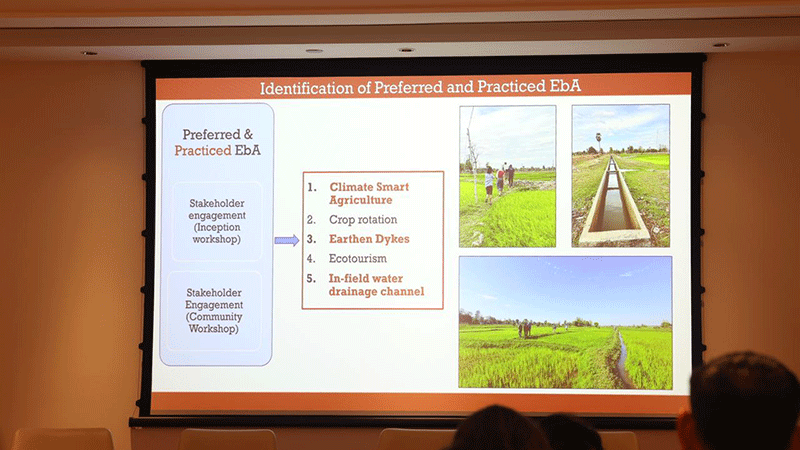
| Presentation of the practice in project areas in Savannakhet. |
A roadmap for agricultural resilience in Savannakhet
In the heart of Laos, Savannakhet province has long been celebrated as the nation’s “rice bowl”. To drive through the province is to see a sea of green—paddy fields stretching toward the horizon, fueled by generations of agricultural tradition.
But today, if you sit with the farmers who work this land, the conversation quickly turns from the beauty of the harvest to the uncertainty of the sky.
The weather, they say, is no longer an old friend they can trust. The “typical” seasons that their grandfathers relied on have vanished. The rain might not come in June when the seedlings are thirsty, yet it might arrive in a deluge in December, drowning the harvest just as it’s ready.
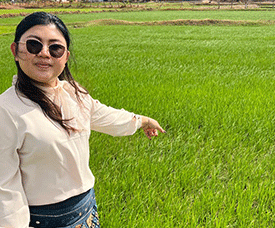 |
| Lead project researcher, Ms Oulavanh Sinsamphanh, visits a project field in Savannakhet province. |
This isn’t just a change in the weather; it’s a fundamental shift in how life works in Savannakhet. For farmers, climate change isn’t a headline in a newspaper—it is the flood in their kitchen and the crack in their dry soil.
However, a new narrative is taking shape. It’s a story not of defeat, but of a clever, community-driven roadmap to a more stable future.
This roadmap comes from a year-long research project titled “Strengthening climate resilience of agricultural livelihoods in Savannakhet province”.
Supported by the Australian Government (DFAT) and led by the Stockholm Environment Institute (SEI) alongside local and regional universities, the project has found that the secret to surviving a changing climate lies in one simple idea: working with nature, rather than trying to beat it.
The Power of “Ecosystem-based Adaptation”
To the scientists, it’s called Ecosystem-based Adaptation (EbA). To a farmer, it simply means using the natural world—the trees, the soil, the hills, and the water—as a shield.
Ms Oulavanh Sinsamphanh, a lead researcher on the project, explains that this isn’t about bringing in expensive, foreign technology that the locals don’t understand. Instead, it’s about looking at what already works and making it stronger.
“Some of these activities have been done by the local people for years,” she says. “It works well because it matches what they actually need.”
The research team—a partnership between the National University of Laos, Kasetsart University, and the Asian Institute of Technology—spent a year listening to these farmers.
From those conversations, 10 key findings emerged from the study, outlining practical EbA strategies that local communities can adopt to build resilience.
These are: (1) Afforestation, (2) Agroforestry, (3) Climate-smart agriculture, (4) Crop rotation, (5) Use of flood-resistant crops, (6) Construction of earthen dykes, (7) Development of ecotourism, (8) In-field water channels, (9) Integrated crop-livestock systems and (10) Intercropping techniques.
Climate Smart Agriculture, Earthen Dykes and In-field Water Drainage Channels are initially implemented in the area.
Bridging the Gap: From Wisdom to Action
The beauty of this plan is that much of it is built on “local wisdom”. Ms Oulavanh points out that things like earthen dykes and water channels are already being built by villagers using their own hands and knowledge.
“It is an effective method,” she notes, “but it is not sufficient. They need it more.”
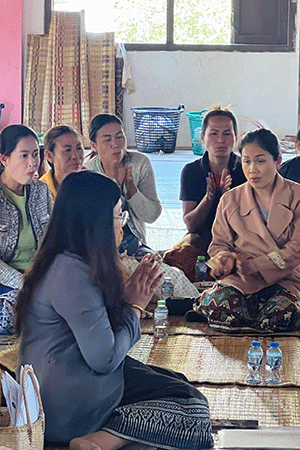 |
| Ms Oulavanh meets with farmers in Savannkhet province to ensure that practices are based on local preferences. |
The farmers told the researchers that they have the will, but lack the resources. They need help scaling up.
They need “sub-tunnels” to bring water to fields that are miles away from the main river. They need the government to help them map out “zoning”, deciding which land is best for rice and which land should be used for other crops that don’t mind getting their feet wet.
A Call to Action for the Future
The research provides more than just a list of farming tips; it provides a mandate for action for the government, NGOs, and international partners. The findings give reason to be optimistic about the potential of ecosystem-based adaptation measures to enhance climate resilience in agricultural communities. However, to realise this potential at scale, the policy brief recommends the following:
● Mainstream EbA into national and subnational development planning, including agriculture, water, and natural resource management strategies.
● Bridge implementation gaps through locally led planning and budgeting, ensuring that community knowledge informs policy and that funds reach community initiatives that plan, implement, and benefit from EbA.
● Embed GEDSI principles in climate adaptation, supported by inclusive training, improved policy design, and accountability mechanisms.
● Strengthen multi-level governance and coordination, enabling synergy between EbA and infrastructure investments for long-term water and agricultural resilience.
● Sustained investment, inclusive approaches, and cross-sector collaboration will be essential to safeguard rural livelihoods and ecosystems in the face of a changing climate.
The Road Ahead
As the sun sets over the fields of Savannakhet, the challenge remains great, but the path forward is clearer than ever. By combining the scientific rigor of international research with the deep-rooted knowledge of the Lao farmer, we can protect the “rice bowl” of the nation.
This is to ensure that when the next unpredictable storm comes, the farmers of Savannakhet aren’t just surviving—they are thriving. This is a call to action for everyone to invest in the soil, the water, and the people who feed the country.
--This article is produced through the Media Research Partnership Fund coordinated by SEI Asia with the generous support of DFAT, Government of Australia.
By Keoxomphou Sakdavong
(Latest Update January 13, 2026)
|

