 |
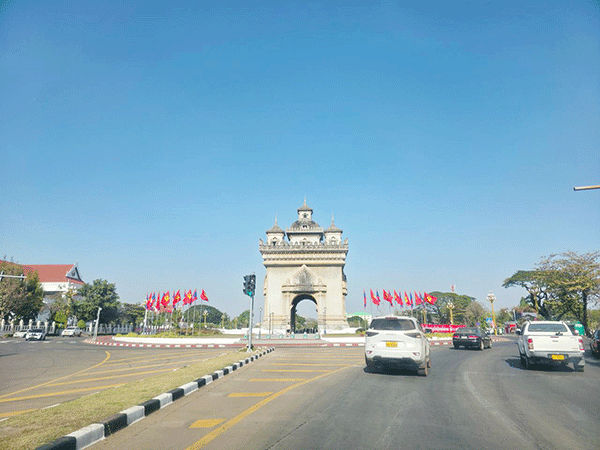
| National and Party flags encircle the Patuxay Monument, a powerful symbol of Laos’ unity and development. |
Govt maps Laos’ development path to 2030
The government has set out a detailed strategy to develop Laos through economic reform, social improvements, and environmental protection under its new five-year plan.
Prime Minister Sonexay Siphandone presented the 10th five-year National Socio-Economic Development Plan for 2026-2030 at the 12th National Congress of the Lao People’s Revolutionary Party, which took place from January 6-8.
The National Party Congress is the highest decision-making body of the Lao People’s Revolutionary Party and sets the country’s political, economic and social direction for the next five years.
The development plan outlines six main objectives and 26 focus work plans aimed at accelerating growth, improving living standards, and strengthening national resilience.
Under the plan, the government targets annual economic growth of at least 6 percent, gross domestic product per capita of US$3,104, and an inflation rate of less than 5 percent over the five-year period.
Public debt is expected to fall below 70 percent of gross domestic product, while nationwide forest cover is set to reach 70 percent by 2030, linking development with environmental protection.
To achieve these goals, the government aims to build a self-reliant and resilient economy by making better use of domestic potential, keeping the macroeconomy stable, and improving investment efficiency.
Micro, small and medium enterprises are expected to play a stronger role, alongside state-owned enterprises and local collective production groups, to boost productivity and competitiveness at the regional and international levels.
The plan identifies the digital economy as a key driver of modern and sustainable development, supporting innovation, productivity, and new business opportunities.
Human capital development is another core priority, with reforms planned in education, skills training, and public health services to better meet current job market needs.
Balanced urban and rural development remains central to the strategy, with poverty reduction, food security, and improved nutrition highlighted as national priorities.
The government will also expand social protection systems, promote gender equality, and continue the clearance of unexploded wartime munitions, to improve the lives of affected communities.
Environmental protection and climate action are also on the agenda, to be achieved through more hands-on management of forests, land, water, and minerals, promotion of green growth, and improved disaster preparedness.
Regional and international connectivity will be strengthened through investment in roads, railways, airports and digital infrastructure, alongside stronger trade and investment cooperation.
Cities and special economic zones are expected to serve as key centres for production, investment and tourism, supporting broader economic development.
The plan also places a strong focus on improved state management and administration under the Party’s Sam Sang (Three Builds) directive to ensure governance is efficient, responsive, and law-abiding.
The new strategy builds on progress made under the 9th five-year National Socio-Economic Development Plan for 2021-2025, with development forging ahead despite global and regional challenges.
During the five-year period, Laos recorded average annual economic growth of 4.24 percent, exceeding the target of 4 percent.
Public debt declined from 112 percent of gross domestic product in 2022 to about 88 percent in 2025, while the country recorded a trade surplus of US$8.4 billion.
Prime Minister Sonexay Siphandone said successful delivery of the development plan would benefit communities across the country and strengthen long-term national stability.
By Times Reporters
(Latest Update January 13, 2026)
|

