 |
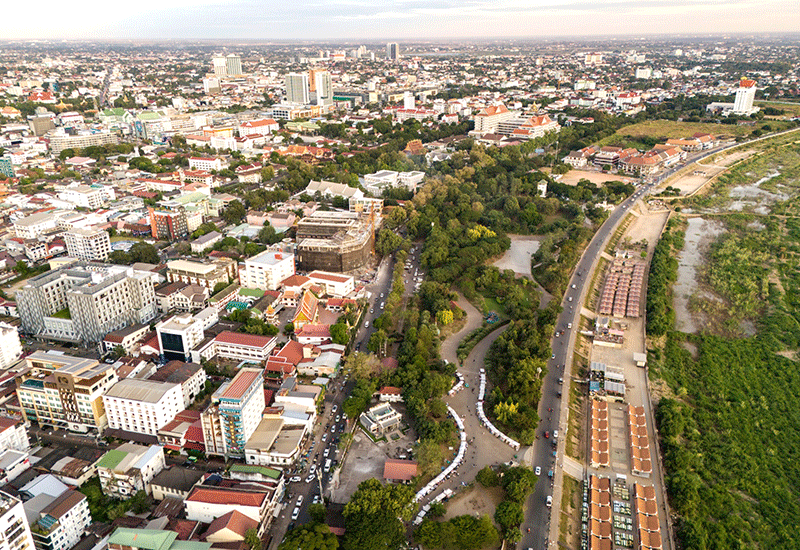
| Laos has until 2026 to complete preparations for graduation from Least Developed Country status, with a transition period lasting until 2029. Photo shows a view of the capital Vientiane. --Photo Phoonsab |
Laos on track to graduate from LDC status this year, UN confirms
Laos has been officially recommended for graduation from Least Developed Country (LDC) status in 2026, according to the latest assessment by the United Nations.
Laos is among three countries, alongside Bangladesh and Nepal, proposed for graduation following a comprehensive review process.
The recommendation will proceed through formal approval by the UN Economic and Social Council (ECOSOC) and the United Nations General Assembly, marking a significant milestone in Laos’ long-term development and international integration.
The inclusion or removal of a country from the LDC list is determined through United Nations mechanisms and assessments, and not by the decisions of individual governments.
During the Lao People’s Revolutionary Party’s National Congress earlier this month, the Secretary General of the Party Central Committee, Mr Thongloun Sisoulith, presented the Committee’s draft political report outlining the Party’s vision for the next five years. The report highlighted political stability and social order as a solid foundation for socio-economic development.
On the economic front, the Party Secretary General announced a target for average annual economic growth of at least 6 percent in the years 2026-2030. This level of growth would help pave the way for Laos to graduate from LDC status and ensure a smooth transition in the years following graduation, he said.
Development efforts in Laos have been hindered by the Covid-19 pandemic, as well as regional and global economic and financial challenges.
In recognition of these difficulties, the UN General Assembly adopted a Resolution in 2021 that extended the transition period for graduating countries from the usual three years to five.
Under this arrangement, Laos has until 2026 to prepare for graduation from LDC status, with a transition period lasting until 2029.
Based on assessments of Laos’ economic situation by international organisations such as the Asian Development Bank (ADB), in 2024 the economy grew by 4.0 percent, while the International Monetary Fund (IMF) estimated growth at 4.3 percent, and the World Bank (WB) at 4.1 percent.
Data from the National Statistics Centre show that the economy grew by 4.3 percent in 2024, slightly higher than the 4.2 percent recorded in 2023. Gross domestic product in 2024 reached 325,287 billion kip, compared to 158,293 billion kip in 2012, indicating continued economic expansion.
Graduation from LDC status is expected to mark a new phase in Laos’ development, supporting its transition towards becoming a developing nation and moving from low-income to lower-middle-income status, similar to other countries in the region such as Vietnam, Indonesia, and the Philippines.
Following graduation, Laos is expected to strengthen its capacity to produce competitive goods for domestic and international markets through greater use of technology and innovation.
Access to the United Nations Technology Bank for LDCs will help improve standards, product quality, the business environment, and export capacity, contributing to increased foreign investment, job creation, and higher incomes in Laos.
The United Nations, other development partners, and Lao authorities have conducted studies to assess the potential impacts of reduced international grants and special support measures after graduation, to ensure a smooth and sustainable transition.
By Khonesavanh Latsaphao
(Latest Update January 22, 2026)
|

