 |
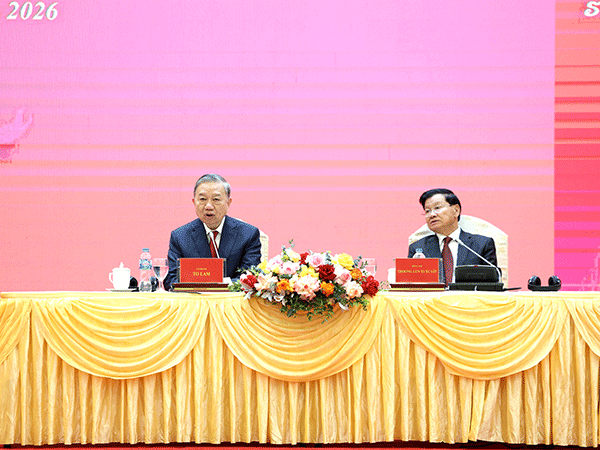
| Secretary General of the Lao People’s Revolutionary Party (LPRP) Central Committee and President of Laos, Thongloun Sisoulith (right), and General Secretary of the Central Committee of the Communist Party of Vietnam, To Lam, co-chair a meeting in Hanoi on Monday. |
Outcomes of Lao National Party Congress top agenda at leaders’ meeting in Vietnam
The key outcomes of the 12th National Congress of the Lao People’s Revolutionary Party (LPRP), including long-term development directions and the 10th five-Year National Socio-Economic Development Plan, took centre stage at a high-level meeting held in Hanoi on Monday.
The meeting was co-chaired by the Secretary General of the LPRP Central Committee and President of Laos, Thongloun Sisoulith, and General Secretary of the Central Committee of the Communist Party of Vietnam, To Lam.
It took place on the sidelines of a state visit to Vietnam by a high-ranking Lao delegation on January 26-27, led by Secretary General of the LPRP Central Committee and President of Laos, Thongloun Sisoulith.
Mr Thongloun briefed the Vietnamese leadership on the main outcomes of the Party’s 12th National Congress, which took the theme “Elevate the Party’s strong leadership role, actively build an independent and self-reliant economy, continue to nurture the people’s democratic regime, and advance steadfastly towards socialism”.
The Congress conducted a comprehensive review of the implementation of resolutions adopted at the 11th Party Congress and defined orientations, policies, and action plans for the next stages of Laos’ development.
These include objectives and tasks for the 2026-2030 period, a 10-year development strategy, and a Vision to 2055, aimed at bolstering the “New Change” policy and laying the foundations for the transition towards socialism.
Despite complex global developments, economic and financial challenges, and the impacts of the Covid-19 pandemic, the LPRP successfully implemented the fundamental directions and objectives set during the previous term, contributing to political stability, socio-economic development, and improvements in the living standards of the Lao people.
A major outcome of the Congress was the adoption of the Party’s Third Political Programme, which provides long-term strategic guidance for building and perfecting the People’s Democratic Regime, defined as a regime of the people, by the people, and for the people.
The programme continues the “New Change” policy initiated by President Kaysone Phomvihane and outlines 11 major policies for the socialist transition, together with 10 key work directions across various sectors.
The Congress also approved the 10th National Socio-Economic Development Plan for the years 2026-2030 and adopted revisions to the Party’s statutes to meet new development requirements.
In terms of personnel, the Congress elected the 12th Party Central Committee, comprising 73 full members, including 12 women, and 15 alternate members, including one woman. The Congress also elected 13 members to the Politburo and 11 members to the Secretariat.
Vietnam’s Party General Secretary To Lam congratulated the LPRP on its achievements over the past five years and on the successful outcome of the 12th National Congress.
He said he highly appreciated President Thongloun Sisoulith’s decision to choose Vietnam as the destination for his first state visit following the Congress, describing it as a powerful demonstration of the great friendship, special solidarity, comprehensive cooperation, and deep mutual trust between the two parties, states, and peoples.
The two leaders reaffirmed their commitment to further strengthening the great friendship, special solidarity, and comprehensive cooperation between Laos and Vietnam in the new development period.
The implementation of Laos’ 10th five-year National Socio-Economic Development Plan (2026-2030) was also discussed.
The Lao delegation briefed their Vietnamese counterparts on the core orientations and priorities of the development plan, emphasising its role as the key operational instrument for translating the resolutions of the 12th Party Congress and the Third Political Programme into concrete socio-economic outcomes.
Vietnam’s leaders welcomed the orientations of the plan and reaffirmed their readiness to continue close cooperation with Laos in areas of mutual interest, including economic development, capacity building, and experience sharing in socio-economic management.
The two sides agreed that effective coordination in implementing national development strategies would contribute to each country’s stability and growth, while further strengthening the long-standing special solidarity, comprehensive cooperation, and mutual trust between the two parties and states.
By Times Reporters
(Latest Update January 28, 2026)
|

