 |
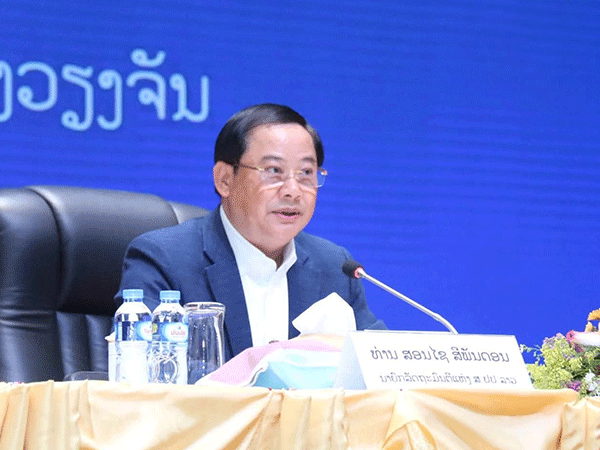
| Prime Minister Sonexay Siphandone addresses a finance meeting on Friday. |
PM pushes for revenue reform on path to self-reliant economy
Prime Minister Sonexay Siphandone has outlined a far-reaching strategy to modernise revenue collection and strengthen fiscal discipline, reaffirming the government’s aim to build a self-reliant economy and ensure Laos becomes an upper-middle-income country by 2035.
Addressing the close of a national finance meeting on Friday, which summarised the progress made in 2025 and outlined directions for 2026, the Prime Minister said major changes to the way revenue is collected is central to creating economic self-reliance and sustaining long-term growth.
The government will set up a systematic, transparent and centralised electronic revenue collection framework, supported by the use of modern technology and stronger coordination across all relevant sectors.
As part of this effort, the electronic invoice system will be expanded to all businesses, while the D-Filing system will be fully implemented to enable electronic submission of forms, budget disbursement, and the collection of fees and service charges.
Revenue collection at international border crossings will be centralised through the Ministry of Finance’s FinPass system, and revenue management platforms across sectors will be interconnected to improve data sharing and oversight.
The prime minister instructed the relevant authorities to review the sharing of budget management between central and local levels of government, with the management of large-scale enterprises to be transferred to the central government to improve monitoring.
Administrative procedures for budget approval and disbursement will also be upgraded.
Alongside institutional reforms, the prime minister outlined key financial targets for 2026, including GDP growth of 5.5 percent, revenue of at least 20 percent of GDP, and increased contributions from state-owned enterprises, targeted at about 1 percent of GDP. Over the longer term, the government aims to maintain average economic growth of 6 percent or higher during the 2026-2030 period.
Minister of Finance Mr Santiphab Phomvihane on Thursday gave a detailed assessment of recent economic performance and the fiscal outlook, noting that Laos remains firmly on track to realise its 2035 development vision.
Mr Santiphab said the government’s long-term ambition is for Laos to become an upper-middle-income country by 2035, supported by sustained growth, fiscal reform and strategic development across key sectors.
To achieve this goal, per capita income is targeted to rise to US$4,600-US$5,000 per annum, underpinned by average annual economic growth of 6-7 percent.
Development efforts will focus on seven economic sectors, which are expected to play a decisive role in restructuring the economy and driving long-term productivity.
Reviewing recent performance, the finance minister said the 2025 state budget plan, which concludes the 9th five-year National Socio-Economic Development Plan (2021-2025), recorded steady progress despite a challenging global environment.
The economy expanded by 4.8 percent in 2025, while average growth over the five-year period stood at 4.24 percent.
Inflation has been brought under control, easing to a single-digit rate of 8.8 percent, while macroeconomic stability has remained firm. Poverty reduction targets under the plan have also been achieved, providing a strong foundation for the next phase of development.
Looking ahead to 2026, Mr Santiphab said the government will implement the 10th National Socio-Economic Development Plan, with priority given to strengthening fiscal discipline and revenue collection so that revenue accounts for 20.02 percent of GDP.
Revenue collection efforts will focus on strengthening customs duty and other forms of taxation, creating new sources of revenue, and increasing the income earned from logistics services. Modern revenue collection tools will be deployed, while tax and customs duty exemptions that are inconsistent with existing regulations will gradually be reduced.
On the expenditure side, budget spending will be tightly controlled at all stages, from planning and allocation to monitoring and auditing, to ensure that limited financial resources are used efficiently and aligned with national priorities.
By Times Reporters
(Latest Update February 2, 2026)
|

