 |
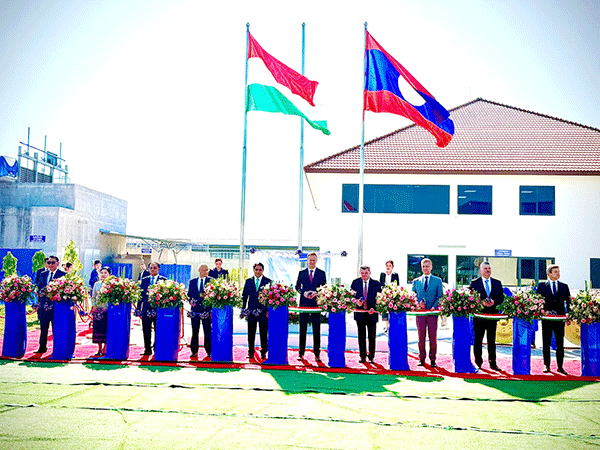
Dr Atsaphangthong Siphandone (fifth left), Mr Péter Szijjártó (fifth right) and other officials cut a ribbon to hand over the Vientiane Water Treatment Project.
|
Vientiane upgrades wastewater treatment with Hungary-funded project
Vientiane authorities have taken a significant step in the development of modern and sustainable urban sanitation with the official handover of the Hungary-funded Vientiane Water Treatment Project.
The project, which involves both water supply and wastewater management, was handed over on Wednesday in Kharmngoy village, Xaysettha district.
The Vientiane Water Treatment Plant and Sewer System Project has a 26,000m3/day technological capacity and 52,000m3/day structural capacity and is financed by a Tied Aid loan from the Government and people of Hungary,
The project was officially handed over by Hungary’s Minister of Foreign Affairs and Trade, Mr Péter Szijjártó, to the Mayor of Vientiane, Dr Atsaphangthong Siphandone.
The ceremony was attended by the Hungarian Ambassador to the Lao PDR, the European Union Ambassador to Laos, and representatives from relevant ministries and authorities.
Speaking at the event, Director of the Vientiane Department of Public Works and Transport, Mr Bounyavat Niraxay, noted that the project was financed through an interest-free conditional loan provided by the Government of Hungary. The loan, valued at US$100 million, was facilitated via the Export-Import Bank of Hungary (Exim Bank) under an agreement signed in 2018.
The project initially had a four-year implementation period, with subsequent extensions leading to a final completion target of March 2026. The Lao-Hungarian Water Project Association was the primary contractor.
Designed to meet modern European standards, the project significantly expands Vientiane’s wastewater treatment capacity through advanced technology imported from Hungary.
The treatment plant currently has the capacity to process 26,000 cubic metres of wastewater per day, with infrastructure designed to support expansion up to 52,000 cubic metres per day. The facility uses the Moving Bed Bio Reactor system, a modern and efficient wastewater treatment technology. Key components include the construction of a wastewater treatment plant, a citywide pipeline network collecting wastewater from the Hong Ke area, and nine pumping stations.
The pipeline consists of 7.3 kilometres of gravity-flow pipes and 7.1 kilometres of high-pressure pipes.
In addition, seven major facilities were built, including grit and sand chambers, treatment tanks, sludge thickening and dewatering buildings, a UV disinfection tank, and administrative offices and laboratories.
Construction of the main components is 99 percent complete, with the remaining minor works expected to be finalised by March. The project includes an 18-month warranty period to ensure operational reliability.
To guarantee long-term sustainability, the Vientiane Department of Public Works and Transport and the Vientiane Water Supply State Enterprise have trained personnel to operate and maintain the system.
Once fully operational, the project is expected to play a crucial role in environmental protection, improved public health, and upgraded sanitation in Vientiane.
By Times Reporters
(Latest Update February 5, 2026)
|

