 |
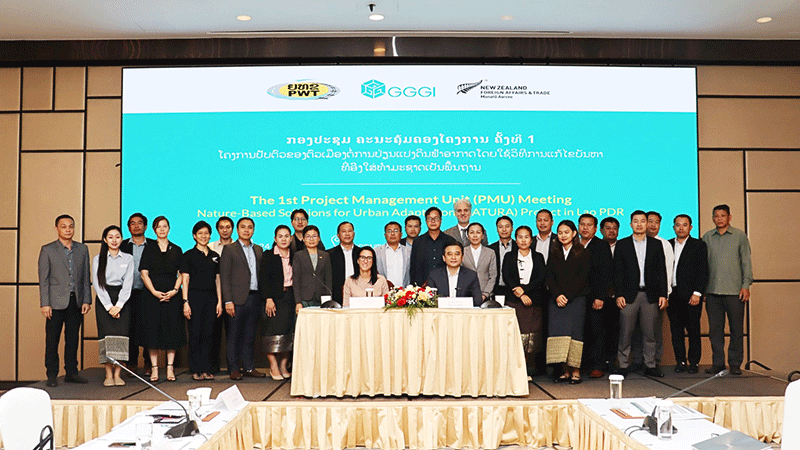
Government officials, donors and stakeholders attend the Project Management Unit meeting on Tuesday. --Photo Global Green Growth Institute
|
Laos to tackle urban flooding through US$6.5 million wetland restoration scheme
Laos is strengthening urban climate resilience through the implementation of a US$6.5 million nature-based solutions project aimed at restoring degraded wetlands and reducing flood risks in Vientiane.
Funded by the Ministry of Foreign Affairs and Trade of New Zealand, the initiative—known as the NATURA Project—also seeks to create sustainable livelihood opportunities through wetland restoration while promoting long-term climate adaptation.
Officially titled “The Nature-Based Solutions for Urban Adaption (NATURA) Project”, the venture is being rolled out by the Department of Housing and Urban Planning under the Ministry of Public Works and Transport in collaboration with the Global Green Growth Institute (GGGI).
The first Project Management Unit meeting took place in Vientiane on Tuesday.
The meeting was co-chaired by the Director General of the Department of Housing and Urban Planning, Dr Bounta Onnavong, and GGGI Country Representative to the Lao PDR, Ms Dagmar Zwebe.
Deputy directors general, deputy district governors, and heads of relevant departments and offices from sectors across the capital participated in the discussions.
Dr Bounta said the project received a grant of US$6.5 million from New Zealand through the Global Green Growth Institute. The funding will support the restoration and development of the Nong Loup Ian area in Nonkhilek village, Sikhottabong district, which will serve as a pilot site for applying nature-based solutions to urban flood management.
In parallel, Phase 1 has carried out data collection and feasibility studies for the Nong Ping area, identified as the proposed site for implementation under Phase 2.
The meeting marked the first formal consultation of the Project Management Unit following its appointment by the Minister of Public Works and Transport in September 2025.
Discussions focused on assigning responsibilities among Project Management Unit members and reviewing progress and the 2026 Annual Work Plan to ensure coordinated, timely, and effective implementation.
Dr Bounta emphasised that project success depends on clear role allocation, internal unity, and strong coordination within the Project Management Unit.
He called for transparent reporting, regular monitoring and evaluation, and clearly defined timelines and performance indicators for each activity, noting that 2026 will be a key year for active implementation.
Officials noted that rapid urban expansion in recent years has led to the encroachment and degradation of natural wetlands, increasing communities’ vulnerability to flooding and climate-related risks.
By restoring and enhancing wetlands through nature-based solutions, the project aims to provide a sustainable and cost-effective long-term approach to climate adaptation while promoting community participation and improving the overall quality of life in Laos.
By Times Reporters
(Latest Update February 26, 2026)
|

