What lessons would a nation’s leader choose to leave for future generations?
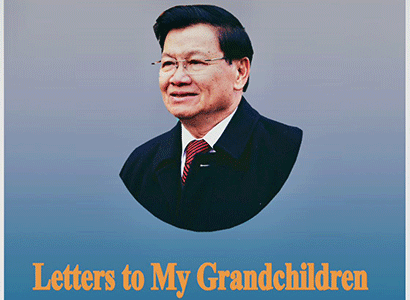
In Letters to My Grandchildren, President Thongloun Sisoulith opens a window into his life through a collection of heartfelt letters written during official journeys abroad between 2014 and 2019. More than a family memoir, the book recounts an extraordinary journey from a humble childhood in a remote village in Huaphan province to the highest office in the Lao PDR.
Through vivid recollections of hardship, perseverance, education, and public service, President Thongloun shares the experiences and values that shaped his character and leadership. Readers will encounter the story of a young boy who crossed rivers to attend school, overcame poverty and adversity, and remained steadfast in his pursuit of knowledge and service to the nation.
Rich with personal reflections and life lessons, Letters to My Grandchildren offers a rare and intimate portrait of the man behind the presidency while providing inspiration for young people, parents, and leaders alike. It is a story not only of one individual’s journey but also of resilience, dedication, and the enduring belief that determination can transform even the most modest beginnings into a life of remarkable achievement.
The book comprises 12 chapters, and the Vientiane Times will present each chapter in the newspaper.
Chapter 1 - Where Was I Born? Under What Circumstances? I wish to share with you, my grandchildren, this account of my life on the occasion of my 70th birthday, which falls on 10 November 2015. This year, my grandchildren are: Children of Thonglee Sisoulith: 1. Mr Aphivat Sisoulith (Khob); 2. Ms Souphatta Sisoulith (Anfiew); 3. Mr Aphinan Sisoulith (Bill).
Children of Thavisouk Sisoulith: 1. 2. 3. Ms Ketkeomany Sisoulith (Violin); Mr Soukthavysai Sisoulith (Marcus); Mr Santithavisouk Sisoulith (Yuri). Even though you are not yet able to read—or even if you can, you may not fully understand everything I sketch in this letter—it will, I believe, be of value to you when you grow older. One day, you will be able to read this letter from your grandfather, who loves you with all his heart.
Through the various experiences that I have gone through, at the very least you will learn about the life of a man who was born and raised in circumstances filled with hardship and struggle, and who has overcome many challenges and tests to reach this day.
I began writing this letter on the special flight QV 888 from Vientiane to Busan (Republic of Korea) on 10 December 2014, a flight scheduled from 9:00 a.m. to 3:00 p.m. It was arranged for Prime Minister Thongsing Thammavong to attend the ASEAN–Republic of Korea Commemorative Summit celebrating the 25th anniversary of ASEAN–ROK relations in Busan, and I had the opportunity to accompany him in my capacity as Deputy Prime Minister and Minister of Foreign Affairs. Your grandmother and your aunty Noy were also on that flight.
My dear grandchildren, I am deeply proud to see that you were able to come into this world in comfortable circumstances— in your places of birth and in every aspect of your surroundings…. Compared with the conditions of my own birth, it is as different as sky and earth.
I was born into a poor farming family in Ban Nachon (Na Chon Village), Ta Saeng Sob Hao (Sob Hao Sub-district), Xiengkhoh District, Houaphanh Province. Yet my actual birthplace was not the village as such: I was born deep in the forest, beside a small stream, because at that time the Second World War was nearing its end. My father and mother had fled the village into the deep forest to escape the bombing. The villagers called that deep forest “Khao Lung.” My mother was pregnant there, and that is where I was born. The following year, after the Birth in the forest, amid every kind of deprivation, is hard even to imagine: no doctor, no medicine, no midwife. My mother delivered me herself; my relatives cut the umbilical cord and wiped and washed me with water from the stream, then tended to us according to the customary practices of farming folk. I was fortunate to survive and grow up, to live on to this very day.
I became aware of my beginnings when, at the age of ten, my parents told me about the circumstances of our family. They said: “My son (meaning me), you are not our only child. In truth, we had two sons and one daughter before you, but none survived. At three months, five months, and nine months, they passed away.” My parents suffered grief beyond words from the loss of their infants. Desperate and not knowing where to turn, they decided to seek help from a venerated village shaman (moh du) in Na Chon village. Before approaching him, they first performed the necessary rituals, as custom required. When they finally met the shaman, he agreed to hold a ceremonial divination to discover why their three children had all died so young. A few days later, the shaman prepared his ritual ground according to traditional practice. When the ceremony was complete, he said: “You two, husband and wife, cannot bear children — you are fated to lose them. If you have another child, it too will die. The sacred powers have decreed it: you are a couple destined to be barren.” My parents then asked him, “Is there any way to lift this curse — to change our fate? Having a child is our greatest wish in life.” The shaman performed another divination ceremony, casting his readings for about thirty minutes before turning back to them and saying that there were two possible ways…
Option 1. “You, husband and wife, must separate. The husband should take a new wife, and the wife should take a new husband. Only then will the chance of having and raising a child successfully be high. If instead you adopt another person’s child as your own, there remains a risk that the child may still die.”
Option 2. “You must perform a large spiritual ritual — a saiyasat ceremony. It will require the sacrifice of one buffalo, two pigs, and five chickens. These will be offered to the moh yao (spirit medium) or moh sen (ritual priest), who will invoke the spirits of both of you and ascend to petition the celestial deities of the heavenly realm (fah thaen — the sacred powers) for a child. If they agree to grant you a child, they will lay down various conditions; the hope is that you as husband and wife will be able to accept those conditions. If you cannot accept the conditions the deities decree, that will be another matter.”
My parents immediately chose Option 2 and agreed to do everything as the sharman advised. A few days later, they sought out the chief ritual priest (moh yao or moh sen) — the most renowned in Na Chon and the surrounding villages, who was also a respected elder and a relative of my father. My father recounted to him the earlier prophecy, and he agreed to perform the great ceremony as proposed, though first he would need to determine an auspicious day and time. About a week later, the ritual began. It lasted two days and two nights. Eyewitnesses later said that a sacred presence came upon the ritual priest. His body trembled, his face turned red, he tied a white cloth around his head, satcross-legged, and laid a sword across his lap. In a low, quivering voice, he spoke slowly: “You wish to have a child of your own blood — that cannot be. You may bear two children, one boy and one girl, but they will not survive unless you give them to others as foster children. They must call those others ‘father’ and ‘mother,’ and call you two ‘uncle’ or ‘aunt,’ in keeping with the custom of the household you entrust them to, for all time. And your children must address their adoptive parents as ‘father’ and ‘mother’ for the rest of their lives. Only by doing this will the children you bear be able to live long lives.””
My parents accepted all the conditions and promised that, if a child were born, they would give the baby to my eldest uncle, Thao Kai—my father’s elder brother (ai Neo) and the very ritual priest performing the ceremony—as his adopted child. And the child to be born in future would have to address his own father and mother as “uncle” and “aunt” from then on, in accordance with the agreement. For this reason, I grew up calling my own father and mother “uncle” and “aunt,” and my younger sister, “Grandma Peet” (Ya Peet) did so as well; it has stayed with us right up to the present.
It was a great joy for my parents that two years later I was born into this world. During the pregnancy, they did their best to care for my mother’s health and continually prayed to the deities, asking that their wish be fulfilled. After I was born on 10 November 1945, five years later my younger sister “Grandma Peet” was born, and she, too, has lived to this day.
In early childhood I fell ill often; at times I nearly didn’t survive. Once, when I was a little over four years old, I lost consciousness for nearly an hour from a high fever, but then came back. My parents and relatives wept, implored the spirits, and burned pig bristles and chicken feathers as offerings, begging the spirits not to take the life of “the little one,” but to return it, and promising that as soon as I recovered they would sacrifice a pig and a chicken for the spirits to eat.
Given all this, I’ve come to think that my two elder brothers and one sister who were born and then died likely did so because there was no hygiene and we were raised however circumstances allowed; when anyone fell ill there were no medicines, only folkspiritual rites—divination (sen), spirit-invoking (yao), and incantations (babon) as the main recourse, in line with what people were used to believing. I was an extremely hard child to raise, the only
son, and my parents cherished me as a child granted by the deities. That, too, was a belief bound up with the backwardness of the old society, which had no scientific way out. Besides being sickly, I was contrary and clingy, forever trying my parents’ patience: I wanted what I wanted and made my mother do things my way—for example, if I wanted milk, I had to drink it exactly where I pointed: sitting in the sun, or perched on a rock in the middle of the stream, or somewhere else like that… The villagers told me these stories when I was grown, and I have felt ever since that I owed my parents an enormous debt; I’ll never know how I could possibly repay it. One could say that my very being born into this world and surviving to grow up was good fortune for my parents. I was an ordinary child, brought up in that late-traditional, “natural” way—good luck for me, though it meant hardship for my father and mother. Even so, they were proud.
I reached school age, but there was no school to attend because our country was still under foreign invasion and war. Only when I was about ten did a first-grade class open in the village, so I could enroll, though not regularly, because the fighting often forced us to flee into the forest. Before school, and even while I was studying, I worked to help my parents despite being small: foraging for food, helping in the rice fields, and caring for my younger sister and other relatives; and I studied on my own whenever there was no teacher. When there wasn’t, I did all sorts of chores out of sympathy for my parents. My father’s health was fragile, and my mother had to shoulder all the family’s work. These circumstances made me a child who learned to think for himself from an early age—curious and full of questions. My parents were kind and respected in the village; they set a good example and raised me well. Because of this, I became a good student, always near the top of the class, completing Grade 1 in the village, then continuing at the sub-district school and finishing Grade 5 with consistently strong marks.
This is where I come from. I want to tell you, my grandchildren, so you can compare how I was born and the circumstances of my coming into the world with your own. Even now, I can hardly believe that I have grown up to become who I am today, to have achieved what I have in my life’s work.
By Times Reporters
(Latest Update June 1, 2026)
|