 |
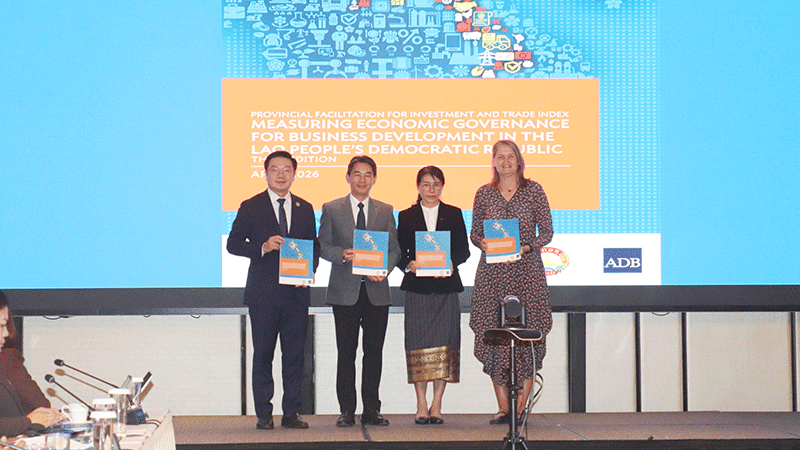
| (From left) Deputy Minister of Finance Soulivath Souvannachoumkham, Deputy Minister of Industry and Commerce Manothong Vongsay, LNCCI Vice President Dr Valy Vetsaphong, and ADB Country Director for the Lao PDR Shanny Campbell display the newly released ProFIT report on Tuesday. |
Report on business development calls for further reforms to support SMEs
A new report issued by the Asian Development Bank (ADB) and the Lao National Chamber of Commerce and Industry (LNCCI) has called for further reforms to improve the business environment and strengthen support for small and medium-sized enterprises (SMEs) in Laos.
The report comes at a time when businesses continue to face significant challenges in business registration, regulatory compliance, and access to finance despite modest improvements in economic governance.
The findings are contained in the third edition of the Provincial Facilitation for Investment and Trade Index (ProFIT): Measuring Economic Governance for Business Development in the Lao PDR, released on Tuesday.
The launch ceremony was attended by Deputy Minister of Industry and Commerce Manothong Vongsay, Deputy Minister of Finance Soulivath Souvannachoumkham, ADB Country Director for the Lao PDR Shanny Campbell, representatives of development partners, members of the business community, and government officials.
Based on a survey of 1,386 enterprises in 17 provinces and the capital Vientiane, the report assesses how businesses experience regulations and public services at the subnational level.
The survey was conducted by The Asia Foundation with support from Australia’s Department of Foreign Affairs and Trade.
The report stated that transparency, policy consistency, and efforts to reduce informal charges have improved since the previous assessment. However, firms continue to encounter significant barriers in starting and operating businesses, while implementation of national reforms remains uneven across provinces.
Speaking at the launch, LNCCI Vice President Dr Valy Vetsaphong said the report provides valuable insights into the challenges facing small businesses and identifies areas where reforms can have the greatest impact.
“The ProFIT report captures the views of businesses across the country and highlights where reforms can deliver the greatest impact,” she said.
“It can support stronger public-private dialogue and more effective action to reduce the cost of doing business, improve confidence, and encourage enterprise development.”
ADB Country Director for the Lao PDR, Ms Shanny Campbell, said the report offers practical guidance to help strengthen the country’s business climate and support sustainable economic growth.
“This report provides practical, evidence-based guidance for improving the business environment in Laos,” she said. “Simpler procedures, more transparent services, and better access to finance can help firms grow, create jobs, and expand opportunities, including for women entrepreneurs.”
According to the report, SMEs remain the backbone of the Lao economy, accounting for about 99 percent of formally registered businesses and 94 percent of formal-sector employment.
Despite their importance, many SMEs continue to face high transaction costs, administrative burdens, and limited access to formal financing, restricting their ability to expand, invest, and create jobs.
Women-led enterprises often face additional obstacles, including challenges in formalisation, access to business information, and obtaining finance, underscoring the need for more inclusive policies.
Access to finance was identified as one of the most pressing constraints facing businesses. The report notes that the share of bank credit allocated to SMEs declined from 30.9 percent in 2015 to just 12 percent in 2022, limiting opportunities for investment and growth.
To address this challenge, the report recommends expanding credit guarantee schemes, simplifying loan appraisal processes, improving financial literacy, promoting digital financial services, and increasing the use of movable assets as collateral.
The report also highlights persistent burdens related to tax compliance, shortages of skilled labour, and low adoption of digital technologies.
Only 10 percent of surveyed firms reported using the Lao National Single Window, suggesting considerable room for improvement in digital service delivery.
The findings also reveal significant differences among provinces in the quality of economic governance and business services, indicating that implementation of national reforms remains inconsistent across the country.
Among its recommendations, the report calls for further simplification and digitisation of business registration and tax administration, stronger provincial institutions through e-governance, and greater investment in skills development and infrastructure.
The ADB and LNCCI said the findings are intended to support policy dialogue and guide reforms aimed at strengthening private sector development, improving competitiveness, and promoting more inclusive and sustainable economic growth in Laos.
By Times Reporters
(Latest Update June 3, 2026)
|

