Air pollution in Laos: A silent killer
Today, June 5, marks World Environment Day. To commemorate this significant occasion, the global community has organised numerous activities aimed at raising public awareness about environmental protection.
This year’s theme, “Humanity cannot turn back time, but we can grow forests, revive water sources, and restore soils. We are the generation that can make peace with the land”, highlights our critical role in protecting the environment. In light of this, I would like to share my insights on environmental issues in Laos, focusing specifically on the pressing issue of air quality, its impacts, causes, and potential solutions.
 |
| Baburam Paudel. |
In my capacity as an energy specialist at SNV, which supports Laos to develop sustainable and inclusive markets for energy technologies and services focusing on renewable energy and energy efficiency solutions, contributing to more equitable livelihoods for all, I observe that air pollution due to irresponsible burning has become a serious concern and could become a silent killer if not addressed properly.
Laos is renowned for its lush landscapes, serene beauty and fresh and healthy air. However, over the past year few years, the country has been facing a serious threat: air pollution with alarming levels of PM2.5, posing significant challenges for the environment and community health. Unfortunately, air pollution can also seriously impact tourism.
According to the World Air Quality Report 2023 Laos was ranked 21st globally on the list of the most polluted countries in 2023 and second among Southeast Asian countries. The annual average PM2.5 concentration (μg/m³) in Vientiane in 2023 was found to be 29.3, which is 5.86 times higher than the WHO’s safe upper limit. PM2.5 refers to fine particles with a diameter of 2.5 micrometres or smaller. These particles are harmful to health when inhaled.
Data indicates that approximately 10,000 Lao citizens die each year from preventable causes related to air pollution, accounting for about 17 percent of total annual deaths in Laos. Alarmingly, 16 percent of these deaths are among children under the age of five. Studies indicate that air pollution significantly reduces life expectancy in Laos.
Sources of air pollution
The major source of air pollution in Laos is the burning of solid waste in open areas, slash and burn farming, extensive use of biomass cooking fuel (charcoal and firewood), vehicles, construction and industries, coal-fired power plants, etc. Indoor air pollution alone contributes to 44 percent of deaths from air pollution in Laos. More than 90 percent of people still rely on biomass as a primary source of cooking fuel.
The majority of them use inefficient traditional cookstoves which release plenty of harmful pollutants such as fine particulate matter (PM2.5) and carbon monoxide into the air. Household air pollution exposure leads to noncommunicable diseases including stroke, ischaemic heart disease, chronic obstructive pulmonary disease (COPD), and lung cancer. It is said that a typical wood-burning cookstove emits 300-400 cigarettes worth of smoke an hour into the environment around the stove.
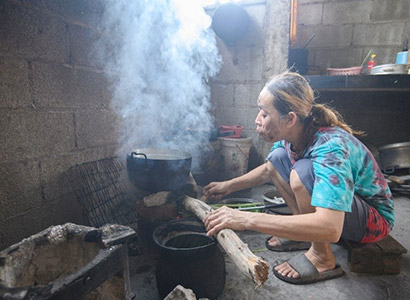 |
| Cooking practices that are not environmentally friendly can significantly increase air pollution in Laos. |
Heavy reliance on biomass fuel and inefficient cookstoves creates a health burden on women and children, who are typically responsible for preparing fuel and cooking foods.
Firewood and charcoal are the most widely used fuel for cooking in Laos and this has contributed to high rates of deforestation and environmental degradation across the country. Slash-and-burn agricultural practices are another detrimental factor for deforestation.
Tackling pollution and reducing its severe health effects is fundamental to achieving Laos’ broader development goals. Pollution causes illnesses that mainly affect low-income people, children, the elderly, and other vulnerable groups.
Lower emissions contribute to a healthier environment and help to mitigate climate change.
These illnesses reduce the productivity of adults and, in the case of children, affect their ability to attend school and learn, which subsequently limits their opportunities for professional and human development. Thus, efforts to reduce pollution are an investment in human capital, leading to higher productivity and economic growth.
Solutions
Laos’ efforts to minimise air pollution and create a better environment have been a significant challenge. However, this does not mean we are hopeless and cannot take action.
One of the best solutions to air pollution is to switch from fossil and biomass fuels to electricity. This transition requires substantial technical efforts, resources, time, and dedication. Laos can begin this journey by shifting cooking fuel from biomass to electricity, which can greatly improve indoor air quality.
Laos is in a good position to take the initiative in the clean cooking transition as it is endowed with renewable energy resources and has been the leader in electricity exports in the Greater Mekong Subregion.
This requires a combination of different measures, such as awareness, technological innovation and policy initiatives. One of the approaches adopted for the cooking transition is the smoke-free village, and this has been recognised as a successful approach in many countries.
This approach focuses on behaviour change communication on the benefits of smoke-free environments by replacing a significant driver of deforestation and climate change. This will lead to improved health, reduced climate and environmental impacts, empowered women, and improved livelihoods.
Laos is hosting the ASEAN Summit in October 2024. This summit provides an ideal opportunity for Laos to rally all ASEAN countries around the cause of environmental protection.
Let’s focus on this critical agenda, encouraging active participation and commitment. By working together towards a common goal, sharing resources, and embracing sustainable practices, ASEAN countries can pave the way for a healthier and more sustainable future for everyone.
Author: Baburam Paudel is Energy Sector Leader, SNV Laos, bpaudel@snv.org
By
Advertorial Desk
(Latest Update June 5, 2024)
|

