 |
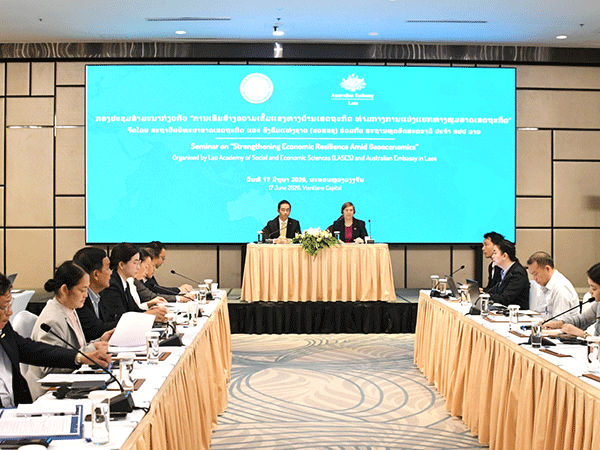
| Vice President of the Lao Academy of Social and Economic Sciences and President of the Laos-Australia Friendship Association, Dr Sthabandith Insisiengmay (left), and Australian Ambassador to Laos Ms Megan Jones co-chair a seminar in Vientiane on June 17. |
Economists warn of slower growth, rising inflation as Middle East conflict bites
Economists have warned that Laos may miss its 5.5 percent growth target this year, with expansion forecast at just 4-4.5 percent and inflation expected to return to double digits as global geopolitical tensions and higher energy prices put increasing pressure on the economy.
The warning was issued at a seminar titled “Strengthening Economic Resilience Amid Geoeconomics”, jointly organised by the Lao Academy of Social and Economic Sciences and the Australian Embassy in Laos on June 17.
Presenting a macroecono-mic assessment, Deputy Director General of the Macroeconomic Research Institute, Dr Vanxay Sayavong, said the country’s economic outlook had become more vulnerable as external shocks continue to affect trade, investment, and consumer spending.
“Laos’ macroeconomy in 2026 has become considerably more vulnerable, with growth expected to reach only 4-4.6 percent, below the government’s target,” he said.
The government had targeted economic growth of 5.5 percent this year, but experts now estimate it will be 4-4.6 percent.
According to research findings, Laos’ Vulnerability of Macroeconomic Index has risen to 0.63 from an average of 0.50, indicating higher risks across several sectors of the economy.
One sign of the growing pressure is the increase in import inflation, which rose from 3.7 percent in February to 10-13 percent in April and May. Economists expect the average inflation rate in 2026 to be 9.7 percent or possibly a double digit figure. While the government’s inflation rate target is capped at 5 percent per year, with an allowed fluctuation of +/- 2 percent
According to the Lao Statistics Bureau, the inflation rate was 9.0 percent in May.
The report identified the energy sector as the main source of risk this year. Ongoing conflict and instability in the Middle East have pushed up global oil prices, increasing costs for countries that rely heavily on imported fuel.
Researcher at the Institute for Industry, Commerce and Energy under the Ministry of Industry and Commerce, Dr Viengsavang Thipphavong, said the closure of the Strait of Hormuz had sent global crude oil prices above US$100 per barrel.
As a result, the cost of diesel at the pump in Laos increased by as much as 182 percent while petrol prices had risen by 91 percent by April, placing heavy pressure on transport operators, manufacturers, and farmers.
Higher fuel costs have also driven up the price of fertiliser and logistics services, raising concerns over food production costs and household expenses.
Tourism has also felt the impact. Data presented at the seminar showed that visitor numbers during the Lao New Year celebrations in Luang Prabang fell by 46 percent compared to the previous year, partly because of higher travel and living costs.
Providing further insight into the causes of the energy crisis, Professor Peter Warr of the Australian National University said disruptions to global oil supplies had played a major role in driving up fuel prices worldwide.
Professor Warr told the seminar that the blockade of the Strait of Hormuz since late February had disrupted about 20 percent of global oil supplies, leading to a combined loss of 7 million barrels of oil production per day from Saudi Arabia, Kuwait and Iraq.
According to Professor Warr, global petroleum demand exhibits high inelasticity. Consequently, a mere 20 percent decrease in supply can cause prices to double, as consumers and industries are unable to rapidly adjust their fuel consumption.
He warned that oil prices were unlikely to fall sharply in the near future because repairing damaged energy infrastructure in the Gulf region and rebuilding depleted fuel inventories would take several months.
“Oil prices are unlikely to return to US$60 per barrel anytime soon,” he said.
Professor Warr said countries that depend heavily on imported fuel, including Laos, were particularly vulnerable to prolonged disruptions in global energy markets and should continue exploring measures to strengthen energy security and reduce exposure to external shocks. Speaking at the opening ceremony, Vice President of the Lao Academy of Social and Economic Sciences and President of the Laos-Australia Friendship Association, Dr Sthabandith Insisiengmay, said the seminar was part of ongoing cooperation between Laos and Australia to strengthen understanding of global economic challenges.
“I sincerely hope this seminar will benefit all participants, particularly in deepening understanding of geoeconomic issues, current response approaches, and lessons learnt from Australia’s experiences,” he said.
Australian Ambassador to Laos Ms Megan Jones said economic security had become increasingly important as global events became more interconnected.
“A secure and resilient economy provides more than a buffer against external shocks. It underpins our social fabric, builds confidence to engage internationally, and enables inclusive and sustainable growth,” she said.
Experts at the seminar urged the government to strengthen energy security by expanding renewable energy investment, diversifying import sources, and making greater use of regional trade agreements.
They also recommended accelerating transport links, improving border trade, and promoting greater use of electric vehicles to reduce dependence on imported fuel.
Despite mounting external challenges, participants said timely policy action and stronger economic resilience could help Laos maintain stability and protect livelihoods during a period of global uncertainty.
By Phonepaseuth Volakhoun
(Latest Update June 18, 2026)
|

