 |
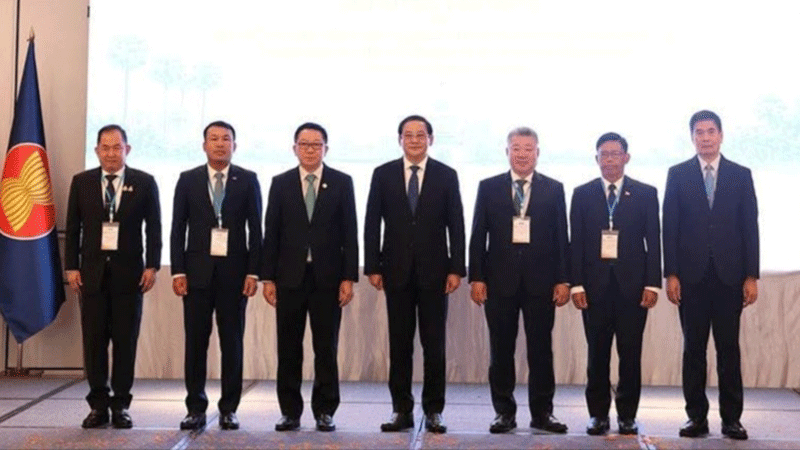
| Prime Minister Sonexay Siphandone (centre) attends the Mekong Ministerial Steering Committee meeting in Vientiane. |
Mekong countries ramp up action against air pollution
Mekong countries have reported significant progress in reducing fire hotspots and transboundary air pollution, while warning that the return of El Niño conditions later this year could heighten wildfire and haze risks across the region.
The issue of air pollution topped the agenda at the 14th meeting of the Sub-Regional Ministerial Steering Committee on Transboundary Haze Pollution in the Mekong Sub-Region, which took place in Vientiane on June 25.
Prime Minister Sonexay Siphandone attended the meeting alongside ministers from Cambodia, Myanmar, Thailand and Vietnam, who strssed the need for stronger regional cooperation and accelerated action to achieve a haze-free ASEAN by 2030.
Prime Minister Sonexay observed that forest fires and transboundary air pollution have become major threats across the subregion.
They have caused losses in biodiversity, negatively affected public health, and inflicted significant economic damage throughout the Greater Mekong Subregion.
In response to these challenges, ASEAN leaders have introduced clear policies and cooperative agreements aimed at reducing air pollution, which is caused by agricultural burning.
However, forest fires and the resulting air pollution spread across the region every year, as they are the result of traditional farming practices among rural and remote communities.
To speed up progress towards resolving the problem, Prime Minister Sonexay called for closer cooperation among the affected countries so that agreed policies are put into action and yield results.
This would help to achieve sustainable solutions and fulfil the vision of “A Haze-Free ASEAN by 2030”, he said.
A review by the ASEAN Specialised Meteorological Centre of the weather and haze situation in the Mekong sub-region showed that during the 2025 dry season the overall fire hotspot count was 34 percent lower than in 2024, reflecting the effectiveness of preventive and mitigation measures undertaken by ASEAN Member States.
Nevertheless, widespread transboundary air pollution persists in large areas of Myanmar, Thailand, Laos and Vietnam.
The meeting noted that the fire hotspot count increased by 8 percent during the December 2025-May 2026 dry season compared with the same period the previous year.
An Alert Level 3 was issued on March 27 following widespread pollution across much of the sub-region, particularly eastern Myanmar and northern areas of Thailand, Laos and Vietnam.
Looking ahead, the meeting expressed concern over the onset of El Niño conditions this month, which are forecast to intensify in August and September.
This could result in drier conditions across parts of the Mekong sub-region later in the year, increasing the risk of forest fires.
Ministers stressed the importance of heightened vigilance, better preparedness, and closer regional cooperation to counter the problem.
By Times Reporters
(Latest Update June 29, 2026)
|

