 |
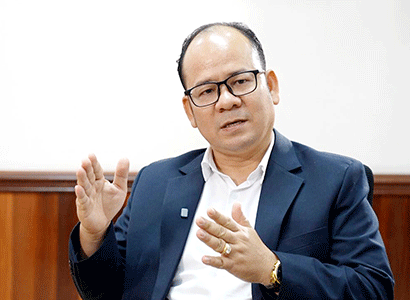
| Dr Khammon Chanthachit. |
First national media congress: a historic opportunity to shape the future of Lao media
As Laos enters a new phase of national development and digital transformation, the media industry faces unprecedented opportunities and challenges.
Against this backdrop, the first National Media Congress, scheduled to take place in July, is expected to be a historic milestone that will define a new strategic direction for the development of the media in the years ahead.
In an exclusive interview with the Vientiane Times, Dr Khammon Chanthachit, an alternate member of the Party Central Committee, a standing member of the Party Committee, and Deputy Head of the Commission for Information and Education of the Central Committee, shared his views on the significance of the congress and his vision for the future of the media.
According to Dr Khammon, the congress is particularly important following the transfer of the country’s five main state media organisations—Lao Press in Foreign Languages (Vientiane Times), Lao National Radio, Lao National Television, Pasaxon newspaper, and the Lao News Agency—to the supervision of the Commission for Information and Education of the Central Committee last year.
“This institutional restructuring is an important step in strengthening the Party’s leadership over the media and ensuring greater unity in communication, information dissemination and ideological education,” he said.
The congress, he explained, is necessary to redefine the role of the media under these new conditions and to bring about a transformation in both mindset and working methods.
More importantly, it seeks to ensure that the media continues to serve as an effective instrument of communication between the Party, the State and the people.
Beyond reviewing past achievements, the congress will assess the challenges facing the media, including the organisational structure, personnel development, infrastructure, technical facilities and financial management. The findings will help shape a new policy framework for the future.
One of the key outcomes expected from the congress is a proposal for the Politburo of the Party Central Committee to issue a new resolution on strengthening the Party’s leadership and the State’s management of the media in the new era, replacing Resolution No. 36/ PPCC, which has guided the sector since June 1993.
For Dr Khammon, the event carries historic significance. It comes after 76 years of growth and development of the media industry and 33 years of implementation of the Politburo’s previous resolution on media affairs.
As such, the congress represents an opportunity not only to review the past but also to chart a new course for the future.
Asked about the most important changes needed for the media to remain relevant in the digital age, Dr Khammon stressed that change is essential.
“The most important thing is for the media to transform its mindset and working methods to keep pace with global changes without losing sight of its principles, ideals and professional ethics,” he said.
In an era characterised by the rapid spread of information and the growing influence of social media, he believes that state media must continue to be a trusted source of information—accurate, timely and capable of explaining complex issues clearly and responsibly to the public.
He identified four priorities that should guide the future development of the media: improving content quality, making appropriate use of digital technologies and artificial intelligence, developing multi-skilled media professionals, and creating sustainable financial mechanisms that enable media organisations to strengthen and sustain themselves.
Dr Khammon emphasised that the media’s mission extends far beyond merely reporting events.
“The media must serve as a driving force for development, reflect the concerns and aspirations of the people, act as a bridge between the government and the public, promote cultural values, preserve national identity, and help to combat misinformation and disinformation that could undermine social stability and national development.”
Looking ahead, he envisions a modern, dynamic and credible media industry capable of competing in an increasingly digital and interconnected world. By the 80th anniversary of the establishment of the Lao media, he hopes that the country’s principal state media organisations will be stronger, more resilient, and financially sustainable.
At the same time, he believes that the future of the media should continue to be guided by four fundamental principles: truthfulness, educational value, guidance, and a spirit of struggle.
In addition, the media should fully embrace its role by serving as a voice that dares to speak out, one that understands the hearts and minds of the people, one that responds swiftly to changing situations, one that can overcome obstacles, one that upholds and defends the truth, and one that delivers precise and impactful messaging.
In concluding the interview, Dr Khammon called on media organisations and media professionals across the country to preserve and further promote their proud traditions and achievements, strictly observe the law, uphold professional ethics and integrity, and work together to lead the media industry into a new era of quality, professionalism, and innovation.
As Laos prepares to convene the first National Media Congress this month, expectations are high that the gathering will not merely review the past, but will serve as a defining moment in shaping a stronger, more modern and more influential media sector—one capable of supporting national development and serving the interests of the nation in an increasingly complex global environment.
By Phon Thikeo
(Latest Update July 1, 2026)
|

