 |
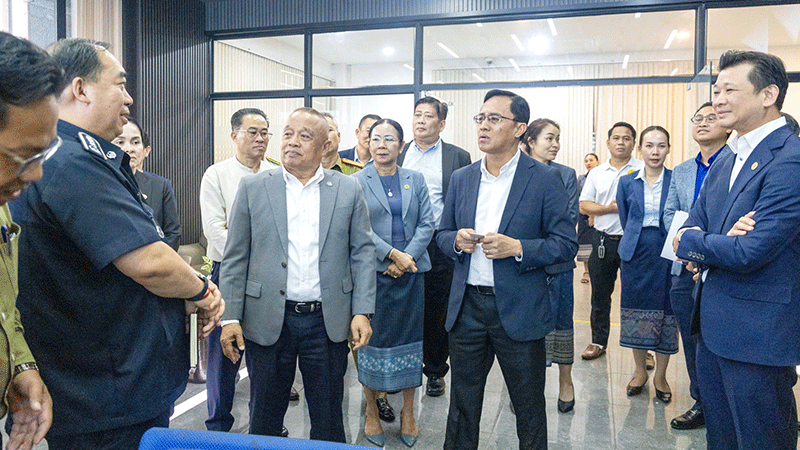
| Mr Leklai Sivilay and his delegation observe operations at the Vientiane Logistics Park. |
Thanaleng Dry Port drives Laos’ land-linked future
The Thanaleng Dry Port is strengthening Laos’ role as a regional logistics hub by connecting trade routes across Asia and beyond, and supporting the country’s land-linked drive.
The role of the Thanaleng Dry Port in transforming regional trade and transport was highlighted during a recent visit by the Minister of Public Works and Transport, Mr Leklai Sivilay, to the landmark logistics facility in Vientiane.
Mr Leklai and his delegation toured the international cargo checkpoint administration building, the data centre, container yard, cargo transshipment warehouse, and the railway transfer point linking the 1.435-metre standard-gauge railway with the one-metre gauge railway.
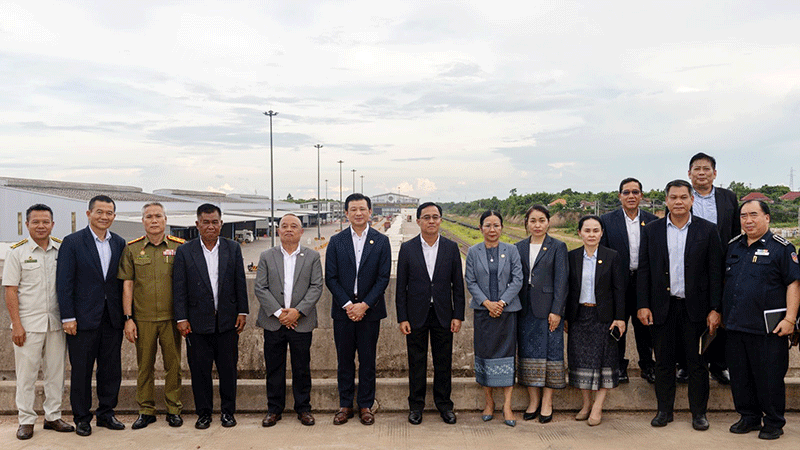 |
| Mr Chanthone Sitthixay and Mr Leklai Sivilay join the delegation and senior executives for a group photo at the Vientiane Logistics Park. |
Discussions focused on the facility’s contribution to national economic growth, cross-border connectivity, and the long-term vision to make Laos a leading regional logistics gateway.
Built as part of the government’s strategy to turn Laos from landlocked to land-linked, the Thanaleng Dry Port has become one of the country’s most significant transport investments since opening for operation in late 2021.
The President of Thanaleng Dry Port Sole Co., Ltd. and Vientiane Logistics Park Co., Ltd., Mr Chanthone Sitthixay, said the project reflects the government’s vision to capitalise on Laos’ strategic location at the heart of mainland Southeast Asia.
“This connectivity strategy is considered one of the most important and best strategic concepts of the Party and government, by making use of the country’s geographic location as a driving force for the economy,” Mr Chanthone said.
 |
| |
The facility has received international recognition for its scale and strategic importance. According to the developers, the United Nations Economic and Social Commission for Asia and the Pacific (UNESCAP) has ranked Thanaleng Dry Port as the second-largest dry port in the Asia-Pacific region.
“We have received considerable international recognition that the Lao government is moving in the right direction in transforming the country into a hub for freight transport and logistics services to drive the economy,” Mr Chanthone said.
More than 1,000 delegations from governments, development organisations and companies have visited the site over the past four years to study its integrated logistics model and explore opportunities for cooperation.
He said the facility serves as a key link between the Laos-China Railway, Thailand’s transport network, and the wider Association of Southeast Asian Nations region, creating new opportunities for trade, investment, and cross-border transport while supporting sustainable socio-economic growth.
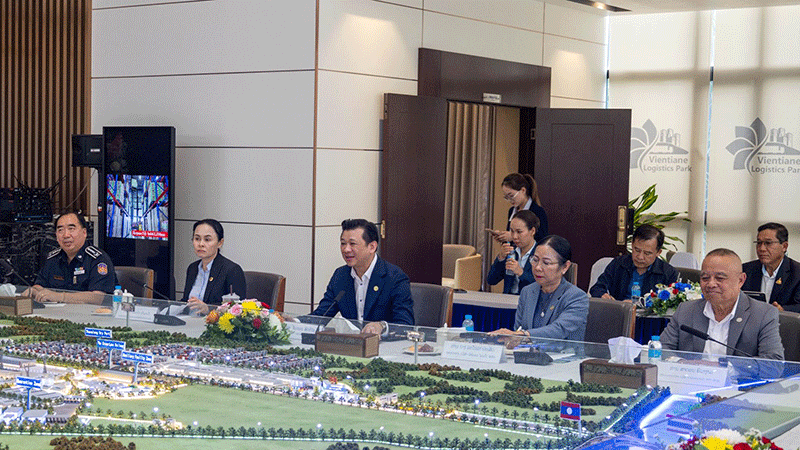
Managing Director of the Thanaleng Dry Port, Mr Sakhone Philangam, briefed the minister on the project’s operations and development. He outlined the range of services available at the integrated logistics centre, including customs clearance, tax payment, container handling, warehousing, and the one-stop service system, which helps simplify cargo movement for transport operators.
He said the project plays the same role for a landlocked country as a seaport does for a coastal nation.
“This dry port functions like the ‘seaport’ of a landlocked country,” he said.
Today, around 2,000 vehicles enter and leave the dry port each day, reflecting the growing movement of goods through Laos as regional trade expands.
A key objective of the project is cargo consolidation, bringing freight together at one location before it continues its journey by road or rail. This allows transport companies to maximise cargo loads, reduce the number of empty return trips, and improve overall efficiency.
According to the developers, an efficient cargo consolidation system could reduce transport costs by about 40 percent while lowering fuel consumption and supporting more sustainable freight services.
But the project has also faced significant challenges as it works to reshape the country’s logistics system.
Mr Sakhone said the original goal of consolidating cargo in one location has not yet been fully achieved.
One challenge is that Laos is predominantly an importing country, creating an imbalance in freight flows. As a result, some trucks still return without cargo, reducing efficiency and increasing transport costs.
Despite these difficulties, the dry port has become an important contributor to state revenue.
Since operations began, customs revenue generated through the facility has increased steadily each year. During the first six months of this year, the amount of customs duty collected reached about half of the whole 2026 target of approximately 11,000 billion kip, underlining the growing importance of the facility to the national economy.
Behind the project stands one of the largest private infrastructure investments in Laos.
Mr Chanthone said more than US$210 million has been invested in the dry port’s infrastructure together with advanced digital systems and logistics technology.
He acknowledged that large-scale infrastructure projects require patience and long-term commitment.
“What we are most proud of is having contributed to building large-scale infrastructure for the nation, and having received recognition and praise from the Party and government,” Mr Chanthone said.
During his visit, Mr Leklai Sivilay praised the achievements of the project and its contribution to modernising Laos’ transport and logistics sector.
“The development of this dry port has been of enormous help to the government in managing imports and exports, promoting transparency, modernising operations, and enabling steadily increasing revenue contributions to the state budget each year,” the minister said.
He also reaffirmed the government’s support for businesses that contribute to national development.
Looking ahead, both the government and the developer share the ambition to establish Laos as a leading logistics centre linking Southeast Asia with China and wider international markets.
As trade volumes continue to grow and regional transport networks become more closely connected, Thanaleng Dry Port is expected to play an increasingly important role in facilitating cross-border commerce, attracting investment, and creating new opportunities for Lao businesses.
More than a logistics facility, the dry port represents a long-term investment in the country’s future—one that is helping reshape the way goods move across the region while bringing Laos closer to its vision of becoming a truly land-linked nation.
By Advertorial Desk
(Latest Update July 3, 2026)
|

