 |
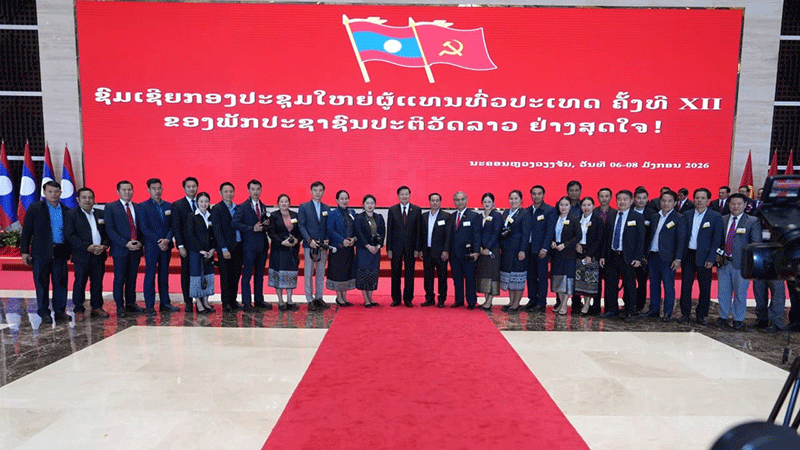
| Reporters gather for a photo with Party Secretary General and Lao President Thongloun Sisoulith at the 12th Party Congress earlier this year. |
Building a stronger future for Lao media in the digital age
In a world where information travels faster than the wind, truth is sometimes overshadowed by an overwhelming flow of facts and figures.
Artificial intelligence (AI), social media and digital platforms have transformed the way people receive and understand news. Alongside new opportunities, they have also brought challenges that media organisations around the world must confront.
To address these challenges, Laos is convening the First National Media Congress from July 13-15 at the National Convention Centre in Vientiane, aiming to strengthen the Party’s leadership role and raise the quality of journalism to new heights.
The conference is not merely an academic gathering or a review of past achievements, but a significant opportunity to define a new direction for the media amid rapid changes in the digital era.
The congress is taking place at a time of special significance. Following the transfer of five state media organisations to the supervision of the Commission for Information and Education of the Central Committee, namely Lao Press in Foreign Languages (Vientiane Times), Lao National Radio, Lao National Television, Pasaxon newspaper, and the Lao News Agency, the media is entering a new era of management and development.
Speaking to reporters ahead of the congress, Politburo member of the Party Central Committee and Head of the Commission for Information and Education of the Central Committee, Mr Khamphanh Pheuyavong, said that under Resolution No. 23 adopted by the Politburo of the Party Central Committee on February 24, 2026, an overall responsible committee was appointed to oversee preparations for the congress.
|
| Journalists stand with Politburo member of the Party Central Committee and Head of the Commission for Information and Education of the Central Committee, Mr Khamphanh Pheuyavong, following an interview about preparations for the First National Media Congress. |
“The Party Secretary General gave an address at the National Culture Hall to mark the 70th Lao Mass Media and Publishing Day in 2020,” Mr Khamphanh said.
“The speech included this stirring statement: ‘A reporter is someone who shines a light, who pierces the heart, who provokes strong feelings in the reader, who dares to overcome obstacles, who loves the truth, and who hits the target with their words.’ We must put these guiding ideas of the Party Secretary General into practice,” Mr Khamphanh said.
The congress will review the implementation of various pieces of legislation, examine the organisational structure of the media and its personnel, and strengthen material and technical infrastructure and financial management so that media operations achieve higher standards.
Additionally, studies will be undertaken on a new Politburo resolution to replace Resolution No. 36, which has been in effect since 1993.
The main aim is to improve quality and comprehensively develop the media, encouraging personnel to focus on reality, education, guidance, and combativeness.
Looking back at the 76-year journey of the media — from the Lao Issara newspaper first published in 1950 to today’s online media landscape — the media has supported Laos’ struggle for independence and national protection and development.
From printing newspapers with limited equipment to producing content on websites, Facebook, YouTube, TikTok and other digital platforms, the media has grown hand-in-hand with other aspects of Laos’ progress.
Over the years, the media has continuously adapted to change. It has transitioned from the publication of printed newspapers to online platforms, in keeping with technological advancements and changing consumer preferences.
This transformation is not simply a change in the channels used to distribute information; it represents a shift in the mindset and working methods of media personnel.
In an age when everyone can take photographs, record videos and share information within seconds, traditional forms of media cannot compete with the speed of social media. However, what professional media outlets possess — and what social platforms cannot replace — is credibility. It is essential that journalists continue to uphold the principles of accuracy, responsibility and professional ethics in order to maintain public trust.
Another major challenge is the rise of artificial intelligence (AI). To some, AI may appear to be a competitor to journalists. Instead, AI should be viewed as a supporting tool that helps to improve the quality and efficiency of journalists’ work.
AI can assist in many areas, including translating news into multiple languages, verifying information, producing content across different platforms, and restoring historical archives to bring valuable information back to life.
At the same time, reporters must do more than translate official documents and write accounts of meetings.
Media outlets must explain government policies in ways that ordinary people can easily understand, reflect public concerns, connect the government with citizens, and strengthen trust within society.
As Laos moves towards graduation from Least Developed Country status and continues to roll out national development plans, the media will play an increasingly important role in promoting the country’s image, attracting investment, supporting tourism development, and publicising Laos’ national identity to the international community.
Amid the competition of the digital world, Laos cannot compete with larger countries in terms of volume of information or financial resources.
However, Laos possesses characteristics that enhance the country’s appeal and single it out among other nations, namely its rich culture, simple way of life, diversity of 50 ethnic groups, world heritage sites, the Mekong River, Buddhism, traditional cuisine, and local products that reflect the country’s national identity.
These valuable assets represent Laos’ “soft power”, which the media should focus on and offer up to the world to raise the country’s profile on the international stage.
The future of the media should not be measured in terms of the number of followers or views, but by credibility, social impact and the ability to build mutual understanding between Laos and the global community.
In a world where fake news and deepfake technology are emerging every day, truth remains the most valuable asset of journalism.
First and foremost, Lao media organisations need to invest in human resources. The new generation of journalists must develop digital skills, data analysis abilities, multimedia production techniques, ethical use of AI, and foreign language capabilities.
At the same time, content should be broadened to include multiple languages, including those used by various ethnic groups, to ensure that all communities can access information equally.
The Congress is therefore not only a reflection on the past or a summary of previous achievements. It represents the laying of a new foundation for the media industry.
If the media can successfully combine truth, innovation, culture and creativity, not only will advances be made in modernisation, but inspired reporting will generate national pride and deliver the voice of Laos to the world.
In an era when everyone can become a content creator, the role of the media industry has become even more important. The mission of journalism is not only to report “what happened”, but also to explain “why it happened” and “how it affects people”. This is the true value of journalism.
Following 76 years of media development, the Congress is an opportunity for the media to move beyond simply being a “policy communicator” to becoming a force that builds trust, strengthens national pride, and connects Laos with the rest of the world.
That may become the most important legacy of this historic congress.
By Khonesavanh Latsaphao
(Latest Update July 15, 2026)
|

