 |
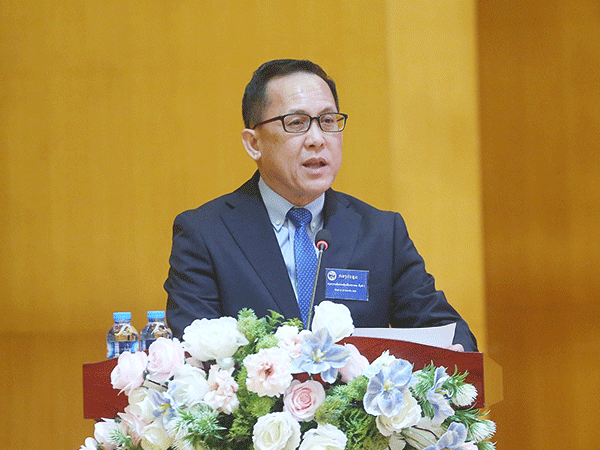
| Minister of Technology and Communications Mr Santisouk Simmalavong addresses the first National Media Congress on Tuesday. |
Technology ministry ramps up AI infrastructure
The government is accelerating the development of artificial intelligence (AI) infrastructure, aiming to modernise the media, improve public services, and drive the country’s digital transformation.
Speaking on the topic “Strengthening AI Infrastructure Development to Support Media Work in the New Era” at the first National Media Congress on Tuesday, Minister of Technology and Communications Mr Santisouk Simmalavong said robust telecommunications networks and AI are essential foundations for journalism in the digital age.
He said AI should serve as a tool to support journalists by making news delivery faster, more accurate, and more efficient, while helping media organisations better connect with people across the country.
“The application of artificial intelligence in the media industry means bringing technology in as an assistant to make the production and presentation of news faster, clearer, and as efficient as possible,” he said.
Mr Santisouk said the technology and communications sector and the media are becoming increasingly interconnected as digital platforms reshape the way information is generated and shared.
Telecommunications infrastructure now supports live broadcasting, news writing and real-time reporting, while also giving media organisations greater opportunities to hear the views of people living in remote areas.
To support this transformation, the Ministry of Technology and Communications is preparing a National Artificial Intelligence Development Strategy, which will soon be submitted to the government for consideration.
The minister also announced the launch of the Lao AI platform, a large language model built using official Lao-language data to strengthen the country’s technological capability and digital independence.
The platform is being improved to support translation, article writing, news analysis, fake news detection, and data trend analysis.
Although Laos still faces numerous challenges, including a shortage of AI specialists and a developing digital ecosystem, the government is steadily expanding the use of AI in line with regional and global trends, Mr Santisouk said.
Beyond the media sector, the government plans to use artificial intelligence to improve public administration and drive national development.
This technology is expected to improve tax collection, budget management, identity verification, logistics, transport and other public services, while helping businesses become more productive and encouraging young people to build their digital skills.
“We are focusing on upgrading public administration, starting with the finance and banking sector, particularly budget revenue and tax collection, identity verification, improving logistics and transport work, and encouraging technological education among young people,” Mr Santisouk said.
He added that the ultimate goal is to leap from being a least-developed country to a “land-linked” country, using Laos’ geographic position and green energy potential to drive sustainable modernisation and increase competitiveness within the ASEAN economy.
According to the ministry, a 2G mobile phone signal is accessible in 98 percent of villages, 3G coverage is available in 85 percent of villages, 4G signal strength exists in 78 percent of villages, and 5G networks cover 18 percent of urban areas.
There are more than 7.8 million mobile phone subscribers and more than 344,000 wired internet accounts. Internet users make up 64 percent and social media users make up 58 percent of the total population.
Mr Santisouk also highlighted the growing risks associated with AI, warning that fake news, deepfakes, online fraud and cyberattacks are becoming more sophisticated.
“Maintaining the accuracy of information and developing AI-based verification systems is essential,” he said.
To address these threats, the ministry is proposing a national information analysis platform, an AI-powered verification centre to detect fake news and deepfakes, and an early warning system to improve information security.
He said cooperation among government agencies, businesses, neighbouring countries, the Association of Southeast Asian Nations and international organisations would be essential to strengthen cybersecurity and combat cross-border cybercrime.
Mr Santisouk said continuous investment in digital infrastructure, AI technology and workforce skills would ensure the media remains trusted, professional, and capable of meeting the demands of the digital era.
The two-day conference, taking place on July 14-15 under the theme “Strengthening the Party’s Leadership Role, Developing Media Work to Transform It to a New Quality Vigorously”, is attended by Party and State leaders, media executives, editors, journalists and communications professionals from across the country.
The opening session was chaired by Party Central Committee Politburo member, Standing Member of the Party Central Committee Secretariat, and Chairman of the Congress Steering Committee, General Vilay Lakhamfong.
Also attending are Politburo member and Head of the Central Committee’s Commission for Information and Education, Mr Khamphanh Pheuyavong, along with other senior Party and State officials.
By Times Reporters
(Latest Update July 15, 2026)
|

