 |
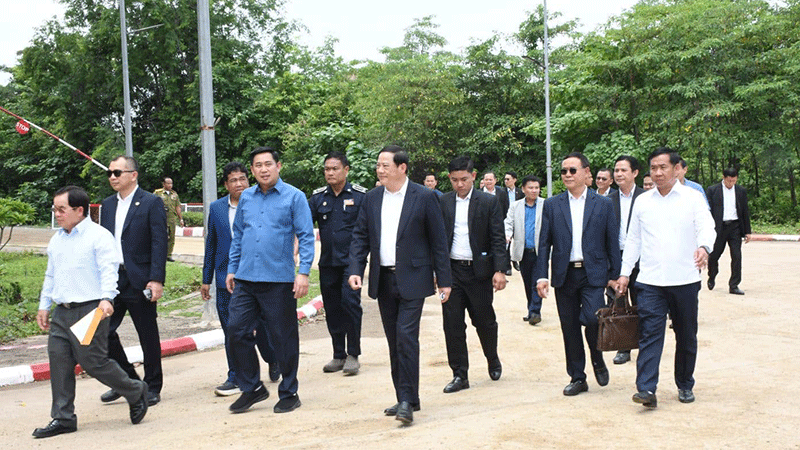
| Secretary of the Champasak Provincial Party Committee, Mr Alounxay Sounnalath (in blue shirt), leads Prime Minister Sonexay Siphandone on a visit to the Nong Nok Khiene International Checkpoint in Khong district, Champasak province. --Photos Prime Minister’s Office |
PM calls for upgrade of Champasak border crossing with Cambodia
Prime Minister Sonexay Siphandone has instructed authorities to modernise the Nong Nok Khiene International Checkpoint in Champasak province, enabling easier passage to and from Cambodia.
The Prime Minister, who oversees developments in Champasak and represents the province in the National Assembly, made the call during a working visit to Khong district on Saturday.
He was accompanied by local authorities on a visit to inspect operations at the Laos-Cambodia border crossing, and also met with local Party and government officials, security forces and residents of Kadane subdistrict.
Nong Nok Khiene International Checkpoint officials said 55,869 people and 2,929 vehicles had passed through the checkpoint in the first six months of this year.
Fees and taxes charged generated 16.21 billion kip in state revenue, equivalent to 86.2 percent of the target for the whole of 2026. In addition, 8,362 visas were issued, generating another US$180,920.
The Prime Minister also instructed authorities to improve cleanliness, and install scanners, CCTV cameras and automated systems to strengthen security and streamline immigration procedures.
He also called for more robust inspections, closer monitoring for suspected online scam groups, improved forest protection along the border, and faster revenue collection to meet or exceed annual targets.
Recognising the checkpoint’s strategic role in regional connectivity, Prime Minister Sonexay encouraged stronger cooperation with neighbouring Cambodian districts through expanded trade, cultural exchanges, sports activities and festivals.
While meeting local officials and residents in Kadane subdistrict, the Prime Minister praised the district’s progress in maintaining peace and stability while advancing agricultural production, infrastructure, education, healthcare, electricity supply, tourism and revenue collection.
He urged authorities to strengthen political awareness and national unity while remaining vigilant against activities that could threaten public order.
He also called for tougher action against drug trafficking, online scam operations, illegal logging, deforestation and unauthorised mining, while emphasising the importance of effective border security.
Prime Minister Sonexay encouraged the continued expansion of commercial agriculture and livestock production in line with the government’s policy of building an independent and self-reliant economy.
He also stressed the need to accelerate poverty reduction, strengthen village development funds, improve land management, promote tourism linked to the One District, One Product (ODOP) initiative, reduce school dropout rates, improve healthcare services, strengthen flood preparedness and enhance public services through the One-Stop Service system.
According to a news release by the Khong district Radio and Television Station, the Prime Minister also heard a report from district authorities on developments in the first half of 2026.
A total of 29 investment projects worth more than 25.613 billion kip were approved, including three solar power farms with a combined generating capacity of 420MW.
District budget revenue reached 8.7 billion kip, or 49 percent of the total target for 2026. Authorities also reported continued progress under the Party’s Three Builds policy, with five subdistricts officially recognised under the scheme, Khong declared a comprehensively strong model district, and three villages upgraded to small rural towns.
Village development funds now hold 12.498 billion kip, while the number of poor households has fallen to 152.
Agricultural production remains strong, with 12,393.2 tonnes of dry-season rice harvested and about 70 percent of wet-season rice transplanting completed across 10,514 hectares. The district’s 94 roads, spanning 636.64 kilometres, now enable year-round access to all villages.
The primary school enrolment rate has reached 98.73 percent, while 72,937 people, including 43,691 foreign tourists, visited the district in the first six months of this year.
In terms of advances in digital government services, 11,403 household census records were processed electronically and more than 1,100 digital identity cards were issued.
Looking ahead to the second half of the year, district authorities said they would implement the resolutions adopted by the 12th Party Congress, intensifying efforts to combat drugs and online scams, strengthening mineral resource management and eliminating poverty among the remaining 152 poor households.
Prime Minister Sonexay said the district’s achievements demonstrated encouraging progress but stressed that continued cooperation between government agencies, local authorities and residents would be essential to sustaining economic growth, safeguarding national security and improving living standards in one of Laos’ key border districts.
By Times Reporters
(Latest Update July 28, 2026)
|

