 |
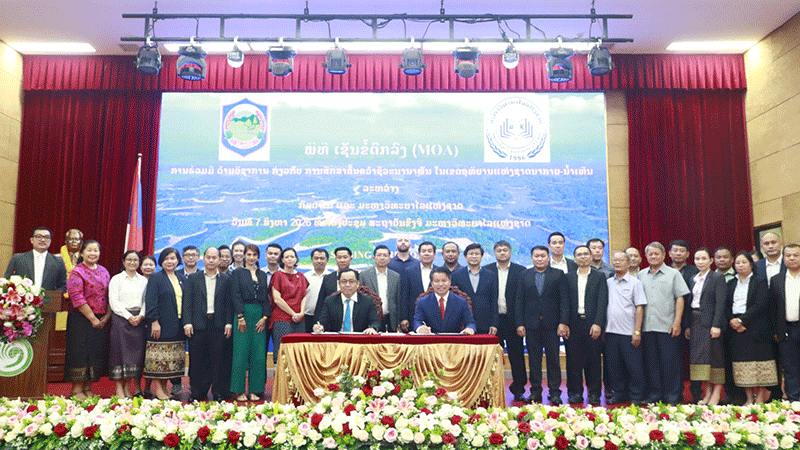
| Vice-President of the National University of Laos, Prof. Dr Phouphet Kyophilavong (right), and Director General of the Department of Forestry, Assoc. Prof Dr Somvang Phimmavong, prepare to sign a Memorandum of Agreement, witnessed by stakeholder representatives. |
Nakai–Nam Theun National Park and National University of Laos sign five-year agreement to strengthen scientific research and conservation
Five-year agreement establishes a national framework for research coordination, capacity building, biodiversity and socio-economic monitoring, and scientific data management in one of Southeast Asia’s most important protected areas
The Nakai–Nam Theun National Park (NNT NP), under the Department of Forestry, Ministry of Agriculture and Environment, and the National University of Laos (NUOL) signed a Memorandum of Agreement (MoA) on August 7 2026, establishing a five-year framework for cooperation on social and biological research, biodiversity and socio-economic monitoring, capacity building, and systematic and transparent data management in Nakai–Nam Theun National Park.
The Memorandum was signed at the National University of Laos in Vientiane by Vice-President of the National University of Laos, Prof. Dr Phouphet Kyophilavong and Director General of the Department of Forestry, Assoc. Prof. Dr Somvang Phimmavong, on behalf of Nakai–Nam Theun National Park.
Covering 427,770 hectares across Khammuan and Bolikhamxay Provinces in central Laos, Nakai–Nam Theun National Park is one of the largest contiguous primary-forest landscapes within the Indo-Burma Biodiversity Hotspot, with approximately 88 percent of the landscape still forested.
It harbours globally significant species, including the Annamite Striped Rabbit, Owston’s Civet, Red-shanked Douc and White-cheeked Gibbons.
Within the National Park, 8,979 people, including 4,437 women, live in 15 villages representing Mon-Khmer (Katuic and Vietic), Tai-Kadai and Hmong-Mien ethnic groups.
Originally established in 1993 under Prime Minister Decree No. 164 and elevated to National Park status in 2019 under Decree No. 36/PM, the park is governed under Prime Minister Decree No. 76/PM (2026), which establishes the Nakai–Nam Theun National Park Management Committee, chaired by the Minister of Agriculture and Environment, with the Department of Forestry serving as the Committee’s secretariat and the Nakai–Nam Theun National Park Management Office as its technical unit.
Under the Memorandum, NUOL is designated as a key national scientific focal point supporting the coordination of social and biological research conducted in NNT NP, in close cooperation with the Department of Forestry and the NNT NP Management Office and in accordance with applicable laws, regulations and approval procedures.
NUOL will serve as a principal scientific coordination point for Lao and international researchers, universities, research institutes and non-governmental organisations seeking to undertake research in the park.
It will also establish a Research Review Committee composed of NUOL faculty, technical experts and a representative of NNT NP to assess scientific quality and feasibility and to help ensure that proposed research contributes to the park’s long-term conservation priorities.
The agreement therefore establishes a more systematic mechanism for scientific review, coordination and information sharing, while research activities remain subject to relevant Government authorisation procedures and the management requirements of NNT NP.
The Memorandum comes at a time of expanding scientific activity in the park. Research and monitoring in NNT NP are currently organised around four principal programmes: long-term and systematic wildlife monitoring, building on three completed cycles of systematic camera-trap surveys undertaken between 2018 and 2023; restoration of the Critically Endangered Asian Swamp Cypress (Glyptostrobus pensilis, locally known as Mai Hing Sam), of which NNT NP holds the world’s only known old-growth population, estimated at approximately 400 remaining trees; conservation of the Endangered Wolf Barb (Luciocyprinus striolatus, locally known as Paa Kang), for which Lao PDR is the species’ last refuge; and the Asian Elephant Programme, which is producing the first updated population estimate and distribution map for the Nakai Plateau since 2008.
These programmes build on more than a decade of biodiversity research in the park, spanning primate and gibbon monitoring, botanical and otter surveys, ground and arboreal camera trapping, environmental DNA surveys, and research on the endemic Large-antlered Muntjac.
This body of earlier work was led by Association Anoulak, in collaboration with national and international technical partners and Nakai–Nam Theun National Park.
“This Memorandum marks an important step in strengthening nationally led, science-based conservation in the Lao PDR. By bringing the scientific and academic expertise of the National University of Laos into closer partnership with Nakai–Nam Theun National Park, we can strengthen the quality and coordination of research, develop the next generation of Lao scientists, and ensure that scientific knowledge contributes directly to the long-term management and conservation of this exceptional landscape,” said Prof. Dr Phouphet.
The agreement also seeks to expand collaboration with the national and international scientific community and facilitate high-quality research that responds to the conservation and sustainable-development priorities of the park.
It will promote capacity building for Lao students and researchers, helping to increase the participation and leadership of Lao scientists in research conducted within the country’s protected areas.
A Nakai–Nam Theun Biodiversity Research Database will be jointly established, with NUOL supporting its scientific administration and coordination with NNT NP. The database will serve as an important repository for research information and data, subject to agreed data-management protocols, and will strengthen institutional knowledge, scientific transparency, appropriate data sharing and equitable benefit-sharing principles among participating partners.
The Memorandum also forms one element of a broader partnership model that NNT NP is developing to support its long-term sustainable financing. The park’s core long-term financing is secured through the Nam Theun 2 Concession Agreement until 2035, supplemented by government resources and support from international development partners.
Building on this foundation, the park aims to strengthen cooperation with international and national non-governmental organisations, civil society organisations, academic and research institutions, and other partners with relevant technical expertise and financing capacity to support current and future research and conservation programmes aligned with the park’s vision and strategy.
Looking ahead, the park also intends to explore appropriate public–private partnerships for sustainable ecotourism and biodiversity tourism, with the objective of diversifying conservation financing, generating benefits for local communities, and promoting responsible national and international visitation to one of Laos’s most remarkable landscapes.
The Memorandum will also contribute scientific knowledge and national research capacity relevant to NNT NP’s UNESCO World Heritage nomination process and the broader portfolio of international recognition being pursued for Nakai–Nam Theun National Park.
It complements the park’s nomination to the ASEAN Heritage Park process initiated in May 2026 and its candidacy under the IUCN Green List of Protected and Conserved Areas.
Strengthened national scientific capacity and credible long-term biodiversity monitoring will provide an important foundation for these processes while building lasting in-country expertise.
“The nomination of Nakai–Nam Theun as a Natural World Heritage Site is a national undertaking and forms part of our broader ambition to strengthen the conservation and international recognition of the Lao PDR’s outstanding natural heritage. This Memorandum provides an important scientific foundation for that ambition by bringing together the Department of Forestry, the National Park and our leading national university. More importantly, it strengthens Lao national capacity to generate and use scientific evidence for the long-term management of our protected areas,” Assoc. Prof. Dr Somvang said.
The signing ceremony was attended by representatives of the Ministry of Agriculture and Environment, Ministry of Education and Sports, Ministry of Culture and Tourism, National University of Laos, Nakai–Nam Theun National Park Management Office, Nam Theun 2 Power Company and Nam Kat Yolapa, together with university professors and researchers and conservation partners, including WWF, the Wildlife Conservation Society, the International Union for Conservation of Nature (IUCN), RECOFTC – The Center for People and Forests, Association Anoulak, FISHBIO and the Namjai Community Association.
“By 2035, we want Nakai–Nam Theun National Park to be internationally recognised, sustainably financed and effectively managed, while delivering lasting benefits to the communities living in and around the park. Achieving these objectives requires strong scientific evidence. This Memorandum provides a nationally led mechanism to strengthen that evidence base and creates an important platform for Lao and international scientists and conservation partners to work alongside us,” said Director of Nakai–Nam Theun National Park, Dr Teuanchay Phongkhamphanh.
By Advertorial Desk
(Latest Update August 10, 2026)
|

