 |
 |
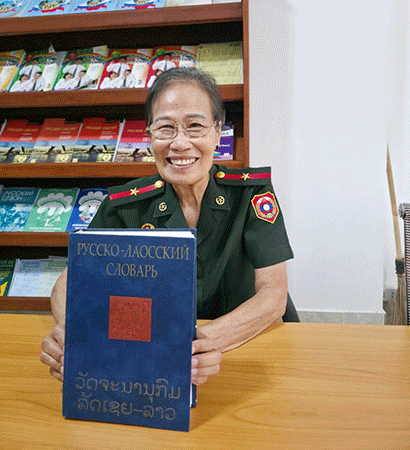
| The entrance to the restaurant.Mrs Sengchan Bandasak, proudly wearing her military uniform, displays her life’s work—the Russian-Lao Dictionary—alongside her recently awarded Pushkin Medal and the decree signed by the President of the Russian Federation. |
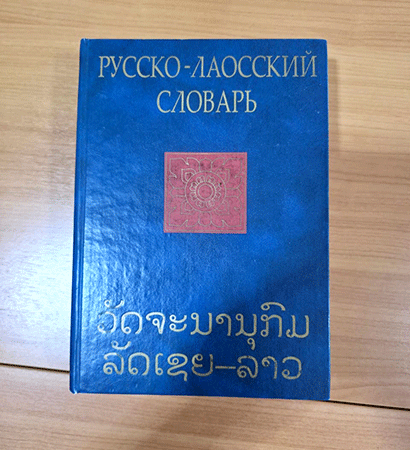
The Russian-Lao Dictionary, the culmination of a decade of work by Mrs Sengchan Bandasak and her husband. |
A bridge built on words: a lifetime of dedication to the Russian language in Laos
For more than five decades, one devoted educator has poured her intellect, resilience, and heart into preserving and translating the Russian language in Laos. This lifelong commitment has not only shaped generations of students but has now earned her one of the Russian Federation’s highest honours for contributions to culture and education.
Amid the celebrations marking Russia’s National Day on June 11, 2026, Mrs Sengchan Bandasak was awarded the prestigious Pushkin Medal. Decreed by Russian Federation President Vladimir Putin and presented by the Russian Ambassador to Laos, Mr Sergey V. Seskii, the medal formally recognises her outstanding contributions to the humanities, literary arts, and international education.
The gleaming medal on her chest that day was not merely metal cast into a symbol of achievement — it represented the sweat, tears, perseverance, and more than half a century of life dedicated by a Lao woman to weaving the threads of language into an unbreakable bridge between two nations.
With a voice filled with deep pride, Mrs Sengchan spoke openly to the Vientiane Times about the moment she received the news. “When I learned that I would receive the Pushkin Medal of Honour through a decree by President V. Putin of the Russian Federation, I was overwhelmed with emotion.”
“This distinguished honour means everything to me; it will inspire me with the strength to continue carrying out my duties,” she said.
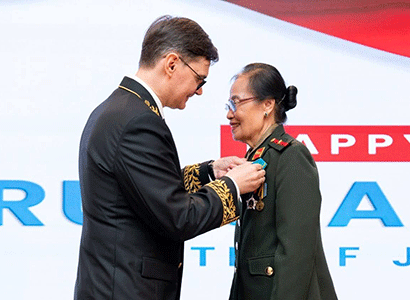 |
| The Russian Ambassador to Laos, Mr Sergey V. Seskii, presents the prestigious Pushkin Medal to Mrs Sengchan Bandasak during the Russian National Day celebrations. –Photo Russian Embassy in Laos |
Journey to the “Land of the White Bear”
To truly comprehend the magnitude of Mrs Sengchan’s legacy, one must rewind to 1973. Then a young French language teacher, she accepted a scholarship to study in the Soviet Union without knowing a single letter of the Cyrillic alphabet.
Initially, she assumed that learning Russian would mirror the ease of mastering French. However, upon arriving on Soviet soil, the harsh reality of Russia’s complex grammar became a steep wall testing her resolve. Yet, fuelled by perseverance and intensive small-classroom teaching, she conquered the basics within three months.
Returning to Laos in 1977, Mrs Sengchan made history. She became the first Lao Russian-language teacher at the High School Oudom Fangoum and later at Vientiane High School. At a time when Russian instruction relied heavily on Soviet expatriates, she was the first local educator to teach the language of the “land of the white bear” to Lao students.
Her motivation was anchored in a phrase she learned as a student: “Wherever the influence of socialism reaches, the Russian language will reach too.” This ethos solidified her determination to devote her life to teaching.
The Crucible of the Dictionary (1989–1999)
Under a scientific cooperation agreement between the URSS Academy of Sciences and the National Institute of Social Sciences under the Council of Ministers of the Lao People’s Democratic Republic, the Lao specialists Sa-ad Bandasak and Sengchan Bandasak – a married couple – were sent to Moscow in 1989 and appointed to staff positions, as research assistants at the Institute of Linguistics of the URSS Academy of Sciences.
Neither could have predicted the historic turbulence that awaited them. Their 10 years of compilation coincided precisely with the collapse of the Soviet Union.
For a decade, they made their home in Moscow, remaining there even as the entire Soviet Union buckled under severe economic hardship. The crisis inevitably touched their lives, yet they refused to leave.
Bound by a deep sense of duty to their field, they chose to stay and work in Russia, taking immense pride in their roles as research fellows at the Institute of Linguistics of the Russian Academy of Sciences.
For Mrs Sengchan, there had always been a fervent hope of advancing her academic research on the Russian language and finally defending that long-awaited dissertation. In the end, however, those personal academic ambitions had to be set aside; the dictionary demanded every waking hour.
Compiling a dictionary at a time when computers had not reached all corners of the world was an intellectual battle. Every single word of the 24,000 entries had to be rigorously analysed for context, grammatical correctness, and hidden nuance, but against all odds the dictionary was completed in 1999. The dictionary contains modern, commonly used vocabulary covering the main fields of science and technology, medicine, economics, politics, culture and sports. The scientific and practical value of the dictionary lies in the more detailed and qualitatively new development of dictionary entries, the inclusion of unique ethnographic and etymological information, and the use of important grammatical, semantic and stylistic characteristics.
Mrs Sengchan said the work of the Russian-Lao research team at the Institute of Linguistics in Moscow serves as an excellent fruitful bilateral scientific cooperation that benefits both friendly nations – Laos and Russia.
Changing Tides and Ultimate Vindication
The timing of their return to Laos in 1999 was a bitter pill to swallow. Amid shifting global paradigms, interest in the Russian language had practically vanished and the dictionary was sidelined. Adapting to the times, Mrs Sengchan took a position as head of the ASEAN unit at the Institute for Cultural Research until her retirement.
But True Value Eventually Comes to Light
In 2004, when the Russian Prime Minister came to Vientiane for a summit, he brought with him the Russian-Lao dictionary. Recognising it as the sole completed achievement of the two countries’ scientific and technical cooperation, he formally presented it to the Lao government. This momentous event breathed life back into the language, confirming that the Bandasaks’ decade of sacrifice had not been in vain.
“Mother Teacher” and the Resurgent Light of Russian
Retirement did not quench Mrs Sengchan’s spirit as a “mould-shaper of minds”. Recognising her value, the Lao military leadership invited her to teach at the Kaysone Phomvihane National Defence Academy. They also officially inducted her into their ranks, allowing her to wear a military uniform.
To the cadets, she is simply “Mother Teacher”—a mentor who teaches grammar while serving as a psychologist, a source of unwavering encouragement, and a fair disciplinarian.
“For me, teaching is about giving without expecting anything in return. A teacher nurtures and imparts knowledge, upholds discipline, and embodies fairness. A teacher must be patient and constantly seek new knowledge.”
Today, Russian language education is flourishing once more in Laos. Driven by military cooperation such as the joint “Laros” military exercises that involve advanced tactics and FPV drones, the demand for fluent personnel is high. Furthermore, Russian is now taught in six secondary schools in Vientiane, with plans for a dedicated Lao-Russian primary school on the horizon.
At the centre of it all remains the dictionary. As the sole surviving compiler, Mrs Sengchan is currently working with Russian experts to revise and modernise the text.
An Enduring Intellectual Legacy
The Pushkin Medal highlights the importance of her life’s work; she is only the second Lao citizen to ever receive it. Yet, the true testament to Mrs Saengchan Bandasak’s life is not the medal itself, but the fact that her dictionary remains the vital key unlocking communication, diplomacy, and cooperation between Laos and Russia.
Her story of patriotism, resilience, and unending devotion ensures that the friendship between these two nations will continue to bear fruit, deeply rooted in the unbreakable bridge of language she worked so hard to build.
By Phonepaseuth Volakhoun
(Latest Update August 12, 2026)
|

