 |
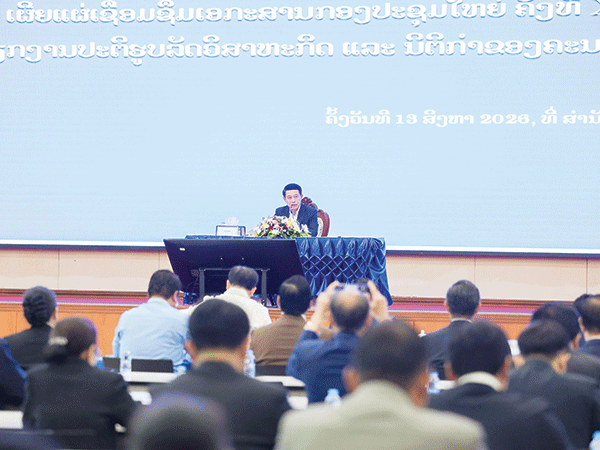
Mr Saleumxay Kommasith addresses the meeting in Vientiane on dissemination of the resolution of the 12th National Congress of the Lao People’s Revolutionary Party related to state enterprise reform.
|
Laos seeks capable executives to lead state firms
Laos is moving to put capable executives in charge of state-owned enterprises as part of reforms aimed at improving management, reducing debt and raising returns on state assets.
A Politburo member, Standing Deputy Prime Minister and Chairman of the State Enterprise Reform Committee, Mr Saleumxay Kommasith, said the government will focus on three priorities – restructuring organisations and personnel, improving professional management, and reducing debt.
He said these three areas were identified as the main priorities after a review found that 98 to 99 percent of the country’s state enterprises were operating at a loss.
“If we are doing business and investing, and it is a loss, why do we continue as we are?” he said at a meeting in Vientiane on Thursday on dissemination of the resolution of the 12th National Congress of the Lao People’s Revolutionary Party related to state enterprise reform.
He said state enterprise assets were valued at about 137 percent of national gross domestic product, or roughly US$27 billion based on the GDP of about US$20 billion. Yet the return on this investment is less than 1 percent, highlighting the need for major changes.
Mr Saleumxay said the first priority is organisational restructuring and personnel.
The committee wants state enterprises to have clearer responsibilities and more professional boards and management teams. A key change is the separation of the positions of chairman of the board and director general.
Mr Saleumxay said large state enterprises should select their directors general through open and competitive processes. He cited Electricité du Laos as an example, where three candidates were shortlisted, interviewed and assessed through a transparent scoring system.
He said the approach should serve as a model for large enterprises, while smaller companies will be assessed according to their size, assets and operations.
The committee will also review state representatives serving on boards of enterprises and remove arrangements that do not meet the new requirements.
Mr Saleumxay said some enterprises had developed informal management structures in which relatives and acquaintances occupied key positions.
“Some state enterprises operate like a family business,” he said, stressing the need for professional corporate governance.
The second priority is professional management. Mr Saleumxay said state enterprises must move away from political patronage and adopt business principles, measurable results and greater transparency.
Enterprises will be expected to strengthen financial management, improve accounting systems, undergo proper audits, and establish clear key performance indicators. They will be encouraged to use technology in financial and production management to reduce losses and prevent the leakage of state resources.
State enterprises will also be encouraged to meet the standards required for listing on the Lao Securities Exchange.
Enterprises that cannot become financially viable will face decisions on their future, including restructuring, conversion into joint ventures, or, where necessary, dissolution.
The third priority is debt reduction. Mr Saleumxay said almost all state enterprises carried debt, putting pressure on public finances and limiting the government’s ability to direct revenue towards development.
He said the problem will require sustained efforts over the next four to five years.
“Whatever national revenue comes in, if we all go towards this, it’s leaving nothing for development,” Mr Saleumxay said, referring to the financial burden created by losses and debt of state enterprises.
The reform committee will seek ways for enterprises to increase revenue, improve their capital structures, and gradually reduce debt to sustainable levels.
The reform is being carried out under the direct guidance of the Political Bureau, reflecting the importance placed on improving the performance of state assets.
The Deputy Head of the Party Central Committee Office and Standing Member of the State Enterprise Reform Committee, Dr Kikeo Chanthaboury, said the reform and management responsibilities of state enterprises were transferred from the Ministry of Finance to the committee in September 2025.
Since then, the committee has strengthened governance, revised legal instruments and collected data to prepare for deeper reforms.
The committee has reported some early improvements. Among 123 enterprises, total net profit reached 3,653.2 billion kip in 2024, an increase of 108 percent from 2023, while debt has gradually declined.
New rules require all state enterprises to keep proper accounts and undergo financial and accounting audits from 2026. Some enterprises that previously lacked proper accounting systems have begun establishing them and seeking audits.
The committee is reviewing the size and composition of enterprise boards after finding cases of excessive board membership, people serving on multiple boards, and retired or transferred officials remaining in board positions.
It has prepared an initial framework for a 10-year State Enterprise Reform and Development Strategy for 2026-2035 and a five-year plan for 2026-2030. The plans aim to bring state enterprises into full regulatory compliance, strengthen oversight and gradually reduce the government’s debt burden.
Mr Saleumxay stressed that reform is not simply about reducing the number of state enterprises, but about ensuring that state assets generate greater economic value and contribute more effectively to national development.
By Phonepaseuth Volakhoun
(Latest Update August 14, 2026)
|

