 |
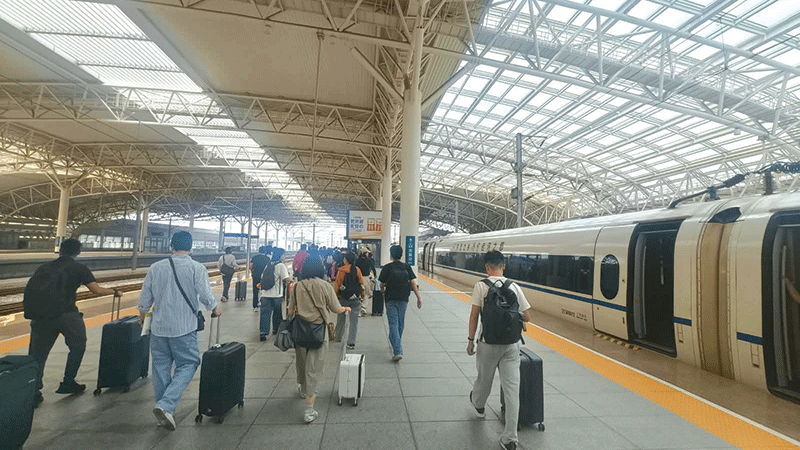
| Beijing-Jiangsu high-speech rail forms part of BRI and the route reaches Laos and beyond. |
China’s 15th Five-Year Plan could advance Laos’ land-link ambitions as Beijing strengthens ties with BRI countries
China’s 15th Five-Year Plan could give fresh momentum to Laos’ ambition to transform itself from a landlocked country into a land-linked regional hub, bolster regional connectivity, and open wider opportunities to drive growth across key sectors.
Covering 2026–2030, the plan places a strong emphasis on high-level opening up and high-quality, innovation-driven sustainable development, while calling for deeper cooperation with countries participating in the Belt and Road Initiative (BRI).
Proposed by China in 2013, the BRI focuses on infrastructure development and cooperation, building railways, roads, bridges, ports, hydropower plants, and solar and wind farms across partner nations. Future momentum is set to be built on these achievements.
Regional rail network gathers pace
Towards Southeast Asia, the development of a regional high-speed rail network is gaining pace. Hosting his Lao counterpart, Thongloun Sisoulith, in Beijing in June, Chinese President Xi Jinping called for a joint effort to accelerate construction of the China-Laos-Thailand railway. This project forms part of the envisioned 3,900-km rail network connecting the southwestern Chinese city of Kunming to Singapore via Laos, Thailand and Malaysia. President Xi’s push is seen as a clear reference to the Thailand-China high-speed railway and related infrastructure designed to connect with the Laos-China railway, which began operations in 2021, linking Kunming to the Lao capital Vientiane.
Although delays occurred initially, construction of the Thailand-China high-speed railway is progressing. The project’s first phase, linking Bangkok to Nakhon Ratchasima, is 55.27 percent complete and scheduled for completion by 2030. Following Thai Prime Minister Anutin Charnvirakul’s five-day visit to Beijing in mid-July, the Thai government announced plans to open bidding in December for the second phase, extending from Nakhon Ratchasima to Nong Khai to link with the Laos-China railway across the Mekong River. Additionally, Laos and Thailand are advancing plans to build a second bridge across the Mekong between Vientiane and Nong Khai to accommodate the high-speed railway.
Professor Zha Daojiong of International Political Economy at Peking University noted that the high-speed rail project in Thailand has gained faster momentum than previously seen.
While China’s current plan offers cooperation opportunities, the professor suggested that partner countries should proactively initiate projects and approach China if wanting to advance cooperation projects.
“You can propose cooperation projects to fit into the five-year plan,” Professor Zha said at a seminar titled “China’s 15th Five-Year Plan and Opportunities for the Rest of the World”.
The seminar was held at the university as part of a recent two-week Immersive Workshop for Asian Media Professionals in Beijing and Jiangsu Province, which brought together reporters and editors from 19 countries.
Laos’ land links take shape
While awaiting completion of the Thailand-China high-speed rail link, the Laos-China railway—a flagship BRI project—has already transformed Laos’ economic geography. A transshipment yard built at the Thanaleng Dry Port near the Mekong River in Vientiane enables containers carried on trains using the Laos-China railway standard-gauge (1.435-metre) track to be transferred seamlessly onto the one-metre-gauge track used by the Laos-Thailand railway. In 2024, the ASEAN Express was launched, establishing an international rail freight system connecting Malaysia, Thailand, Laos and China. This route has evolved into an essential gateway between China and Southeast Asia and a vital regional growth engine.
During the first half of 2026, the value of goods imported and exported via the railway soared to US$2.5 billion, representing a 33.8 percent year-on-year increase. Freight transported by train from Southeast Asia through China, Kazakhstan, Russia, Belarus and Poland can reach Duisburg in Germany in just 14 to 21 days, compared to 45 days by sea.
Passenger demand has also grown steadily, with monthly trips across the line rising from about 600,000 initially to a peak of 2.25 million by May 2026, boosting tourism throughout the region.
To further broaden regional links, Laos signed a Memorandum of Understanding in June enabling it to join Corridor 2 of the Organisation for Co-operation between Railways (OSJD). This rail corridor links Laos with Vietnam, China, Kazakhstan, Russia and Estonia, reinforcing Laos' position as a critical connector between mainland Southeast Asia and Eurasia.
Lao President Thongloun Sisoulith on September 1 told the Shanghai Cooperation Organisation (SCO) Plus Summit held in Bishkek, Kyrgyzstan, that Laos—an SCO dialogue partner—fully supports stronger links between Southeast Asia and the Eurasian region at all levels.
Driving industrialisation
Improved connectivity has unleashed Lao economic potential previously constrained by high transport costs and logistical hurdles, paving the way for accelerated industrialisation. At least seven special and specific economic zones (SEZs) have been established along the Laos-China railway corridor—including initiatives launched while the railway was still in planning—to attract investment, promote manufacturing, and create local jobs.
Professor Zha echoed this sentiment, emphasising that countries must look beyond physical infrastructure to maximising benefits by driving industrial activities that add value to local products.
“You don't just want a railway to be a railway to move goods. The railway must move goods that have added value in your society,” he told workshop participants.
Human resource development drive
Human resource development remains a cornerstone of China's engagement strategy, including in emerging fields like technological innovation and artificial intelligence (AI).
At the 2026 World AI Conference and High-Level Meeting on Global AI Governance held in Shanghai in mid-July, President Xi Jinping announced that China will provide developing countries with 5,000 opportunities in AI training and seminar programmes over the next five years. Beijing will also help set up international AI application cooperation centres with ASEAN, the League of Arab States, the African Union, the Community of Latin American and Caribbean States, the Shanghai Cooperation Organisation, and BRICS.
“We should ensure that AI is an important driver of shared prosperity and common security,” President Xi said.
As a global leader in AI development and application, China showcased how AI is integrated into real-world applications—from government administration and healthcare to robotics, manufacturing, logistics, and smart cities—during the Immersive Workshop across Beijing and Jiangsu.
AI is being used to streamline administrative procedures, assist doctors in precision surgery and support elderly care, while intelligent robots are increasingly performing household, educational, and service tasks. In industry, AI-powered robots and automated systems are being deployed in high-precision manufacturing, logistics and transportation, while smart-city infrastructure uses AI to improve urban management and support autonomous vehicles.
For Laos, engaging with this digital wave took another formal step when the government signed on as a founding member of the World Artificial Intelligence Cooperation Organisation (WAICO) during the 2026 World AI Conference, hoping to deepen cooperation with the bloc. China proposed the establishment of WAICO following its launch last year of the Digital Silk Road as part of the broader BRI to build a global digital network.
Laos is set to benefit substantially from the China-aided human resource development programme. Following President Thongloun’s June visit to China, Beijing pledged professional training programmes for 3,000 Lao students and specialists. Starting in 2028, China will increase the cap for Lao nationals taking courses at Chinese universities to 10,000. Both nations also plan to establish vocational training centres, promote digital literacy, and strengthen educational technology cooperation. Locally, the Laos-China Railway Vocational and Technical College in Vientiane has already trained numerous personnel to operate the railway system.
Green growth accelerator
China's advanced renewable energy technologies—spanning solar, wind, and new energy vehicles—are driving sustainable development abroad. In southern Laos, the Monsoon Wind Power Project-- the largest in Southeast Asia-- utilises Chinese wind technology, while the China General Nuclear Power Group inaugurated a 1,000MW solar power farm in northern Oudomxay province in April, making history as Southeast Asia's largest single-site solar project. The company also signed an agreement to build additional wind farms in Luang Namtha and Oudomxay provinces with a combined capacity of 556MW, supporting Laos’ goal of achieving net-zero emissions by 2050.
As the world's largest clean power generator, China's innovations were highlighted during visits to firms like the GCL Group Limited in Jiangsu Province, where research and development have improved solar-cell efficiency while reducing manufacturing costs.
Agricultural modernisation
Modern agricultural cooperation has likewise bolstered productivity in Laos. Partnerships between research institutes support tropical cash crops, while joint agricultural demonstration centres transfer technical know-how. Cooperation also includes agricultural biotechnology linkages. China is sharing its domestically developed Huaxi cattle genetics with Laos, and providing 10 breeding bulls and 100,000 doses of frozen semen, under a deal signed last year, to enhance beef cattle breeding and food security.
Recently, Laos and China's Fanxing animal husbandry technology company signed a Memorandum of Understanding in Vientiane to study the feasibility of establishing a research and demonstration centre for livestock breed improvement, targeting cattle and goat production for domestic consumption and export.
China is Laos' largest source of foreign investment and second-largest trading partner, with bilateral trade reaching US$9.82 billion in 2025—a 19.3 percent year-on-year increase—and Chinese imports from Laos rising 20.7 percent to US$5.5 billion.
These key areas of bilateral cooperation align closely with Laos’ 10th National Socio-Economic Development Plan (2026–2030). This alignment presents significant opportunities for Laos to deepen cooperation with China. At the same time, to maximise the benefits of broader international cooperation, Laos is taking steps to address domestic challenges and improve its business environment.
Addressing the first Investment Promotion and Management Conference in Vientiane recently, Prime Minister Sonexay Siphandone called for urgent action to develop a skilled workforce, simplify investment procedures, and improve trade, infrastructure and logistics links.
A more conducive business environment would enable Laos to benefit more fully from international integration, attract more foreign investment and support sustainable economic growth.
At the same time, by taking a more proactive approach to identifying and initiating cooperation projects with China, Laos could further leverage its partnership with Beijing and translate bilateral cooperation into tangible development outcomes. This would contribute to building a Laos-China community with a shared future, as agreed by leaders of both countries.
By Souksakhone Vaenkeo
(Latest Update September 7, 2026)
|

