 |
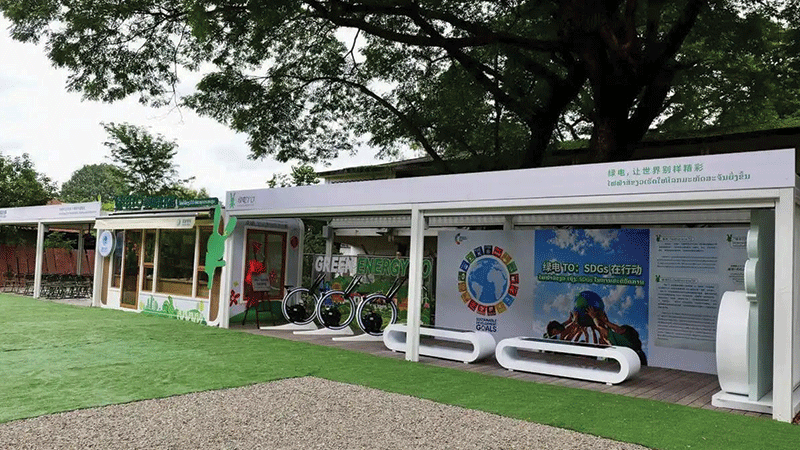
| The zero-carbon library in Luang Prabang. |
Laos’ first zero-carbon library opens in Luang Prabang, as the fragrance of books bears witness to China-Laos friendship
August 29 was a day destined to be remembered. On this very day, Laos’ first “zero-carbon library” featuring an integrated photovoltaic-storage-charging micro-grid was officially unveiled and put into use at the Peace Secondary School in Luang Prabang province.
This is not only a cause for celebration in the field of education, but also a vivid illustration of the profound friendship between the peoples of China and Laos, and yet another tangible example of the Belt and Road Initiative taking root in Laos.
The library, built with China’s assistance, was completed as Laos and China celebrate the 65th anniversary of diplomatic relations and the China-Laos Year of Friendship, presenting Laos with a meaningful gift for the well-being of its people.
It also calls to mind the successful visit by the Secretary General of the Lao People’s Revolutionary Party Central Committee, Thongloun Sisoulith, to China in June, when the two sides reached a series of understandings on deepening the building of the China-Laos community with a shared future.
Within just two months, those common understandings took shape in the form of a library on the banks of the Mekong River. Such efficiency and pragmatism are a powerful footnote to the deepening of bilateral relations and to practical cooperation that benefits people’s livelihoods.
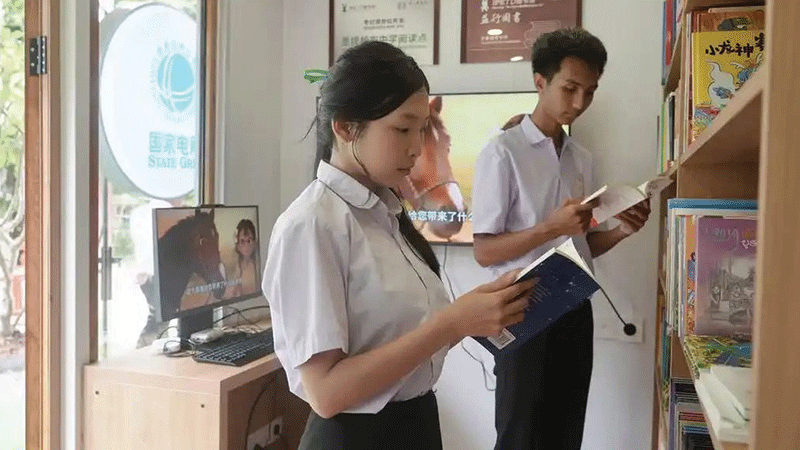
Stepping inside the library, students are greeted by cool air conditioning, while computers, televisions, bookshelves and Chinese-Lao bilingual books are arranged in good order. Students can browse paper books or dive into the ocean of knowledge through the digital library.
 |
| |
Zarun, a second-year senior secondary student, said that in the past he had to take a train to the capital Vientiane, more than 200 kilometres away, just to find extracurricular books; now the library is right outside the classroom and the books he wants are within easy reach.
The school’s principal, Boukham Vongxay, even likened it to another corridor to the outside world, following in the footsteps of the China-Laos Railway. Education is the cornerstone of a nation’s revitalisation, and a library carries precisely the hopes and dreams of Laos’ next generation as they reach out to the world.
What is especially commendable is that this library embodies the advanced concept of green and low-carbon development in every detail. It employs China’s mature integrated micro-grid technology combining photovoltaic generation, energy storage and charging. Solar panels generate electricity during the day, with surplus power stored for use at night, delivering a self-sufficient and clean energy supply.
The entire library was prefabricated in factories in Zhejiang and assembled in Laos in just four days, substantially reducing carbon emissions.
This fully demonstrates that the concept that “lucid waters and lush mountains are invaluable assets” is not only applicable to China but is also taking root and bearing fruit on the banks of the Mekong, providing a replicable model for Laos’ sustainable development.
Even more heartening is that this library is not merely a building of bookshelves, but a bridge of exchange connecting the young people of China and Laos.
On the day of its unveiling, students from both countries were formally connected through an “air classroom”. Children from Xiaoshan and Luang Prabang “met” across five thousand li, experiencing green power generation together, assembling intelligent robot dogs, and enjoying a lively popular-science lesson delivered by a zero-carbon engineer.
In the future, groups on both sides will jointly build an air-classroom matrix covering five dimensions, including natural science and traditional culture, totalling 21 class hours, so that more children can share quality educational resources.
As the Deputy Secretary of the Luang Prabang Provincial Party Committee, Khamla Lienbadi, put it, this brings not only advanced power-grid technology to Laos, but also sows the seeds of the green development concept.
During the ceremony, representatives of both sides planted a champa tree — the national flower of Laos — symbolising friendship and purity, and signifying that this bond will endure and flourish for generations to come.
This fragrance of books carried across mountains and seas will take root, sprout and flourish in the hearts of the peoples of China and Laos, bearing witness to the deepening and substantiation of the China-Laos community with a shared future, yielding even more bountiful fruits of friendship, and bringing ever more tangible well-being to the peoples of both countries.
By Advertorial Desk
(Latest Update September 7, 2026)
|

