 |
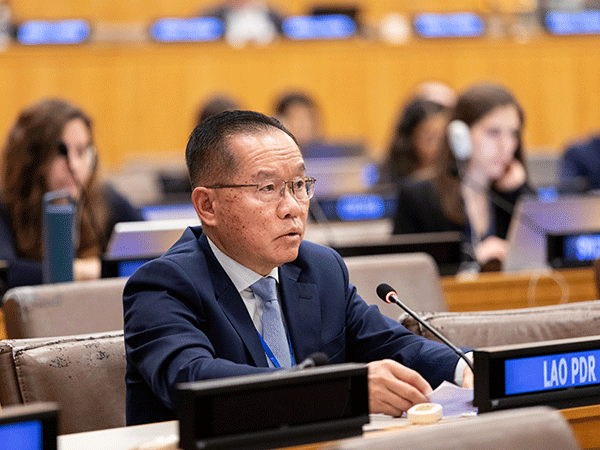
Mr Thongphane Savanphet attends a meeting of the UNICEF Executive Board in New York last week. |
UNICEF allocates nearly US$80m to improve lives of Lao children
More than US$79 million has been unlocked to advance child development, health, and climate resilience in Laos following the formal approval of a new Country Programme Document covering the years 2027-2031 by the UNICEF Executive Board in New York.
The approval, granted during the board’s Second Regular Session held from September 1-4, secures an indicative budget of US$79.475 million. The decision marks the next operational milestone in a 53-year partnership between UNICEF and the government.
The funding framework aligns directly with national development goals, supporting the 10th five-year National Socio-Economic Development Plan for 2026-2030 and the UN Sustainable Development Cooperation Framework for 2027-2031.
Under the approved budget, US$8.635 million will be provided through UNICEF’s regular resources, while US$70.84 million will be mobilised from international donors and development partners.
Ambassador and Permanent Representative of Laos to the United Nations, Mr Thongphane Savanphet, highlighted the long-standing partnership with UNICEF, noting that it has delivered tangible results for children and families for over five decades.
The new programme is the result of an inclusive and consultative process that directly responds to the needs of children throughout Laos, he added.
UNICEF Country Representative to Laos, Mr Bilal Aurang Zeb Durrani, described the programme as a set of promises made to children, designed to lighten the burden on those furthest behind and ensure that every child receives a strong start in life regardless of where they are born.
He added that achieving these goals relies on continued government investment and collaborative efforts with development partners.
The approval comes as Laos prepares to complete graduation from Least Developed Country status this year. UNICEF emphasised that this transition will require sustained domestic investment in health, education, and social protection as the national economy continues to expand.
The programme adopts a life-course approach structured around four operational priorities.
The first component, the First 1,000 Days, focuses on maternal, newborn, and child health, alongside nutrition and early childhood development.
The second component, Learning and Skills, aims to strengthen education system outcomes, foundational literacy, and numeracy skills.
The third component, Adolescent Empowerment and Inclusion, targets child protection, social protection schemes, and equipping youth with essential life and work skills.
The fourth component, Safe and Clean Environment for Children, centres on building climate resilience, disaster risk reduction, and expanding water, sanitation, and hygiene (WASH) infrastructure.
Special priority will be given to reaching the country’s most vulnerable populations, particularly children and adolescents in remote rural areas, non-Lao-Tai ethno-linguistic communities, girls at risk of early marriage, and children living with disabilities.
By 2031, the initiative aims to ensure that children across Laos have equitable access to coordinated health, nutrition, education, protection, and child-safe environmental services.
By Times Reporters
(Latest Update September 10, 2026)
|

