 |
| |
Coffee and conversation in Laos
I became aware of the changing coffee culture in Laos quite by accident. An experience in Vientiane made the connection between coffee and Lao hospitality particularly memorable. Near the iconic Patuxay Monument, I entered a cafe and noticed a woman sitting with three friends. I assumed she was a customer enjoying a leisurely conversation. She helped me change my foreign currency and assisted me in uploading the ‘Grab Taxi app’ onto my phone. She was warm, patient and genuinely welcoming, all the while remaining comfortably among her group of friends. It was only later that I discovered she was actually the proprietress. The experience made me think about the character of Lao cafes, places that are businesses, certainly, but which can remain remarkably personal spaces where the distinction between owner, customer and friend is less rigid than one might expect.
There was a time when coffee in Laos was something to drink in the morning, perhaps with condensed milk, before setting off for the day but, today, coffee seems to have acquired another purpose. In Vientiane, Xayabouly and other towns, cafes are becoming an interesting intersection of people, conversation and changing social habits, with coffee as the connecting thread.
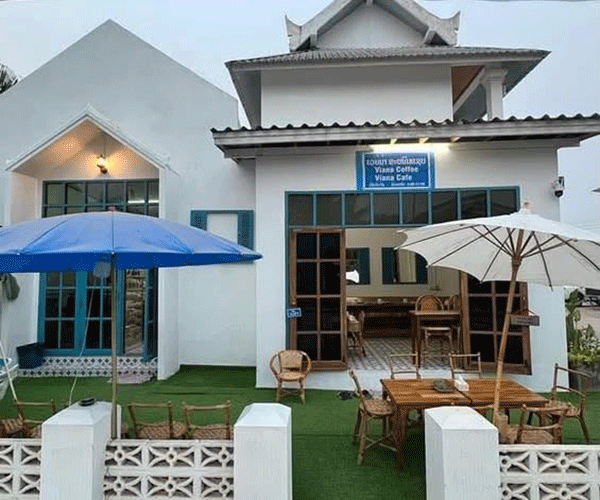
This phenomenon is not confined to Vientiane. My bicycle happened to need a repair in Xayabouly and I needed to kill time. I went to the ‘Viana Cafe’, not because I had heard that it was part of a growing coffee culture, but simply because I wanted to sit down with a cup of coffee while the mechanic did his work.
 |
 |
| |
|
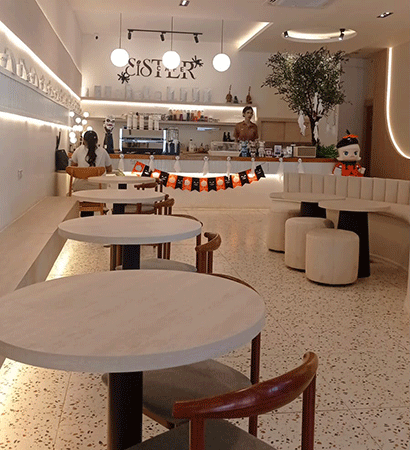
The coffee was cold, dark and slightly sweet, a welcome drink in the heat of the afternoon. I finished it quickly, even as I began to notice the people around me. The cafe was not merely a place where someone came to drink coffee and leave, it was a social space, particularly for younger people. Friends sat together for a considerable time, talking or looking at their phones. There was a relaxed quality to the scene, leaving me wondering whether cafes are taking on some of the roles traditionally played by restaurants, markets and other meeting places in Lao life.
On another occasion, my host Sai took me all the way from the city centre to ‘PSC Coffee’, near the north bus station, a cozy cafe offering a wide variety of espresso, matcha and teas. I was rather surprised that he was prepared to travel so far just for coffee. Sai, however, seemed to regard it as perfectly natural. He told me that there were five or six good coffee places in Xayabouly, a town that many visitors would hardly associate with a developing cafe culture.
The place near the bus stand was attractive in its ordinariness, a place where people met, sat and drank coffee. Travellers stopped before catching a bus, while local people could meet friends or simply take a break from the day. Sai’s enthusiasm made me realise that the cafe culture I had noticed in Vientiane was also taking root in smaller towns.
This growing cafe culture is particularly interesting because Laos is not a country that has recently discovered coffee. Coffee has been grown here for more than a century, particularly in the coffee-growing regions of the Bolaven Plateau in southern Laos. The journey from the coffee trees on the Plateau to a cup in a Vientiane or Xayabouly cafe is becoming part of a distinctly Lao story.
What has changed is not so much the presence of coffee as the way coffee is being consumed. For younger Lao people in particular, the modern cafe offers something beyond the beverage itself. It provides a comfortable and informal setting away from home and work. With smartphones, laptops and social media now an ordinary part of everyday life, cafes function as meeting places, informal offices and social spaces at the same time. In this way, the cafe brings together an old agricultural tradition and a new urban lifestyle for office workers, students and younger customers.
Perhaps the most interesting thing about Lao coffee today is not simply where the beans are grown or how they are roasted. It is what happens after the coffee reaches the cup: one table, one friendship and one conversation at a time.
Author: Mr Priyan R Naik, a columnist and independent journalist based in Bengaluru, India. He regularly writes for Indian, SriLankan, Bangladeshi and Malaysian newspapers. Currently, he is on the Advisory Board of the Equipment Times, India’s No. 1, Mining & Construction Equipment Industry magazine and is a Member of the Jury for the prestigious Yellow Dot Award.)
By Priyan R Naik
(Latest Update September 17, 2026)
|

