 |
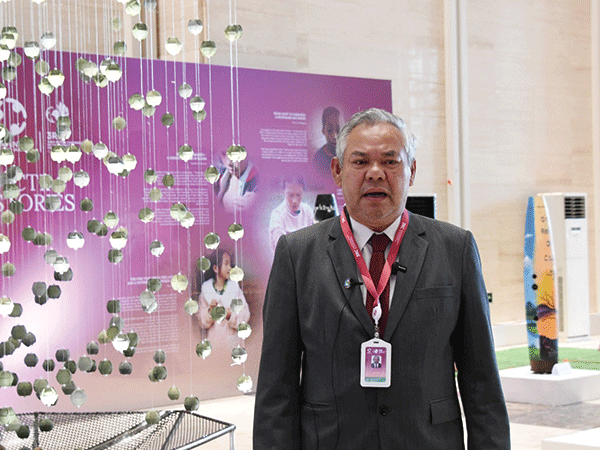
| Mr Bounpheng Sisavath talks to reporters during the Third Review Conference of the Convention on Cluster Munitions on Tuesday. |
Laos still faces massive UXO clearance task
Laos faces a huge task to clear an estimated 80 million unexploded cluster munitions, with only just over one million devices removed after decades of clearance efforts.
Talking to the Vientiane Times during the Third Review Conference of the Convention on Cluster Munitions taking place in Vientiane this week, Head of the National Regulatory Authority for UXO/Mines Action (NRA), Mr Bounpheng Sisavath, said the remaining unexploded ordnance (UXO) poses a long-term challenge for Laos.
“You could say there is still a great deal remaining,” Mr Bounpheng said when asked about the clearance rate, which currently stands at less than 1 percent.
During the more than 50 years since the Indochina War ended, the Lao government has worked with international organisations since 1994 to deal with unexploded ordnance scattered across the country.
During the war, which took place from 1964 to 1973, about 580,000 aircraft sorties dropped more than 2 million tonnes of ordnance on Laos, covering about 87,000 square kilometres.
An estimated 270 million cluster munitions, commonly known as “bombies”, were dropped, with assessments indicating that about 80 million failed to explode and remain scattered across almost every province.
“More than 20 types were dropped on Laos, and each must be destroyed in place,” Mr Bounpheng said.
Under national standards, once a cluster submunition is found, it cannot be picked up or moved and must be destroyed at the site, he said.
Some items remain on the surface, while others are buried as deep as five to six metres underground. This makes clearance difficult and requires trained teams and specialised methods.
Most accidents occur when people burn land, dig the ground, clear land, or handle unexploded devices. Children are particularly at risk when they find cluster bombs and play with them or try to dismantle them, Mr Bounpheng said.
Last year, more than 6,879 hectares of land in 15 provinces were surveyed and cleared of unexploded ordnance, involving agricultural land and development areas, with some 73,000 devices deactivated.
Nearly 69,000 of the items removed and neutralised were cluster munitions.
During the first eight months of this year, teams identified 6,738 hectares of UXO-risk areas, surveyed and cleared more than 4,285 hectares, and deactivated more than 49,000 UXO items, of which about 31,000 were cluster munitions.
UXO work is organised around four main areas: risk education and awareness, survey and clearance, victim assistance, and information management.
Turning to the Third Review Conference of the Convention on Cluster Munitions, Mr Bounpheng said hosting the conference was significant for Laos as both a State Party to the Convention and a country heavily affected by cluster munitions.
Laos became a State Party to the Convention in 2010 and hosted a related meeting in Vientiane. The ongoing review conference marks the second time the country has hosted the meeting, 16 years later.
“This represents a contribution to the international treaty and the ongoing effort to halt the use of these severe and dangerous weapons,” Mr Bounpheng said.
He said the conference was also an opportunity for Laos to seek further international support for UXO clearance and victim assistance.
“States Parties have an obligation to assist countries affected as we are,” he said.
But changing global and regional conditions are affecting funding for UXO work. Some countries have reduced or stopped assistance as they shift resources towards new priorities of their own, Mr Bounpheng said.
“Global and regional conditions do affect funding support,” he said. “Even so, we still see a positive trend, and funding continues to be provided for our ongoing work.”
Despite continued progress, the scale of the remaining task remains clear.
Thousands of hectares of land are being cleared and tens of thousands of devices are being activated each year, but millions of cluster munitions are thought to remain on land used by rural communities.
By Phonepaseuth Volakhoun
(Latest Update September 17, 2026)
|

