 |
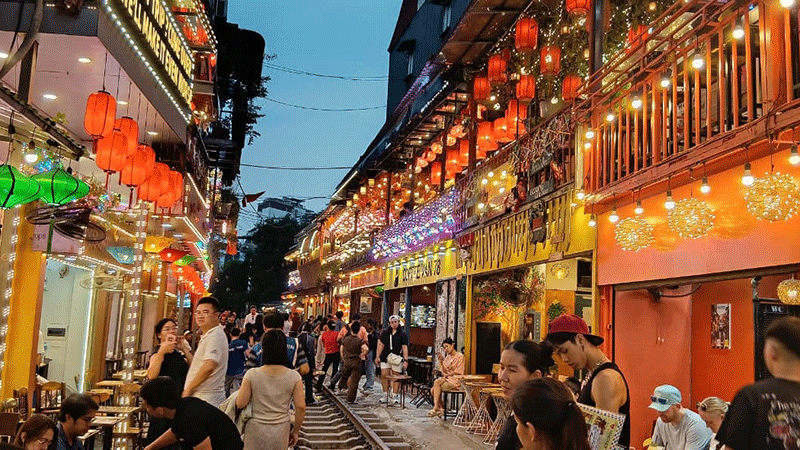
| A perfect night, with warm lights and cosy cafés lining both sides of the street. |
Where the train meets the night: a different side of Hanoi
People stood along the narrow railway, phones and cameras ready, their eyes fixed along the narrow railway track. Café lights glowed beside the rails as conversations filled the evening air. For a few moments, everything seemed to pause.
A distant rumble quickly grew louder. People moved towards the walls as the train approached, its carriages passing astonishingly close to the cafés and houses. Within seconds, the moment was over, leaving behind excited voices, photographs and the fading sound of the train disappearing into the night.
This is Hanoi’s famous Train Street, located in the centre of the capital in the Old Quarter, with well-known sections near Trần Phú–Phùng Hưng and Lê Duẩn, close to Hanoi Railway Station. The railway cuts through a long-established residential neighbourhood where homes, cafés and everyday life sit remarkably close to an active railway line.
I recently visited the area, expecting to find a popular spot for photographs. What I discovered was something more interesting: a neighbourhood where Hanoi’s past and present seem to exist within arm’s reach of each other.
 |
 |
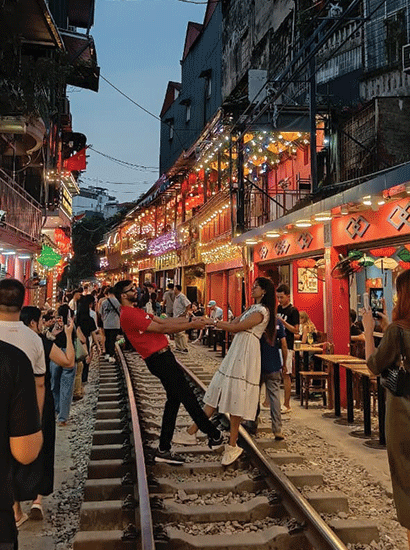
| A couple poses for photographs on the railway tracks at Hanoi Train Street. |
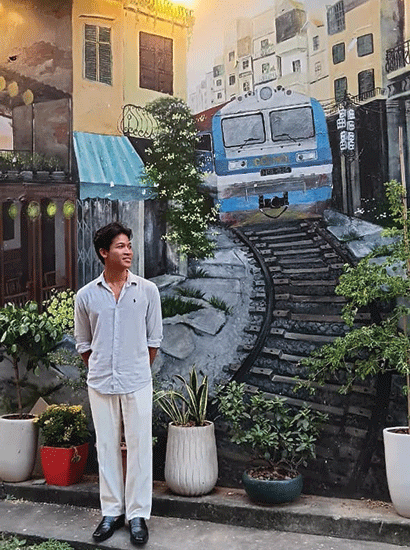
A Cambodian visitor poses for a photo at one of his favourite spots. |
On one side of the tracks are old houses, narrow passages and weathered walls that reflect the character of traditional Hanoi. On the other are cafés and small bars filled with visitors, their lights adding colour to the evening.
Couples pose for photographs. Friends sit together over drinks. Foreign visitors watch the railway with curiosity, while local visitors capture the atmosphere on their phones. Everyone seems to be waiting for something — usually the next train, but perhaps also the next memorable photograph.
The trains pass through the neighbourhood several times a day, including in the evening, although exact arrival times can vary. Rather than relying on a fixed timetable found online, visitors are advised to check the expected train time on the day with local café staff.
The setting has an almost cinematic quality. The railway cuts through the neighbourhood like a line connecting two different versions of the city. During the day, the area can feel like an ordinary residential corner of Hanoi. At night, it becomes a lively meeting place where old architecture, local life and modern tourism blend together.
But there is another side to the experience — one that should not be forgotten behind the photographs.
This is a real, active railway, not a tourist attraction created for visitors. The space beside the tracks is extremely narrow, and a passing train leaves very little room. Visitors should never sit or pose on the tracks, attempt to touch the train or move towards it for photographs. Access can also be restricted by authorities, so visitors should follow local rules and instructions from railway officials or café staff.
What stayed with me most was the intimacy of the place. There are no grand monuments here and no large entertainment venues. Instead, the attraction comes from the closeness of everything — the railway, the houses, the cafés and the people.
Sitting beside the tracks, I could hear conversations from nearby tables while watching the track stretch into the distance. Then, when the warning came that a train was approaching, the mood changed almost instantly. Chairs were pulled back, people moved towards the walls and conversations gave way to anticipation.
For photographers, the scene offers endless possibilities, particularly in the evening when the warm café lights contrast with the dark railway. For visitors simply looking for something different, it offers a chance to experience Hanoi beyond its better-known landmarks.
But Train Street is more than a backdrop for photographs; it is a snapshot of a city constantly changing while retaining traces of its past.
For Cambodian visitor Mon Sokeo, his first trip to Hanoi offered an opportunity to look beyond the city’s famous landmarks and observe how tourism fits into everyday urban life.
“For me, travel isn’t just about visiting new places; it’s a chance to see how cities develop, manage tourism, preserve their history and shape experiences for locals and visitors,” Sokeo told the Vientiane Times.
“My first visit to Hanoi has left a strong impression. Despite being a busy, crowded capital, the city felt welcoming, with locals and tourists moving through its streets side by side,” he said.
What struck Sokeo most was how naturally tourism blends into everyday life.
“Small cafés, creative shops and traditional-style storefronts turn a simple walk into part of the travel experience,” he said.
Hanoi’s architectural heritage also impressed him. Many old buildings, including those from the French colonial era, have been renovated and woven into modern life rather than erased by development.
“This showed me that tourism growth doesn’t mean the old must be replaced by the new. Historic buildings can continue telling a city’s story while serving its present-day economy,” Sokeo said.
He also appreciated Hanoi’s pedestrian-friendly spaces, which allow visitors and residents to explore markets, cafés and cultural sites at an unhurried pace. The one real challenge, he noted, was crossing roads, with motorcycles constantly weaving through intersections. Even a green pedestrian light at traffic signals felt daunting at first.
“What I’ve learnt from Hanoi is that the tourism experience begins long before you get to a major landmark. The city isn’t just another foreign capital; it demonstrates how heritage, hospitality and everyday urban life can come together to create a distinct identity,” he said.
With only a couple of days in Hanoi, I know the city has much more to show visitors. My short stay gave me only a glimpse of its character, leaving me with the sense that many more stories were waiting to be discovered.
So, yes, I will be back soon — ready to wander beyond the familiar sights, walk through the quieter streets and explore more of the hidden charms of Vietnam’s captivating capital.
By Bounfaeng Phaymanivong
(Latest Update September 22, 2026)
|

