 |
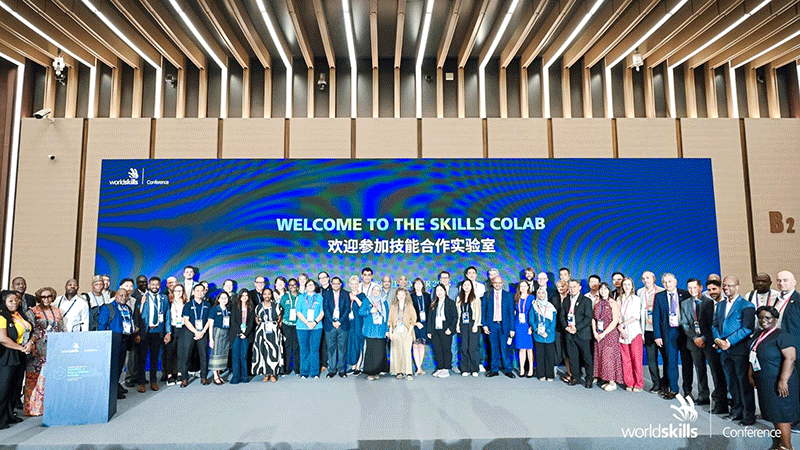
| Laos and participants from other countries attend the WorldSkills Conference in Shanghai last week. |
Lao vocational training success presented at WorldSkills Shanghai event
A pioneering Lao vocational training model that has boosted graduate incomes by over 160 percent was showcased on the international stage during the WorldSkills Conference held in Shanghai, China, from September 23-25.
Representatives from the Vocational Training and Employment Support Services (VTESS) project presented the localised vocational coaching methodology and its workforce outcomes at Skills CoLab, the conference’s practitioner exchange platform.
The VTESS project is funded by the Swiss Agency for Development and Cooperation (SDC) and implemented by a consortium comprising Swisscontact and Switzerland’s Lucerne University of Applied Sciences and Arts (HSLU), working in close partnership with the Department of Technical and Vocational Education and Training (DTVET) under the Lao Ministry of Education and Sports.
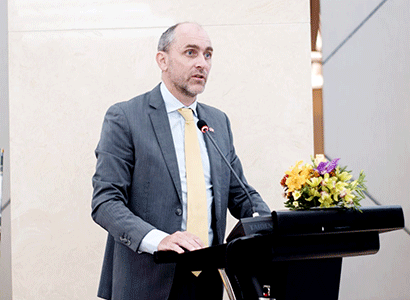 |
| Mr Jean-Gabriel Duss, highlighted that investment in skills should be measured by the futures created rather than just the number of people trained. |
The initiative targets vulnerable young people aged 15 to 35, particularly early school leavers living in income poverty, across Vientiane and the provinces of Oudomxay, Xayabouly, Xiengkhuang, Khammuan and Salavan.
At the core of the project’s success is the Coaching Cycle for Employment and Entrepreneurship (C4EE). Adapted from international models by HSLU experts and local partners, the methodology was streamlined into a 9-month Lao-language programme integrating practical technical skills with soft skills training, job placement support, and startup seed grants.
Participation in the WorldSkills Conference highlighted the global relevance of this approach, which transfers master training capabilities from HSLU to local Lao trainers and provincial coordinators to build long-term local capacity.
Regional Director of the SDC Mekong Region, Mr Jean-Gabriel Duss, stressed that investment in skills should be measured by the futures created rather than just numbers trained.
“Young people once on the margins are now workers, entrepreneurs and employers. At WorldSkills Shanghai, the Lao-Swiss partnership behind VTESS showcases an innovative coaching approach that builds the most important skill of all: the ability to learn, act and drive one’s own change,” he said.
The Swiss government’s support ensures development efforts deliver measurable economic results. According to the project’s 5th Tracer Study released in 2025, approximately 80 percent (246) of the 307 Employment Support Services (ESS) graduates surveyed secured gainful employment, with 98 working for employers, 139 self-employed, and nine earning incomes within family businesses.
Crucially, among 187 surveyed graduates who provided financial data, average monthly earnings surged by more than 160 percent, providing a vital entry point into the formal workforce for youth who previously earned zero income.
Ms Vadsana Inthavongsa, a project graduate who received seed money to launch a beauty salon in March 2025, shared that graduating from the coaching cycle completely transformed her life by allowing her to earn about 18 million kip monthly and provide a stable future for her family.
Similarly, Mr Somphone Meunpanya, a Batch 3 graduate, explained that moving from basic daily wage labour to opening his own barber shop enabled him to earn around 5 million kip per month, bringing him financial independence.
Gender inclusion remains a primary focus across all phases. Women comprise 66 percent of all ESS graduates across Batches 1 to 4, representing 80 percent of participants in Basic Entrepreneurship Training and 80 percent of seed grant recipients. Batch 5 is currently underway, training an additional 632 participants, 60 percent of whom are female.
Deputy Director General of DTVET, Mr Tingkham Soulintha, highly valued the long-standing partnership with Switzerland, saying that VTESS generates real economic self-reliance for young people, particularly women. He affirmed that the project aligns fully with the Ministry’s 5-year Strategic Plan for TVET Development, strongly supporting the nationwide expansion of this proven model.
By Times Reporters
(Latest Update September 30, 2026)
|

