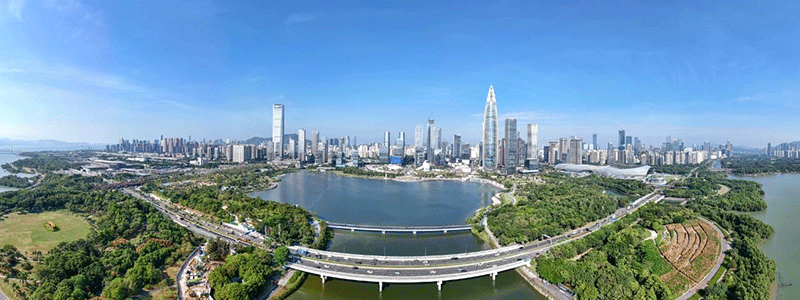
Shenzhen: Where innovation meets the future
In less than five decades, a once-small coastal city has transformed into a vibrant centre of innovation, technology and young talent — with its eyes firmly on tomorrow.
A city can change in a generation, but Shenzhen shows how dramatically it can change in just a few decades. Looking across its modern skyline, busy streets and technology-driven industries, it is difficult to imagine that this dynamic coastal city was only beginning its transformation less than half a century ago. Today, Shenzhen is a city of high-rise buildings, advanced manufacturing, global technology companies, young talent and creative energy — a place where new ideas are not simply discussed, but turned into products, businesses and ways of life.
For eight Lao media representatives from the Lao Press in Foreign Languages, Pasaxon Newspaper and Vientiane Mai Newspaper, this transformation came into sharper focus during their participation in the Asia-Pacific Media Forum in Shenzhen from September 3 to 5, 2026. During their short stay, the
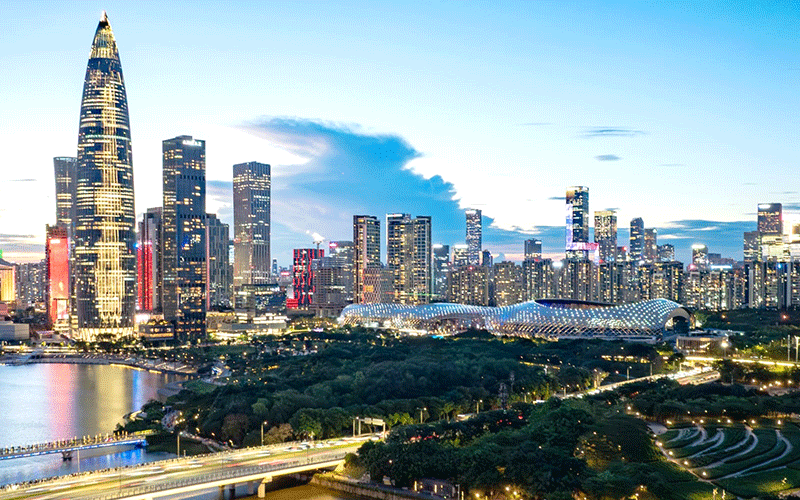 |
Lao delegation, together with media representatives from other countries, visited several development areas, cultural venues and tourist attractions, providing an opportunity to see beyond the city’s impressive skyline and gain a closer understanding of what has driven its remarkable development.
Shenzhen was established as a city in 1979 and became China’s first Special Economic Zone in 1980. Located in southern China and adjacent to Hong Kong, the city has since grown from a relatively small coastal settlement into one of the country’s major economic and technological centres. Its transformation has become closely associated with China’s reform and opening-up, with Shenzhen serving as a place where new approaches to economic development, technology and urban growth have been tested and developed.
According to information from the Shenzhen Municipal People’s Government, the city covers 1,997.47 square kilometres and has a coastline stretching 260.5 kilometres. It has a subtropical monsoon climate, with an annual average temperature of around 23°C. By the end of 2025, Shenzhen had a permanent population of 18.24 million, while the average age of its residents was around 32.5 years. These figures help explain another feature that is immediately noticeable to visitors — the city feels remarkably young, energetic and forward-looking.
 |
Shenzhen’s economic transformation has been equally striking. Its gross regional product reached 3.87 trillion yuan, placing it among China’s leading cities. For four consecutive years, Shenzhen has ranked first nationwide in both total industrial output value and industrial value added among enterprises with annual operating revenues of at least 20 million yuan. Its total import and export value has also ranked first among Chinese cities for two consecutive years.
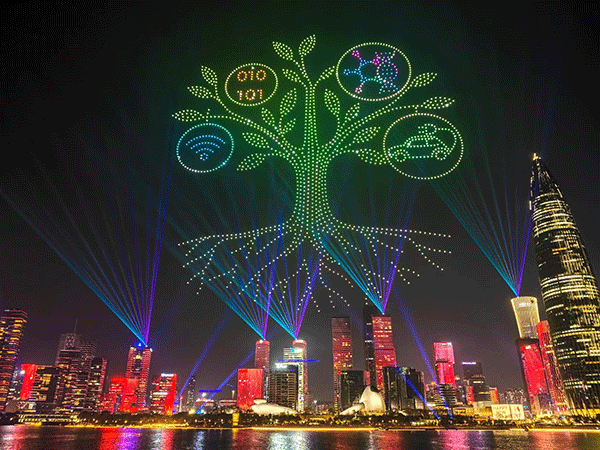
Yet the story of Shenzhen cannot be told through economic figures alone. Much of the city’s identity has been shaped by its determination to develop high technology, advanced manufacturing and new industries. It is home to internationally recognised companies such as Huawei, BYD, Tencent and DJI, whose products and technologies have become familiar in markets around the world.
The city has also developed an extensive innovation ecosystem. Shenzhen is home to more than 26,000 national high-tech enterprises, while its international patent applications under the Patent Cooperation Treaty have ranked first among Chinese cities for 22 consecutive years. Such achievements reflect the city’s emphasis on research, technological development and the conversion of new ideas into practical applications.
For visitors, however, perhaps the most interesting aspect is the human element behind this innovation. Shenzhen has attracted large numbers of skilled professionals and young people, including more than 240,000 returnees who studied overseas and over 28,000 high-level professionals. For three consecutive years, the city has ranked first nationwide in attracting young talent born after 1995.
That youthful character can be seen not only in technology companies and research institutions, but also in the city’s cultural life. During their visit, the Lao media delegation toured museums and cultural facilities, including the Shenzhen Cultural Centre. Shenzhen is home to more than 1,800 cultural venues, offering residents and visitors spaces for exhibitions, performances, education and creative activities.
What particularly attracted the attention of the visiting journalists was the active role played by young people. In many of the places visited, young people were involved in designing, organising and participating in activities. Their presence reflected a city where the younger generation is not simply experiencing change but is actively contributing to it.
This combination of technology, creativity and culture has also contributed to Shenzhen’s reputation as a centre of design. The city was the first in China to be designated a UNESCO “City of Design”, reflecting its efforts to integrate design and creativity into urban development.
For a city often described through the achievements of its technology companies, this cultural dimension offers another way of understanding Shenzhen. Innovation is not limited to laboratories, factories or digital platforms. It can also be found in the design of public spaces, cultural programmes, services and new ways of connecting people with their city.
The timing of the Asia-Pacific Media Forum was also significant. Shenzhen is preparing to host the 33rd APEC Economic Leaders’ Meeting on November 18–19, 2026. China will host APEC for the third time, following Shanghai in 2001 and Beijing in 2014. The upcoming meeting will bring leaders and representatives from across the Asia-Pacific region to a city that has itself become a symbol of economic transformation and international connectivity.
For Shenzhen, hosting APEC is another opportunity to strengthen its international profile and demonstrate its role as a modern metropolis, economic centre and hub for innovation and cooperation. For the Lao media delegation, the forum and city visits offered a valuable opportunity to observe these developments first-hand and to understand more closely the experience of a city that has undergone such profound change in a relatively short period.
Looking back at Shenzhen’s journey, what stands out is not simply the height of its buildings, the size of its economy or the number of technology companies based there. It is the sense of movement that can be felt throughout the city. Shenzhen appears to be a place that does not regard development as a destination, but as a continuing process.
From its establishment as China’s first Special Economic Zone in 1980 to its emergence as a major technology and manufacturing hub, Shenzhen has built its development around reform, openness, innovation, talent and international engagement. Its experience demonstrates how these forces can combine to reshape not only an economy, but also the character of a city.
After a short visit, one impression remains particularly strong: Shenzhen is a city that looks forward. Its young people, technology, culture and constant search for new ideas all point in the same direction.
The future, in Shenzhen, does not seem far away.
It is already taking shape in the city today.
By Phon Thikeo
(Latest Update September 30, 2026)
|