 |
| |
A second ‘Teachers’ Day’ in Xayabouly
I thought I had already celebrated Teachers’Day for the year, in India, which is celebrated on September 5, every year. Last October, while travelling through Laos, I found myself being invited to another Teachers’ Day celebration — this time in the town of Xayabouly. Teachers’ Day celebrations in two successive months made me realise how important the teaching profession is all over the world and how a teacher is honoured in different countries, in different languages, each meaningful in their own way.
In India, Teachers’ Day marks the birth anniversary of Dr Sarvepalli Radhakrishnan, a philosopher, scholar and India’s second President. Indian students across the country embrace this day with flowers, cards and messages of gratitude. Pupils return to school to seek blessings from their teachers, and classrooms erupt in laughter and nostalgia. In India, respect for teachers is loud, heartfelt and striking.
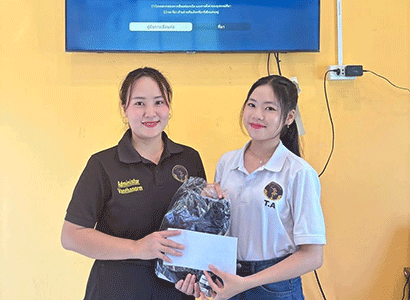
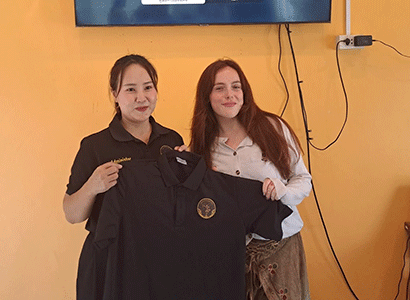
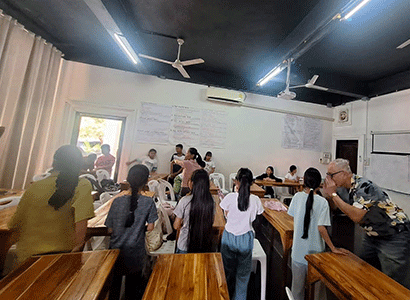
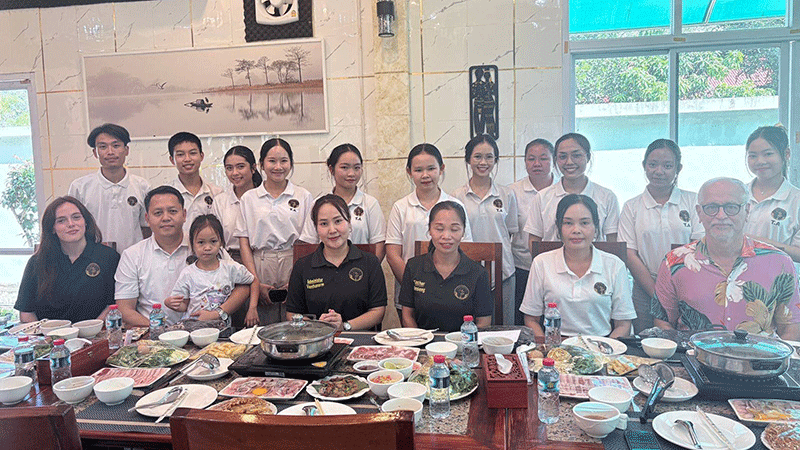
At the Phoudthasay English Learning Centre in Xayabouly, I found Teachers’ Day was celebrated in a quieter but equally profound manner on October 7, the Teachers’ Day in Laos, a national holiday to honour teachers in every corner of the country.
This day is chosen to honour a pioneer in education, Mr Kham, recognised as the first teacher in Laos. Mr Kham had attended one of only two available schools in the country in those times and after graduation had begun sowing the seeds of literacy and learning in Laos where formal education was in its infancy.
He taught wherever people gathered, often in temples, doubling as learning centres. His classrooms, unlike modern ones, had monks studying alongside children, adults sitting next to teenagers, everybody regardless of age, sharing seats in the pursuit of knowledge.
Teachers’ Day was marked by respectful ceremonies, flowers, small performances and words of gratitude. The compound was filled with colourful paper flowers, hand-painted banners and rows of students in freshly ironed traditional dresses carrying handmade gifts that were not just symbolic, but expressions of real effort and affection.
The older students recited heartfelt messages, explaining how their English teachers had opened doors to new opportunities and worldviews.
Moments when students shared personal stories about their teachers were touching. One young woman spoke of how her English teacher stayed after class to help her write her first letter to her sister studying abroad. Another student spoke of a patient teacher who helped him overcome his fear of speaking English in public. At one point the air was filled with children’s voices singing simple Lao songs of gratitude. Their sincerity transcended language.
Deep in thought, what struck me most was the absence of ceremony being performed simply because the calendar demanded it. The students seemed genuinely happy to be there, and the teachers, for once, were the recipients of attention, affection and applause.
In a profession where much of the satisfaction is often invisible, such moments matter. A teacher can see the rewards of his or her efforts instantaneously on the face of a young boy or girl in the classroom, without knowing exactly how far the lesson travels in a student’s life.
Yet, years later, when someone says “Sir, you are one of the teachers I will remember throughout my life”, you feel you have touched some lives and made a difference to the world, perhaps a quiet reward of teaching.
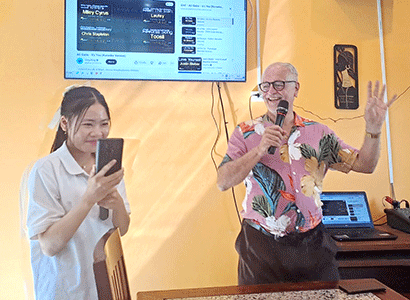
After a formal talk by the centre’s director, each teacher had to give a karaoke performance. Laughter filled the hall as teachers’ names, chosen by a spinning karaoke wheel, were called out to sing. Each turn brought surprise and cheer, breaking hesitation and hierarchy alike, as voices rose in fun, camaraderie and a shared celebration.
I boldly sang a rumbustious Indian pop number, signifying energy, laughter and joyful chaos. All teachers were treated to a sumptuous ‘jeen jum’, a traditional Lao hot-pot meal. Thinly sliced meat, fresh vegetables and herbs were dipped into a gently simmering, aromatic coconut broth and enjoyed with sticky rice in a relaxed setting.
After experiencing India’s exuberant Teachers’ Day and witnessing the more intimate celebration at the Phoudthasay English Learning Centre, I realised thatboth share the same core sentiment that teachers matter because they shape minds and instill values. Teachers’ Day is a reminder that societies grow not through buildings and laws, but through teachers who believe in learning. The beauty, simplicity and genuine gratitude, I felt at the Phoudthasay English Learning Centrestayed with me long after the flower laden bouquets had wilted.
Author: Priyan R Naik is a columnist and independent journalist based in Bengaluru, India, and regularly writes columns for Indian, Srilankan, Bangladeshi and Malaysian newspapers.The article expresses the views of the author and does not necessarily reflect the editorial perspective of the Vientiane Times.
By Priyan R Naik
(Latest Update October 5, 2026)
|