 |
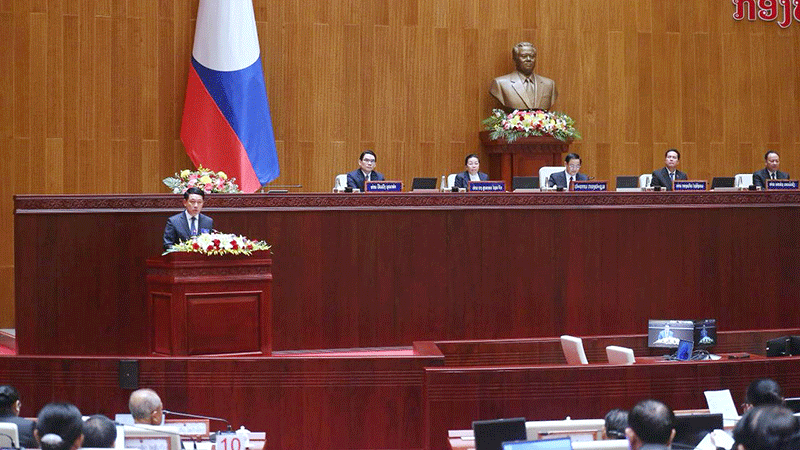
| Prime Minister Saleumxay Kommasith delivers a government report and the 2027 development plan at the opening session of the National Assembly on Monday. |
Govt targets 5.8 percent growth in 2027
The government has set a target of at least 5.8 percent economic growth in 2027 while focusing on stability, productivity, infrastructure, and improvement of people’s livelihoods.
Prime Minister Saleumxay Kommasith presented the government’s proposed 2027 National Socio-Economic Development Plan to the 2nd Ordinary Session of the 10th National Assembly on October 5. The session is chaired by the President of the National Assembly, Dr Sonexay Siphandone.
The 2027 plan covers the second year of the government’s National Socio-Economic Development Plan for 2026-2030.
The government aims to collect 104,475 billion kip in revenue in 2027, equal to 21.87 percent of Gross Domestic Product (GDP). This represents an increase of 24.97 percent compared with the target figure for 2026.
Domestic revenue is expected to rise to 99,275 billion kip, up 26.46 percent from the 2026 plan and equal to 20.78 percent of GDP.
Total budget expenditure is also planned at 104,475 billion kip, equivalent to 21.87 percent of GDP, resulting in a balanced budget.
The government said macroeconomic stability will remain a key priority, with particular attention paid to inflation, currency exchange rates, and domestic and external debt.
The targets were set after inflation averaged 7.9 percent in the first nine months of 2026, while the government expects full-year inflation to remain at 7.4 to 7.8 percent, above its target.
“The government will continue to implement the targets and priority tasks set under the 2026 National Socio-Economic Development Plan and relevant National Assembly resolutions and government directives,” Mr Saleumxay said.
It will also continue efforts to build an independent and self-reliant economy by making better use of the country’s resources and production potential.
Emphasis will be placed on the expansion of a sustainable revenue base through value-added tax, land taxes, fees, and other revenue streams.
The government plans to modernise revenue collection, close gaps that allow revenue to be lost, and integrate data from different sectors to improve tax collection.
It will also study measures to restrict imports of non-essential luxury goods and strengthen domestic productivity to reduce unnecessary foreign currency outflows.
The government plans to strengthen import-substitution and export-oriented production, while encouraging the processing of minerals prior to export.
It also plans to develop mineral processing industrial zones and strengthen oversight of mining operations to ensure they are law-compliant.
Development of the electricity sector is another priority. The government plans to speed up projects already under construction and promote hydropower, wind, and solar projects, particularly those with existing power supply agreements.
Transport infrastructure will receive continued attention, with work planned on roads, railways, waterways and air transport routes that connect production areas, economic corridors and major markets.
The government specifically identified the Vientiane Capital-Hanoi expressway, Route 13 North, Route 13 South, Route 8, Route 9 and Route 12 as top transport priorities.
Road building and repair will continue in line with the policy approved by the National Assembly to improve transport links and support trade, investment and tourism.
Rural development and poverty eradication will remain at the core of the development plan, with the government seeking to create stable jobs and income sources while improving people’s access to basic services.
It will promote integrated agricultural production to ensure food security and gradually shift towards the production of commercial goods that can create jobs and stable incomes.
The government also plans to improve rural infrastructure and public services while strengthening preparedness for natural disasters and climate change.
Prime Minister Saleumxay said the government would translate the 2027 targets into detailed plans and assign responsibilities to relevant agencies and local administrations.
The government will regularly monitor progress and report on the results to the National Assembly.
The 2027 growth target is more ambitious than the latest forecast by the Asian Development Bank (ADB), which projects that Laos’ economy will grow by 4.5 percent in 2027.
The ADB says growth is expected to benefit from services, power generation, construction, and regional connectivity, but external risks, high debt and structural constraints remain challenges.
The 2027 plan builds on the expected 5.1 percent economic growth rate in 2026 while addressing continued pressures from inflation, foreign exchange issues, and debt. The government’s broader approach is to strengthen domestic productivity, improve public services and infrastructure, and create more stable income opportunities for citizens while maintaining economic and social stability.
By Phonepaseuth Volakhoun
(Latest Update October 7, 2026)
|

