 |
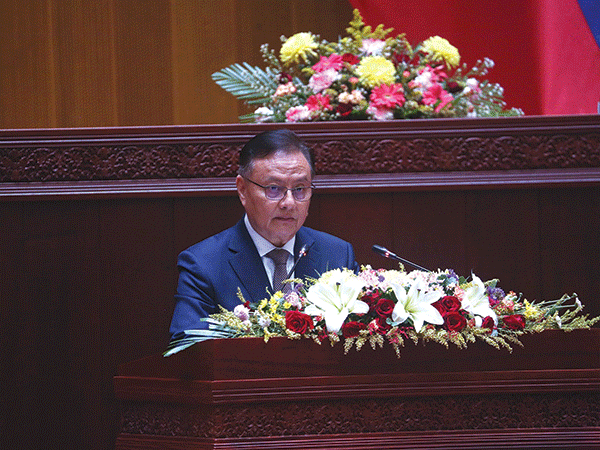
Mr Santiphab Phomvihane responds to questions from National Assembly members on Wednesday.
--Photo Sangkhomsay |
Finance ministry to boost revenue collection, improve public investment
The Ministry of Finance will tighten revenue collection and improve the efficiency of public spending as part of government efforts to strengthen fiscal management and ensure that limited state resources generate greater economic and social benefits.
Deputy Prime Minister and Minister of Finance, Mr Santiphab Phomvihane, outlined these measures when responding to questions from National Assembly members on Wednesday concerning tax revenue collection, budget use, and management of state-funded development projects.
He said the government needs to make better use of existing sources of revenue, particularly earnings from minerals, land rents and concessions, construction projects and large-scale investments, where payments do not match earnings potential.
Revenue from the mining sector increased this year, with land rents and concession fees rising to 1,275 billion kip, up 4 percent on the same period last year. Natural resource fees generated 5,486 billion kip, an increase of 36.6 percent, while taxes and fees paid by mining companies totalled 14,467 billion kip, up 37.2 percent.
Despite these increases, Mr Santiphab said the figures do not reflect the full revenue potential of mining operations.
He pointed to overlapping concession areas, delays in paying concession fees, weak information-sharing and unclear licensing as causes of inadequate revenue. Companies’ export plans tend to exceed actual performance, with implementation averaging only 50 to 60 percent of planned levels, he added.
Of 166 mining companies, 122 were actual exporters in 2025, compared with 96 in 2026, according to the Ministry of Finance.
The government will reassess concession projects and take action against ineffective ones, including cancelling projects rated C and C+ and returning concessions to the State. Future licensing will give priority to companies that will set up processing facilities, so as to add value to minerals rather than export them in unprocessed form.
The ministry will establish a modern system for monitoring minerals from their source through to export. Mineral quality inspection facilities have been installed at seven export points, and the ministry will expand this to other border crossings.
A similar approach will be applied to construction and large-scale projects, with the ministry seeking to close gaps in revenue collection by improving information-sharing between project owners, contractors, tax authorities and other agencies.
Mr Santiphab said some project owners failed to provide sufficient information on project values, implementation periods and contractors, while some contractors are small businesses or entities not legally established in Laos. These problems made it difficult to identify and collect all tax obligations, including income tax, contractor profit tax and value-added tax.
Improving revenue collection will help the government meet essential spending needs. Mr Santiphab said budget allocations are made according to revenue capacity, with priority given to salaries and allowances paid to civil servants, military and police personnel and pensioners, as well as servicing public debt.
Funding for education and sports increased by 35 percent compared with 2025, including additional allocations for school meals, stipends, textbooks and teacher-related programmes.
Public health spending rose by 13 percent, including counterpart funding for maternal and child health, HIV/AIDS, tuberculosis, malaria and reproductive health programmes, and the construction of a 400-bed university hospital in Vientiane.
The government is changing the way state investment is prioritised after acknowledging that projects were previously spread too widely across sectors and localities, leading to unfinished projects and rising debt.
For 2027, the state investment budget has been set at 17,000 billion kip, an increase of 7,500 billion kip from 2026. Of this, 14,605.22 billion kip will be allocated to six priorities under the National Socio-Economic Development Plan for 2026-2030.
These include projects that drive economic growth and strengthen economic self-reliance, rural development and poverty reduction, transport links, food security, natural disaster response, and investment in education, health and skilled labour.
Priority will be given to projects close to completion and new projects considered necessary and urgent, to ensure investment produces speedy benefits.
Mr Santiphab acknowledged that ensuring value for money is a major challenge. Some projects were assigned values that do not reflect the actual work and quality required, and weaknesses remain in technical surveys, project design, construction supervision and contract management.
In some cases, construction has begun while feasibility studies, surveys and design work are still being carried out, resulting in delays, cost increases and contract extensions.
To address such problems, the ministry will strengthen monitoring and consider ending or cancelling ineffective projects. Where an effective project is delayed because of poor contractor performance, the government may terminate the contract and hire a new contractor.
From 2027, state enterprises will play a greater role in feasibility studies, surveys and project designs. This is intended to improve cost estimates and strengthen the government’s ability to control quality and prices.
Mr Santiphab stressed that closer coordination between central agencies and local authorities is essential to achieve full revenue collection, and ensure that public funds are used efficiently and state investment is directed to projects that deliver tangible benefits.
By Bounfaeng Phaymanivong
(Latest Update October 8, 2026)
|

