 |
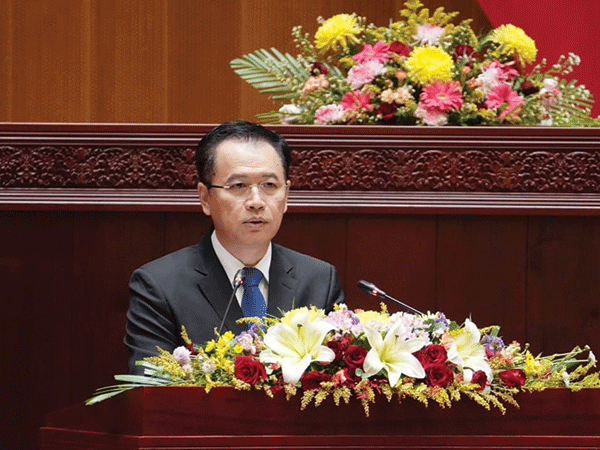
| Minister of Industry and Commerce Mr Malaithong Kommasith responds to questions from National Assembly members on Wednesday. |
Govt moves to end raw mineral exports, pushes processing
The government will ban all raw mineral exports by 2030 in a bid to ensure minerals are processed prior to export and capture higher margins from the country’s natural resources.
Speaking at the National Assembly on Wednesday, Industry and Commerce Minister Mr Malaithong Kommasith said that in the past the aim was to sell minerals in their raw form as a quick source of revenue for the government.
However, this meant that the full potential of Laos’ mineral wealth was unexploited.
“In the past it was our policy to promote mineral processing to add value. In practice, however, the mineral industry tended to focus mainly on the export of raw materials to generate revenue to ease economic and financial difficulties,” Mr Malaithong said.
“This meant we were not using our resources to their full potential.”
To reverse this trend, the government is drafting a Prime Minister’s directive requiring all new mining projects to build processing plants.
The export of unrefined ores from new mining operations will be prohibited as part of a broader drive to create a self-reliant economy.
Mr Malaithong said the order will be officially issued once the government concludes its review of comments from the National Assembly Standing Committee and the recent Extraordinary Plenary Meeting of the 12th Party Central Committee.
Another comprehensive revision of the Minerals Law is slated for submission to the National Assembly at the start of next year.
Under the Prime Minister’s Order framework, new approvals for rare earth projects have been frozen.
For minerals including gypsum, barite, antimony, cobalt, tungsten, and nickel, the government has set a firm 2030 deadline to phase out raw exports entirely.
Existing projects face renewed regulatory scrutiny. The Ministry of Industry and Commerce will draft a roadmap by the end of this year to curb their raw ore shipments.
Meanwhile, companies mining gold, copper, bauxite, and potash will be legally required to integrate their extraction with domestic smelters or processing plants.
The policy shift is already attracting investment in mineral processing, Mr Malaithong said.
The Asia Potash Industrial Park in Khammuan province has attracted 14 factories with a combined investment of more than US$730 million over the past year. Nine factories are already operating and have hired nearly 2,000 people.
The estate exported more than US$120 million worth of products from January to August 2026.
The potash mining project linked to the park has also increased its production capacity. Its tax payments are expected to rise from US$93 million in 2025 to more than US$100 million during the first nine months of 2026.
The government is also seeing stronger interest in processing bauxite into alumina. Several companies with experience in alumina and aluminium production in China have expressed interest in building processing plants in Laos, provided sufficient bauxite resources are available.
However, Mr Malaithong acknowledged that the transition faces steep logistical hurdles. Exorbitant transport costs, fragmented supply chains, and power grid limitations threaten to deter the heavy industrial investments required for large-scale smelters.
He said the global appetite for raw ore remains robust, and both central and local governments rely heavily on these exports to fund ongoing development.
The ban on raw mineral exports threatens to trigger a sudden revenue shortfall, chill the broader investment climate, and potentially expose the state to costly investor lawsuits.
Policymakers must also navigate the delicate balance between offering tax incentives to attract capital and the pressing need to boost state coffers. Ending illicit mining operations and the cross-border smuggling of ore is another hurdle.
In response, the ministry is proposing more rigorous investor screening, requiring firms to prove their technical and financial viability while fully disclosing their ultimate beneficial owners.
Nominee ownership will be prohibited, and companies categorised as ‘weak’ will be barred from future project tenders. The state also plans to deploy real-time weighing systems at mine gates, integrating production data directly with tax management systems to stem revenue leakage. These reforms echo mounting demands from lawmakers for greater sector transparency and community investment.
Mr Akhom Praseuth, a National Assembly member representing Savannakhet province, urged tighter oversight of mining licences and concession agreements, alongside the deployment of better tracking technology.
“The benefits of mineral extraction should not be measured by the amount of ore extracted, but should be assessed by the revenue that goes to the state, the benefits people receive, and the preservation of natural resources for the next generation,” Mr Akhom said.
By Phonepaseuth Volakhoun
(Latest Update October 8, 2026)
|

