 |
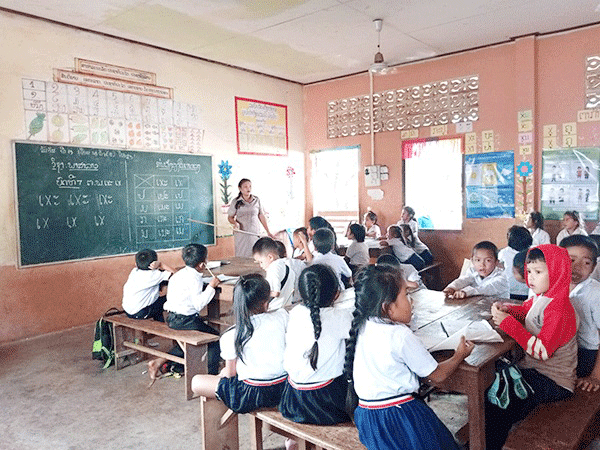
| A teacher gives a lesson at a state primary school in Vientiane. (File photo) |
Keeping children in school, strengthening teachers
Education is more than classrooms, textbooks or school uniforms. For many youngsters, it is the bridge between the life they have today and the future they hope to build.
But when children leave school too early, or when teachers lack the support and training they need, that bridge can become difficult to cross.
This is why Laos is putting renewed attention on one of the education sector’s most persistent challenges.
Speaking during the second Ordinary Session of the 10th National Assembly (NA) on October 7, the Deputy Prime Minister and Minister of Education and Sports, Associate Prof. Dr Thongsalith Mangnomek, explained that the ministry is addressing the problem of dropouts at different levels of education and strengthening the teaching profession.
For the 2025-2026 academic year, the net new enrolment rate for first grade primary pupils reached 100 percent. At the lower secondary level, the dropout rate fell from 12.4 percent to 10.9 percent.
Those figures may appear to be simple statistics, but each percentage point represents real children who have remained in classrooms instead of leaving school.
Bringing children back to school
One of the key approaches has been to make education more accessible and attractive to families facing economic difficulties.
The government has implemented a “Bring Children Back to School” programme, and provided school lunches to around 217,000 pupils. Support has been provided to disadvantaged students, including allowances for 1,000 primary pupils and 4,148 secondary students from poor and vulnerable families.
For talented students, 153 scholarships have also been provided.
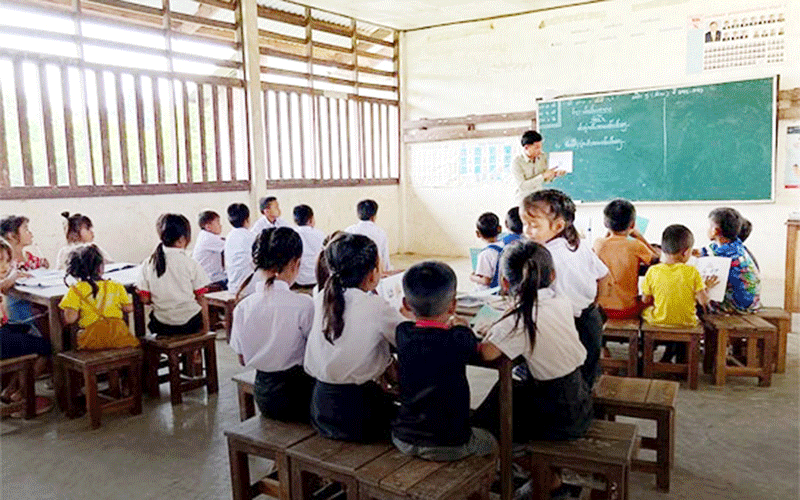 |
| Children attend a lesson at a primary school in Laos. --Photo BEQUAL |
These measures point to an important reality – children do not always leave school because they do not want to learn. Sometimes, the circumstances surrounding them make continuing education difficult.
A family struggling to earn enough money for food may need its children to work. A student living in a remote village may face long distances to school. A school without adequate facilities may offer fewer opportunities than one in an urban area.
Addressing the problem of dropouts, therefore, requires more than simply telling students to stay in school. It requires tackling the economic, social and educational barriers that push them away.
Learning skills for a changing world
The response is also reaching beyond traditional academic education. Vocational education has introduced combined general and vocational training in nine occupational fields, including computer repair, electricity, cooking and tailoring.
The programmes are being offered at ethnic boarding schools and other schools, with 1,762 students taking part.
This approach can prove increasingly important as young people prepare for a labour market that demands practical skills and academic knowledge.
For students who may not follow a conventional academic pathway, vocational education can provide another route towards employment, income and greater independence.
The higher education sector has implemented policies to enable students from poor and remote areas to pursue higher education by providing 1,500 scholarships for the 2025-2026 and 2026-2027 academic years.
Thousands of students are currently studying at four major state universities – the National University of Laos, Souphanouvong University, Savannakhet University, and Champasak University.
The numbers show that opportunities for further study remain important, but the ministry recognises that simply increasing enrolment is not enough. Education must remain relevant to the needs of society and the economy.
The teacher at the heart of reform
If students are the heart of education, teachers are its heartbeat.
A child may have a modern classroom, books and equipment, but without a capable and motivated teacher, those resources cannot reach their full potential.
The ministry, therefore, plans to improve teacher quality and reform the teacher training system. One major step is the consolidation of teacher training colleges into a national university of teacher education, creating a more unified approach to preparing teachers.
The challenge is not simply to have enough teachers. Schools need teachers who are properly trained, professionally supported and able to respond to the changing needs of students.
Continuous professional development is therefore crucial. However, this remains one of the areas where progress has not yet reached the desired level.
Five targets still need attention
Despite encouraging results, the ministry acknowledges that the journey is far from complete.
Of nine targets endorsed by the National Assembly, four have seen good progress, while five have not yet been achieved.
Economic difficulties remain one of the biggest obstacles. Some students and teachers have had to leave education or teaching to seek employment and support their families.
These challenges show that education reform cannot be separated from broader economic and social conditions.
Reforming the system itself
The ministry is, therefore, pursuing reforms at a structural level. The general education system has been changed from the previous 5+4+3 structure to a 6+3+3 system.
Higher education is also being reshaped, with new programmes reflecting modern trends and the country’s development needs, while courses with low demand or limited relevance are reviewed or discontinued.
Universities are being encouraged to expand evening, weekend, online and blended learning programmes so that working people can continue their education without having to leave jobs.
Perhaps the most important part of the reform is that it recognises education as a continuing process, rather than a one-time project.
Laos has made progress, and for 2026, the focus is clear – reduce school dropouts and improve teacher quality.
By Khonsavanh Latsaphao
(Latest Update October 12, 2026)
|

