 |
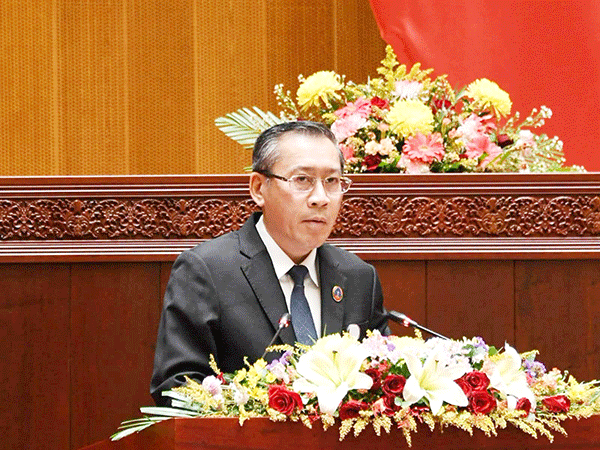
| Minister of Labour and Social Welfare Mr Phosay Sayasone delivers a report at the National Assembly. |
Govt moves to tackle labour shortage as workers flock to jobs abroad
The government is stepping up efforts to address the chronic shortage of labour as businesses struggle to recruit workers, with thousands preferring overseas jobs for better wages and living conditions.
Minister of Labour and Social Welfare, Mr Phosay Sayasone, told the National Assembly the government was working with employers to improve working conditions and job placement services, and encourage more people to take up employment locally.
According to his report, during the first nine months of this year, 76,604 Lao nationals registered as job seekers, of whom 5,259 or just 6.8 percent wanted jobs in Laos, while 71,345 were looking for work in other countries.
Over the same period, 119,382 people were placed in jobs, but only 15,772 found employment in Laos, while 103,610 took jobs outside the country.
The figures highlight the challenge facing local employers, including factories and industrial estates, as people continue to seek opportunities abroad, especially in Thailand and the Republic of Korea.
National Assembly members raised concerns about the number of Lao workers leaving the country, citing high living costs in Laos, the weakening kip, and wages that do not match workers’ expenses.
The minimum wage has also become a key issue as workers struggle with rising living costs. The government last raised the minimum monthly wage to 2.5 million kip in October 2024.
In practice, monthly salaries for private-sector workers in Laos often start at around 3.5 million kip and can reach 4.5 million kip, although actual pay varies by employer and job.
In response, the Ministry of Labour and Social Welfare has urged employers to improve working conditions, job contracts and employee welfare to make jobs in Laos more appealing and encourage workers to remain in the country.
The ministry has also established a working group to coordinate with government agencies, industrial estate operators, and the Lao National Chamber of Commerce and Industry to assess labour needs and formulate measures to address shortages.
Businesses have been asked to provide information about their workforce requirements so the ministry and its partners can better match available workers with vacancies.
The ministry has visited businesses in special economic zones in Vientiane and in Champasak, Khammuan and Savannakhet provinces to encourage employers to advertise vacancies through the online job placement system.
It is also upgrading job placement service points and developing a mobile app and Facebook page to help job seekers find vacancies and businesses recruit workers.
Job fairs are planned for Khammuan, Champasak, Savannakhet and Oudomxay provinces, as well as in Vientiane, at the end of November or in December this year.
The ministry’s figures show that overseas employment is a major attraction for Lao workers. From 2016 to 2026, 708,751 Lao workers took up jobs in other countries, of whom 672,936 went to Thailand, 32,089 to the Republic of Korea, and 3,257 to Japan.
The government is also encouraging vocational training and self-employment, particularly for disadvantaged people and those living in rural areas.
In the first nine months of 2026, 126,392 people received skills training, upgrading or assessment, accounting for 97.22 percent of the full-year target of 130,000 people.
Training covers modern farming methods, mushroom cultivation, cattle raising, weaving and agricultural product processing, alongside marketing, entrepreneurship and business planning.
From 2027 to 2030, the ministry plans to support 750 people through rural employment and self-employment programmes, providing equipment to help 323 people set up their own jobs.
The ministry said labour shortages had led to the hiring of foreign workers, including cases in which employers failed to follow the law. It has temporarily suspended the hiring of workers of certain nationalities, although it did not identify those affected.
The challenge is to help Lao businesses secure the workers they need while creating jobs and working conditions that encourage more people to build their livelihoods in their home country.
By Phonepaseuth Volakhoun
(Latest Update October 13, 2026)
|

