 |
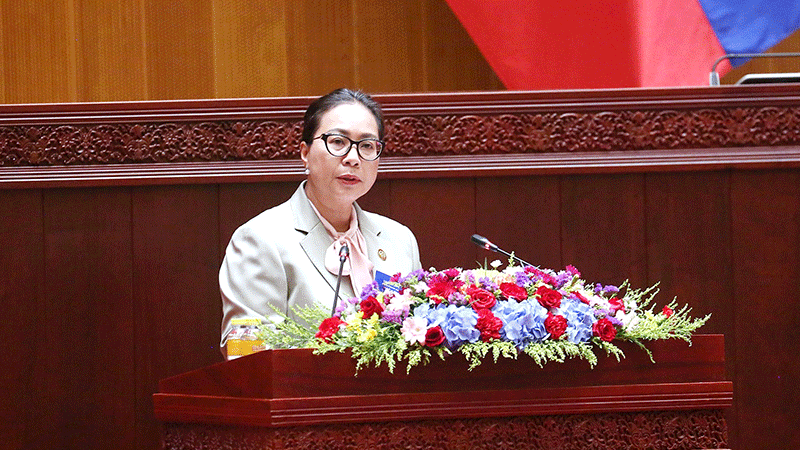
| BOL Governor Mrs Bounkham Vorachit outlines a draft Law on Deposit Protection at the National Assembly on Monday. --Photo Sangkhomxay |
Central bank plans stronger deposit protection, banking safeguards
The Bank of the Lao PDR (BOL) has proposed a new Law on Deposit Protection to raise the minimum protection limit, introduce risk-based insurance premiums, and allow the deposit protection fund to help resolve troubled financial institutions.
The legislation aims to strengthen public confidence in the banking system, safeguard depositors’ interests and improve the country’s financial safety net.
BOL Governor Mrs Bounkham Vorachit presented the proposal to the ongoing National Assembly session on Monday, highlighting the reasons for drafting the law and its key provisions.
Under the draft law, the deposit protection limit would be set at no less than three times gross domestic product (GDP) per capita, with coverage extending to at least 90 percent of all protected depositors.
The current maximum protection limit is 100 million kip per depositor per member institution, covering about 94 percent of protected depositors. However, the BOL said the limit was relatively low compared with regional and international standards, prompting calls for greater protection in line with actual deposit balances.
Another major reform would allow the Deposit Protection Office to expand beyond its existing role of reimbursing protected deposits when member institutions fail.
Under the proposed “Paybox Plus” approach, the office could use the fund to help resolve troubled financial institutions, including through lending to distressed members and supporting mergers, subject to the BOL’s mandate and applicable procedures.
The draft also proposes risk-based insurance premiums. Instead of charging all members the current uniform annual rate of 0.1 percent of average protected deposits, the office could set different rates according to each institution’s risk profile, capped at 1 percent.
The BOL said this would encourage stronger internal management, improve risk control and reduce the likelihood of institutional failure.
Legal protection would also be provided for current and former office personnel who perform their duties in good faith and in accordance with the law. However, officials would remain accountable for misconduct or unlawful actions.
The legislation would require commercial banks and deposit-taking microfinance institutions to join the Deposit Protection Office as members, while allowing membership to expand to other deposit-taking financial institutions established under relevant laws.
The BOL said the existing framework, governed by the Decree on Deposit Protection issued in 2017, had revealed shortcomings in risk management, coordination and the handling of failing institutions.
The decree also lacks detailed provisions on information sharing, contingency planning and simulations of deposit repayments during institutional failures.
The Deposit Protection Office was established in 1999 as a state-owned, non-profit enterprise following regional financial turmoil in the late 1990s. Under the 2017 decree, it became a state financial organisation equivalent to a department, with financial independence under the BOL’s management.
It currently has 41 members, comprising 35 commercial banks and six deposit-taking microfinance institutions.
The proposed law would require payments of protected deposits to begin within 14 days of the office receiving notification from the BOL. Funds remaining unclaimed for 10 years after depositors are notified to submit claims would be transferred to the deposit protection fund.
Comprising eight parts and 66 articles, the draft covers deposit protection, membership, the Deposit Protection Office’s organisation and operation, prohibitions, management and inspection, and final provisions.
Drafting of the law began in May 2024, involving a committee representing the BOL, the Deposit Protection Office, the National Assembly and relevant government agencies. Consultations were held with ministries, commercial banks, deposit-taking microfinance institutions and National Assembly representatives.
The draft also underwent legal review by the Ministry of Justice, discussions with the Prime Minister’s Office and examination by relevant National Assembly committees.
If approved and promulgated, the law is expected to support the 10th National Socio-Economic Development Plan and the five-year financial and monetary institution system development plan for 2026–2030.
The government aims to increase deposits in the financial system to more than 90 percent of GDP during this period.
The BOL said stronger deposit protection would build public confidence, reduce the risk of bank runs, improve access to financial services, and strengthen coordination among financial authorities in preventing and resolving financial crises.
The central bank has asked National Assembly members to provide further comments to improve the draft law’s completeness, effectiveness and practical implementation.
By Times Reporters
(Latest Update October 20, 2026)
|

