 |
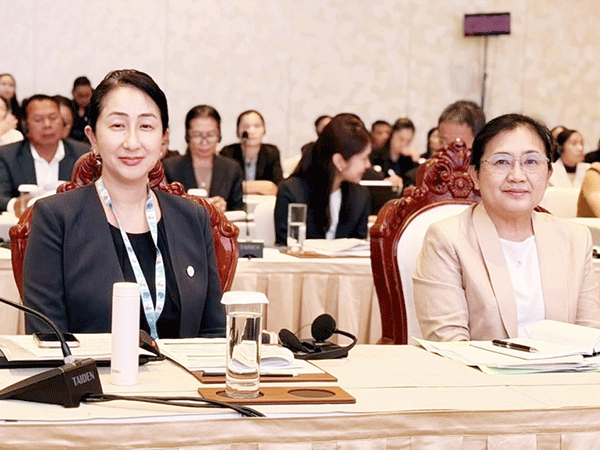
| Deputy Minister of Education and Sports Dr Daravone Kittiphanh (right) and JICA Laos Office Chief Representative, Ms Kobayashi Miyako. |
Education ministry, JICA project improves maths learning outcomes in Lao primary schools
Students in schools participating in a JICA-supported project performed better in mathematics than those in non-project schools.
Notably, Teacher Training College (TTC) demonstration schools, where School Based Continuous Professional Development (SB-CPD) was implemented alongside ICT and TTC support, recorded a remarkable 16.43 percentage point increase in mathematics scores, approximately 6.4 times the improvement observed in non-pilot schools, based on the endline evaluation.
Building on this achievement, Laos is preparing to embark on a new phase of cooperation to improve teaching quality and learning outcomes.
The findings were presented at the final Joint Coordinating Committee meeting of the Project for Strengthening Teacher Capacity to Improve Primary Mathematics Lessons (iTEAM2), held in Vientiane on October 22.
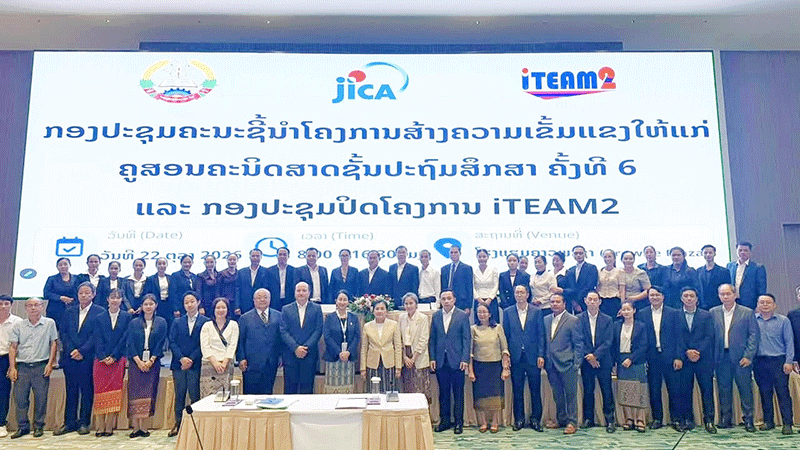 |
| Government officials and representatives of JICA on Tuesday gather for a meeting in Vientiane to mark the completion of three years of collaboration. |
The meeting marked the completion of three years of collaboration by the Ministry of Education and Sports and the Japan International Cooperation Agency (JICA). It was co-chaired by Deputy Minister of Education and Sports Dr Daravone Kittiphanh and JICA Laos Office Chief Representative, Ms Kobayashi Miyako.
Officials from the ministry, provincial and district education authorities, teacher training colleges, schools and development partners attended to review the results and discuss how to sustain and expand the project’s achievements.
Since 2023, iTEAM2 has strengthened teachers’ capacity through school-based continuous professional development (CPD), including classroom observations, lesson discussions, and the development of teaching materials.
The evaluation found improvements in teachers’ mathematics knowledge and increased use of active learning approaches in classrooms. Regular school-based CPD was identified as one of the factors contributing to the positive learning outcomes.
The project builds on iTEAM1, which supported the revision of primary mathematics textbooks and teachers’ guides and their use nationwide. Together, the two projects have combined learning materials, teacher development and more active classroom practices to improve mathematics education.
Another achievement has been the development of CPD resources, including digital learning materials and model lesson videos available through the Kang Panya Lao online platform.
The materials have been officially approved and are being used in school-based teacher development activities, allowing teachers to continue accessing them after the project ends.
iTEAM2 has also strengthened teacher training colleges and established support mechanisms to help teachers share experiences and improve their classroom practices.
Demonstration schools attached to four target colleges — Luang Prabang, Dongkhamxang, Savannakhet and Pakse — have received digital equipment to support more interactive lessons and help students develop digital skills.
In collaboration with UNICEF, the project also introduced Eduten, a digital mathematics learning platform designed to support active learning and mathematics practice. The initiative reflects wider cooperation between JICA and UNICEF in supporting education in Laos.
At the meeting, Ms Kobayashi stressed the importance of sustaining and expanding the project’s achievements beyond its completion.
She said JICA’s ultimate goal was to help every Lao child learn better and achieve their full potential, and highlighted the agency’s continued cooperation with the Ministry of Education and Sports to improve the quality of education in Laos.
The ministry and JICA announced that iTEAM3 would be launched as the next phase of cooperation.
The project is expected to build on iTEAM2’s results and support the transition to the 6-3-3 education system through textbook revision, teacher training, stronger implementation of school-based continuous professional development, and the expansion of successful practices to more schools and districts.
By Times Reporters
(Latest Update October 23, 2026)
|

