 |
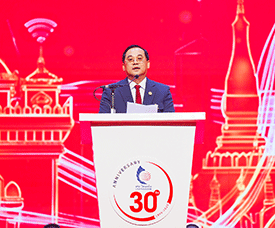
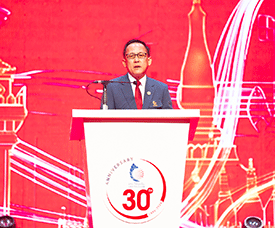
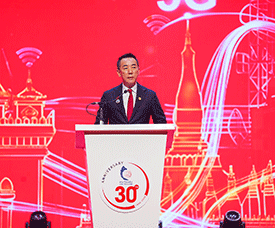
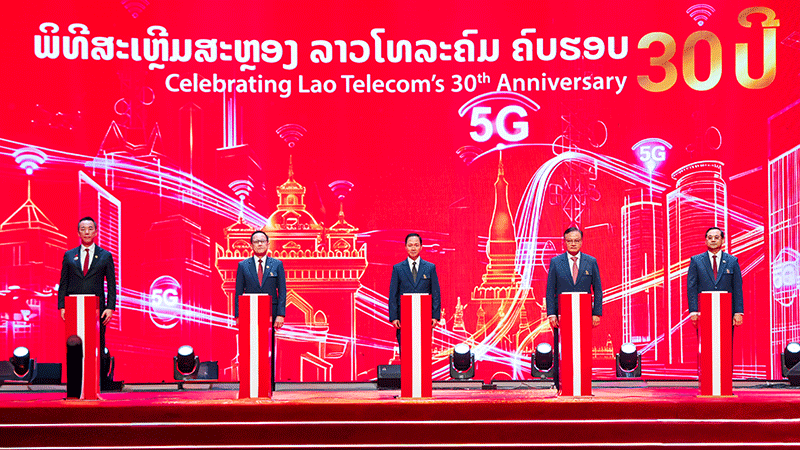
Senior government officials and other guests attend a ceremony in Vientiane to mark the 30th anniversary of Lao Telecommunications Public Company on November 11. --Photo Lao Telecom
|
Lao Telecom marks 30 years of growth, expands network nationwide
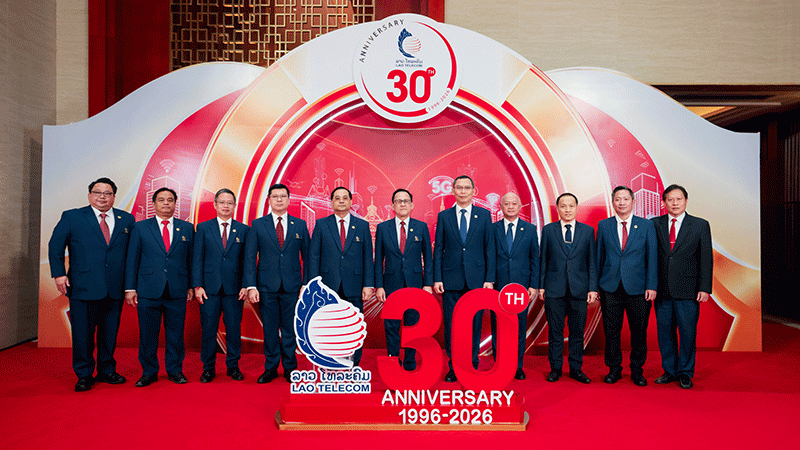
Lao Telecommunications Public Company (Lao Telecom) has celebrated 30 years of operations, highlighting its role in developing the country's telecommunications infrastructure, supporting economic growth and expanding digital connectivity.
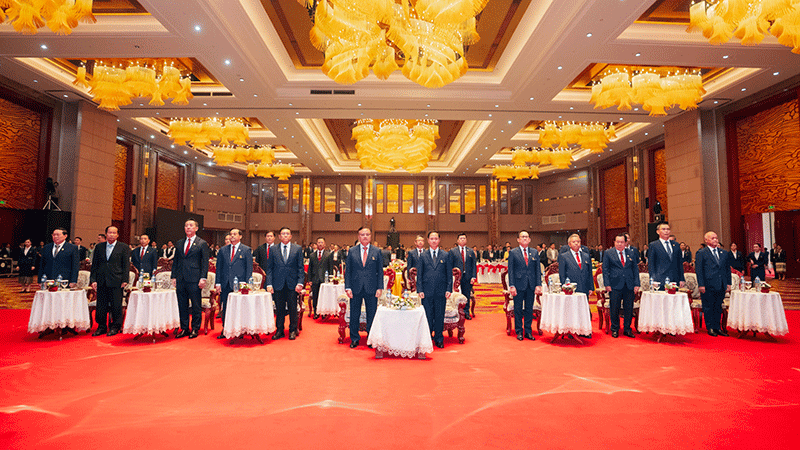
An anniversary ceremony was held in Vientiane on November 11, bringing together senior government officials, foreign shareholders, company executives, staff and other invited guests.
Attendees included Politburo member and Deputy Prime Minister General Khamlieng Outhakaisone, also Minister of National Defence and Chairman of the National Internet Management Committee, and Deputy Prime Minister and Minister of Finance Mr Santiphab Phomvihane, Chairman of Lao Telecom's Shareholders' Council.
More than 550 people attended the ceremony, including ministers and deputy ministers, while provincial branches held simultaneous celebrations, attracting more than 2,000 participants.
Established on November 11, 1996, Lao Telecom was formed as a joint venture between the Lao government, which holds 51 percent of shares, and Singapore-based Shenington Investment, which holds the remaining 49 percent. Its establishment reflected the government's policy to promote foreign investment and develop the telecommunications sector.
Speaking at the ceremony, Lao Telecom’s Director General Mr Souphol Chanthavixay said the anniversary was an opportunity to review the company's achievements and business performance over the past three decades.
He said the company's Party Committee and management had steered its development through numerous challenges, steadily expanding operations and modernising telecommunications infrastructure in line with global technological advances.
Over the past 30 years, Lao Telecom has expanded its customer base and network, serving more than three million mobile broadband (MBB) customers, including prepaid subscribers, and reporting more than 20.5 million fixed broadband (FBB) customers.
Its mobile network now covers 83 percent of the population, meeting the coverage target set in the government's socio-economic development plan and the Ministry of Technology and Communications' development objectives.
 |
|
The company operates around 13,300 base stations, including more than 2,030 2G, 3,620 3G, 6,688 4G, 906 4.5G and 56 5G stations. It also has more than 224,440 fibre-to-the-home (FTTH) ports.
Its optical fibre transmission network spans more than 37,945 kilometres, including a 6,539-kilometre dense wavelength division multiplexing (DWDM) backbone with a capacity of 200Gbps.
Financially, the company has generated more than 29,166 billion kip in revenue, excluding taxes, and accumulated profits of over 6,570 billion kip, with average annual growth exceeding 27.22 percent.
It has contributed more than 5,984 billion kip in financial obligations to the government and paid US$409 million in dividends to the government and shareholders.
Beyond its commercial activities, Lao Telecom has provided more than 194 billion kip in social assistance over the past three decades, including cash contributions exceeding 78.36 billion kip. These supported education, mass organisations, and festivals, with each receiving 6.69 billion kip, 46.03 billion kip and 25.64 billion kip respectively.
The company also contributed more than 79.8 billion kip in equipment and telecommunications services to national efforts to respond to the COVID-19 pandemic.
 |
|
It provided internet services and equipment worth more than 10 billion kip for the 44th and 45th ASEAN Summits hosted by Laos, as well as 11.9 billion kip in equipment and connectivity for distance learning and remote meetings organised by Party and State agencies.
It also supported government flood-response efforts with internet services and equipment worth more than 7.3 billion kip. Social assistance contributions for 2026 are expected to exceed 6.54 billion kip.
Alongside its business operations, the company has continued to improve its regulations and staff welfare policies to raise employees' living standards and improve working conditions.
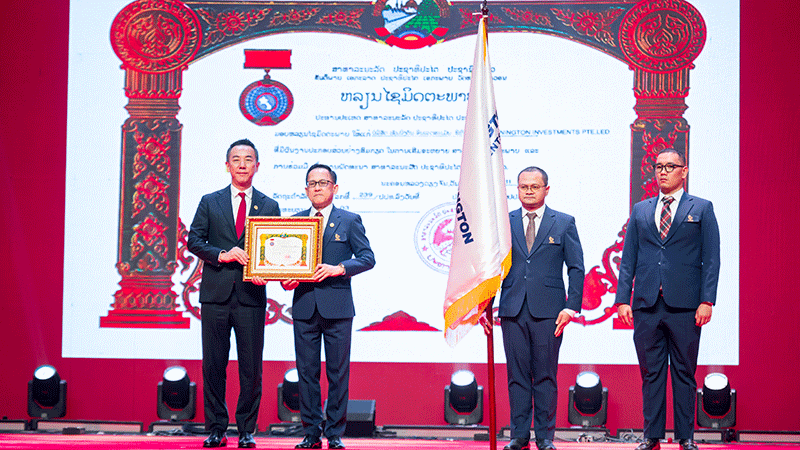
In recognition of their contributions to national development, the government awarded a Medal of Friendship to Shenington Investment and Dr Piyawat Jriyasetapong, Chairman of the Foreign Shareholders' Committee, for their contributions to the joint venture with Lao Telecom.
The company has also received numerous national, regional and international awards in recognition of its telecommunications development and service delivery.
These include First, Second and Third Class Labour Medals, an Outstanding Entrepreneur Award, an Outstanding Leading Business Award during the COVID-19 pandemic, and international recognition for broadband, mobile and digital services.
Other honours include the Outstanding Mobile Operator award at the Asian Telecom Awards, the 9th ASEAN Entrepreneur Award 2024 at the 25th World Knowledge Forum in Incheon, Republic of Korea, the Stevie Awards for Technology Excellence in New York, and recognition for outstanding telecommunications infrastructure development at the ASEAN Business Awards 2024 in Vientiane. In 2025, the company also received an outstanding ASEAN-level award from the International Telecommunication Union (ITU).
Speaking at the anniversary ceremony, Minister of Technology and Communications and Chairman of Lao Telecom's Board of Directors Dr Santisouk Simmalavong congratulated the company on its achievements and contributions to society, noting the continued expansion and improvement of telecommunications infrastructure nationwide.
He said the company must prepare for future challenges by strengthening its capabilities and working to become one of Laos' leading full-service telecommunications and communications providers.
Dr Santisouk called on the company's Party Committee, Board of Directors, management and staff to implement development plans in line with the government's modernisation policy and the demands of the digital era.
He stressed the need to improve service quality and invest in human resources, particularly technical staff, to build a skilled and professional workforce capable of keeping pace with rapidly evolving technologies.
He urged all employees to strengthen their awareness and sense of responsibility, enabling Lao Telecom to meet the demands of the Economy 4.0 era, contribute to national development, and strengthen Laos' connections with the region and the wider world.
By Advertorial Desk
(Latest Update November 12, 2026)
|