How ASEAN+3 media networks and
infrastructure links are reshaping Laos’ future
In an era defined by rapid digital transformation and complex global economic shifts, regional cooperation relies as much on shared narratives as it does on physical infrastructure. That synergy took centre stage at the 12th ASEAN Plus Three Media Cooperation Forum held last week in Fuzhou, Fujian province, China.
Bringing together over 120 media leaders and representatives from 47 outlets across 16 countries and international organisations, the forum took the theme “Openness and Cooperation for Shared Development”.
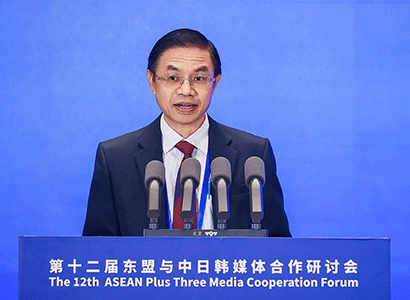 |
Editor-in-Chief of the Pasaxon newspaper, Mr Syvanh Homsayadeth, gives a speech at the 12th ASEAN Plus Three Media Cooperation Forum in China. --Photo People’s Daily |
But beneath the official agenda lies a practical reality for landlocked nations like Laos: building resilient regional bridges requires paired efforts both on the digital screen and on the ground.
For decades, Laos operated under the physical constraint of being Southeast Asia’s only landlocked country. Changing that narrative from “landlocked” to “land-linked” has been a foundational goal of the Lao government, a vision aimed at unlocking trade routes, enhancing logistics, and deepening cultural exchanges.
Addressing international delegates at the forum, Editor-in-Chief of Laos’ Pasaxon newspaper, Mr Syvanh Homsayadeth, highlighted how strategic partnerships have turned this national aspiration into real-world results.
“Since the President of China, Xi Jinping, proposed the Belt and Road Initiative in 2013, within the family of partners jointly building the Belt and Road Initiative—whether large or small economies—all partner countries stand equal in terms of policy and mutual benefits,” Mr Syvanh stated during his address.
“The various cooperative projects implemented are completely free of political conditions; rather, they are guided by the principles of extensive consultation, joint contribution, and shared benefits. This aims to establish a comprehensive, highly efficient, effective, and safe transportation system across water, air, land, and rail—raising connectivity to a new height, facilitating greater investment and trade, creating a free trade network, and strengthening economic cooperation to foster mutual political trust and cultural exchange.”
He observed that turning Laos into a land-linked nation directly responds to the country’s fundamental prosperity needs. “To respond to the development needs for Laos’ prosperity, the two nations of Laos and China have jointly promoted infrastructure cooperation,” he said.
“Notably, the Laos-China Railway and the Vientiane-Vangvieng Expressway were built and officially opened for use at the end of 2020. These projects have significantly facilitated travel and cargo transport via the Laos-China Railway, creating job opportunities, enabling fast and convenient logistics, and increasingly strengthening people-to-people ties and tourism exchanges between Laos, China and the rest of the world.”
While physical rails connect supply chains, digital networks shape public consensus and shared understanding. A primary focus of this year’s ASEAN Plus Three Media Cooperation Forum was adaptationto technological advances, specifically how Artificial Intelligence and digital tools are altering news gathering, media operations, and cross-border story sharing.
Forum participants agreed that while artificial intelligence and digital technology make work more efficient, technological advancement must remain fundamentally people-centred.
The consensus reached in Fuzhou highlights media priorities under the ASEAN+3 framework: leveraging AI tools responsibly while maintaining news reliability, transparency, and public trust; moving beyond single-country news cycles to highlight win-win regional cooperation, sustainable trade development, and community impact; and creating reliable media networks to share verified economic, trade and cultural updates directly between ASEAN, China, Japan and the Republic of Korea.
In this context, media collaboration serves as an indispensable counterpart to physical trade networks. As Mr Syvanh said, “This forum serves as a valuable opportunity to build networks across sectors and among countries collaborating with the People’s Republic of China, promoting mutual understanding and regular information exchange.”
“All of this aims to ensure national interests and build even more successful relations between Laos and China in all fields of work,” he added.
The takeaways from Fuzhou demonstrate that regional cooperation operates as a two-way street. Modern infrastructure provides the hardware—railways, roads, and logistics hubs—while media institutions provide the software of transparency, cultural exchange, and mutual understanding.
As Laos continues its growth trajectory as a regional land-link, the commitment among ASEAN+3 media outlets to foster open, pragmatic dialogue ensures that local voices, economic progress, and people-to-people connections remain squarely at the centre of the story.
By Keoxomphou Sakdavong
(Latest Update Novembber 13, 2026)
|

