 |
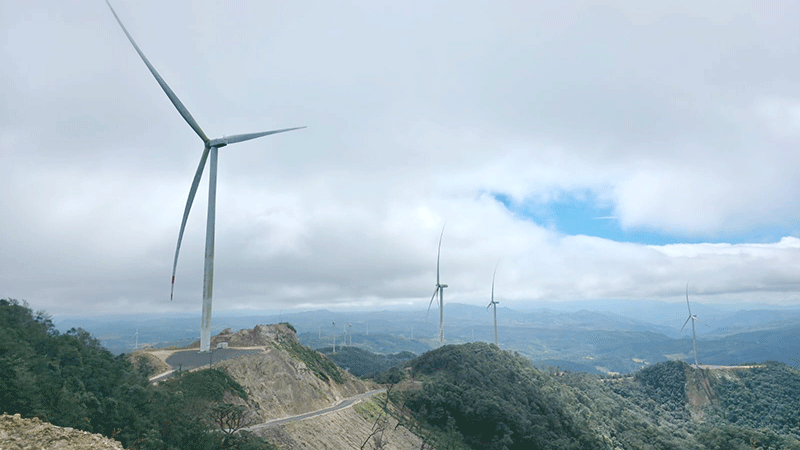
Turbines at the Monsoon Wind Power Project in southern Laos generate renewable electricity for transmission to Vietnam.
|
Laos eyes 8,260MW in electricity transmission to Vietnam
Laos is making progress in 47 electricity projects with a combined capacity of 8,260 megawatts (MW) for transmission to Vietnam, while working to increase the year-round reliability of power supplies.
Director General of the Department of Enterprise Management under the Ministry of Industry and Commerce, Mr Aphisid Sengsourivong, outlined the plans during a meeting with Lao and international journalists organised by the Asian Development Bank as part of a visit to the Monsoon Wind Power Project.
Mr Aphisid said 13 of the plants, with an installed capacity of 2,763MW, were already operational. The remaining 34 plants with a combined installed capacity of 5,497MW, have yet to begin commercial operations but are expected to be completed before 2030.
All 47 projects have signed concession agreements with the Lao government, received Vietnamese approval for electricity imports and secured power purchase agreements, according to the ministry.
A further 16 proposed projects, with a combined capacity of about 10,618MW, are undergoing feasibility studies. Whether they move forward will depend on investment, technical studies and agreements with electricity purchasers.
The scale of the plans reflects Vietnam’s growing demand for imported power. Vietnam Electricity said the two governments agreed in January 2025 on a minimum import target of 8,000MW from Laos by 2030, compared with an earlier target of 5,000MW.
According to the Tuoi Tre News, Vietnam imported 2.92 billion kilowatt-hours from Laos in the first quarter of 2026, nearly 120 percent more than a year earlier.
But building power plants is only part of the challenge. Laos must also ensure that transmission lines can transmit electricity across the border at times when buyers need it.
Mr Aphisid said the government was assessing grid capacity, seeking faster project approvals, and negotiating transmission connection points and electricity prices.
Wind power offers another way to strengthen exports. The ministry said hydropower has historically accounted for 80-90 percent of Laos’ electricity exports, leaving generation vulnerable to reduced water availability in the dry season.
The 600MW Monsoon Wind Power Project, spanning Dakcheung district in Xekong province and Sanxay district in Attapeu province, shows how that pattern could change.
Laos’ first wind farm began commercial operations on August 22, 2025. Its 133 turbines supply electricity to Vietnam under a 25-year power purchase agreement with Vietnam Electricity. The Asian Development Bank arranged a US$692.55 million financing package for the project.
Mr Aphisid said the project might not have proceeded without demand from across the border. Referring to Vietnam’s willingness to purchase the electricity, he said the “Vietnam market is opening up”.
He also acknowledged the difficulties of building Laos’ first wind farm, noting that Laos previously lacked detailed rules for assessing such projects, complicating preparations and negotiations.
“We don’t have really specific regulations or procedures,” he said.
This experience is helping the government consider how to assess future wind developments. Other projects under study include schemes linked to Truong Son, Savan and Xekong, while Vietnamese investors are pursuing additional projects such as the proposed 495MW Savan 2 wind farm in Savannakhet province.
For communities near the Monsoon Wind Power Project, the benefits are not limited to electricity transmitted to other countries. Mr Aphisid said the wind farm employed around 300 people, about 70 percent of them Lao nationals, and that developers were being encouraged to train workers for technical and management jobs.
The project also paid more than US$600,000 in royalties during its initial operating period in 2025, according to figures he provided at the meeting.
As Laos develops more wind and solar capacity alongside hydropower, the test will be whether projects can be completed, connected to the grid and turned into lasting benefits for Laos and its people.
By Phonepaseuth Volakhoun
(Latest Update November 13, 2026)
|

