 |
Head of the Attapeu provincial Department of Agriculture and Environment, Mr Kongchai Sidavong. --Photo Attapeu News
|
22 companies violate land concessions in Attapeu
Attapeu authorities have uncovered widespread violations of land concessions, with 22 of the 24 companies inspected in Sanamxay district found to have breached their agreements, including using land beyond approved boundaries and failing to meet environmental requirements.
The findings were reported by the Head of the provincial Department of Agriculture and Environment, Mr Kongchai Sidavong, during a meeting of the Attapeu Provincial People’s Council on November 24, in response to questions about state land concessions, forestry protection, and timber management.
Central and provincial authorities have approved 235 state land leases and concessions covering over 84,600 hectares, or 8.2 percent of the province’s total area. Of these, agreements have been signed in 121 cases, while 114 approvals are in the preliminary stages, with 78 at the Project Development Agreement stage, and Memorandums of Understanding (MoU) having been signed in 36 cases, according to the Attapeu News.
Inspections of four centrally approved companies carried out in 2024 and 2025 found that three concessions had been breached, with land clearance extending 6,383.65 hectares beyond permitted areas. One project had been sold and its ownership transferred, while another had failed to comply with environmental assessment requirements.
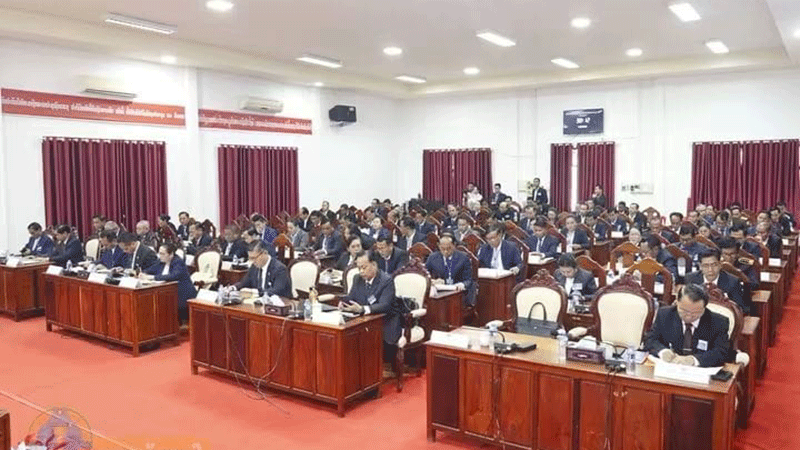 |
A meeting of the Attapeu Provincial People’s Council on November 24.
|
In 2026, inspections of the operations of 24 companies in Sanamxay district found that 22 had occupied more than 144 hectares beyond the permitted area, and all 22 had failed to comply with environmental assessments.
Four companies were operating projects that were still at the MoU stage, while two individuals had started projects before obtaining the necessary investment approvals.
In response, the Department of Agriculture and Environment will accelerate inspections of all projects and update their records in the Land and Concession Information System.
It will also tighten investor selection, reject proxy companies, and require Environmental and Social Impact Assessments to be completed and approval obtained for compensation awarded to affected communities before any project activities get underway.
A digital system for the collection of concession revenues will be set up, as well as public complaint channels.
With regard to forest protection, 298 violations were recorded, including 278 cases of forest encroachment involving 389 households and nearly 3,740 hectares of land.
The other 20 cases involved illegal logging and timber transportation and trading, resulting in the seizure of over 2,248 cubic metres of timber, 21 vehicles and 72 chainsaws.
Authorities have handled 10 cases through education and training, referred three to the courts, with one verdict already decided, and imposed fines totalling nearly 3.4 billion kip in seven cases. In addition, a timber processing factory was given a suspension notice.
In 2026, the government authorised 16 timber harvesting projects in forest restoration areas, with an approved volume of over 20,900 cubic metres. So far, about 13,370 cubic metres have been harvested, of which over 12,000 cubic metres have been measured and transferred to state ownership.
Meanwhile, surveys along the 115kV transmission line corridor between Maknao village in Sanamxay district and the 500kV substation in Phouvong district identified 1,227 cubic metres of timber planted across nearly 65 hectares. Harvesting has been delayed by the rainy season and procedural issues, with authorities preparing to resume work.
The department has also issued environmental certificates to 97 projects. Inspections of 81 projects found four had failed to comply with environmental management plans and were temporarily suspended. Two cassava starch processing plants have since addressed wastewater and odour problems and resumed operations.
Mr Kongchai said the department would strengthen public awareness of legislation, accelerate land allocation and recognition of land-use rights across the three forest categories, and step up inspections and law enforcement to ensure the sustainable and lawful use of land and forest resources.
By Souksamai Boulom
(Latest Update November 26, 2026)
|

