 |
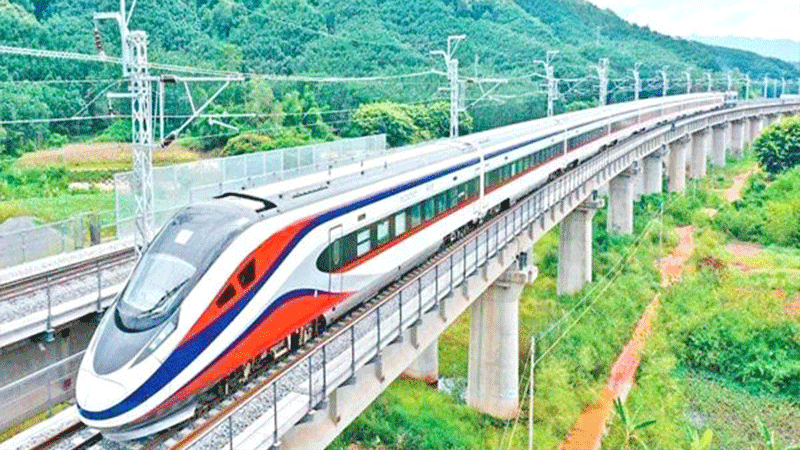
| The Laos-China Railway, a symbol of closer Laos-China relations. |
Laos-China: the high-speed brotherhood forging a shared future of triumph
As the Lao People’s Democratic Republic marks National Day on December 2, the air is thick with the excitement of progress and the affirmation of a nation confidently surging forward.
For nearly five decades since achieving independence in 1975, Laos has championed a path of peace and prosperity. A constant, vital, and powerful companion on this transformative journey has been its trusted neighbour, China.
This isn’t just diplomacy, it’s an unbreakable, formalised bond, celebrated as a “long-term stable and comprehensive strategic partnership”.
Guided by an ambitious, shared vision to build a “Laos-China community with a shared future”, this powerful alliance is dramatically remaking the Lao landscape, helping the nation triumphantly shed its identity as a landlocked country and rise as a pioneering, high-speed land-link hub for the entire Southeast Asian region.
The special bond: A handshake guiding greatness
The strategic depth of the Laos-China relationship is consistently reinforced by the close personal rapport between the leaders of the two Parties and States. This profound, high-level trust has been the unstoppable force, personally inspiring and driving forward the major bilateral projects that are reshaping Laos.
The leaders of the Lao People’s Revolutionary Party and the Communist Party of China share frequent, warm dialogues and exchanges, personally overseeing the dynamic implementation of the “Shared Future” action plan. This direct, top-level engagement is the political engine ensuring that monumental projects, especially those under the Belt and Road Initiative (BRI), are delivered with speed and precision, perfectly aligned with Laos’ bold national development goals.
Rooted in shared principles and a history of mutual support, this relationship transcends mere economics. The reciprocal visits and constant consultations solidify a deep political consensus, creating a supremely stable and predictable environment for vast, multi-decade investments. This special leadership consensus is the bedrock of a robust and forward-looking strategic partnership, ensuring that friendship is truly built to last.
The golden corridor: landlocked no more
The most dazzling proof of this triumphant partnership is the shimmering line of steel that is the Laos-China Railway. This flagship project of the BRI didn’t just lay tracks, it fundamentally re-engineered the destiny of Laos.
The railway now connects Vientiane directly with Kunming in China. Crucially, it creates a seamless logistics chain by linking up with the railway to Thailand at the Thanaleng Dry Port, plugging Southeast Asia directly into the vast China-Europe rail network. This is more than a corridor; it’s a formidable, high-speed artery of prosperity.
A bumper harvest for Lao farmers: freshness wins
The Laos-China Railway has acted as a powerful, tireless engine for agriculture, delivering a major victory against Laos’ long-standing logistics challenges.
The high-speed connection ensures that highly perishable goods, particularly tropical fruits like bananas, watermelons, and mangoes, arrive in vast Chinese cities like Kunming and Guangzhou while still burstingly fresh, dramatically increasing their market value and reducing waste.
The railway is now the primary, most efficient route. Recently, a container train carrying 1,000 tonnes of cassava starch departed from Vientiane South Station, arriving in Central China in just 80 hours—a powerful demonstration of the speed and scale now possible.
The Laos-China Railway Co., Ltd. reports a monumental achievement: since opening, the railway has handled more than 16 million tons of freight, including over 1.7 million tons of agricultural products exported to China. Lower transport costs coupled with higher prices for fresher products mean a genuine, tangible improvement in the livelihoods and prosperity of rural farmers.
Powering the future: lighting up the nation and the region
The Laos-China Railway is not the only physical link; an equally ambitious connection is lighting up the energy sector, solidifying Laos’ status as the “battery of Southeast Asia”.
While Laos has always relied on hydropower, cooperation with Chinese firms is pivotal in helping the nation diversify its energy mix and build an even more resilient, future-proof grid.
Chinese investment is crucial in developing Laos’ solar and wind power capacity. New projects are increasing the share of non-hydro renewables, bolstering the nation’s energy security and environmental commitment.
A landmark project is the China-Laos 500kV Interconnection Project. Set to be completed and operational by 2026, this project physically links the two nations’ power grids, enabling a phenomenal two-way electricity exchange capacity of 1.5 million kilowatts. This stability and capacity will allow Laos to truly shine as a regional clean energy interconnection hub.
The human heart of the “shared future”: people connecting
The true, vibrant foundation of this partnership lies in people-to-people links—a growing, shared relationship of mutual learning and understanding. This cooperation spans education, media, and culture, weaving the two societies closer together in a beautiful tapestry of friendship.
Initiatives like the Confucius Institute actively promote Chinese language and cultural exchange, offering scholarships and study systems that invest directly in the youth of Laos.
The Laos-China Railway has become the main choice of travel, rapidly increasing the flow of tourists, students, and businesspeople. The railway has driven an exponential boom in leisure travel, creating a bridge of personal experience and shared economic prosperity that runs right through the heart of the country.
By Keoxomphou Sakdavong
(Latest Update December 3, 2025)
|

