 |
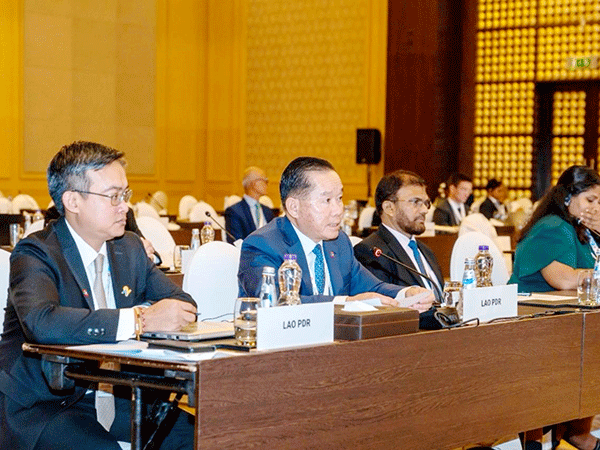
| Mr Thongphan Savanphet (centre) outlines Laos’ progress towards graduating from Least Developed Country status, at a meeting held in Doha last week. |
Laos steps up drive to graduate from LDC status
A Lao government delegation has declared the country’s readiness to transition from Least Developed Country (LDC) status after meeting all three United Nations graduation criteria.
The positive assessment was submitted at a meeting of more than 150 delegates from least developed countries, partner nations and the United Nations system, which was convened in Doha from December 2-4.
Addressing the meeting, Ambassador and Permanent Representative of Laos to the United Nations in New York, Mr Thongphan Savanphet, highlighted the progress Laos has made toward graduating from LDC status.
He said Laos fulfilled the three United Nations criteria for graduation in 2018, 2021 and 2024. These criteria comprise solid performance in the categories of Gross National Income (GNI) per capita, Human Asset Index, and Economic and Environmental Vulnerability Index.
According to the United Nations, LDC status is assessed using three main criteria. The first is income, in which countries must have an average per capita GNI below US$1,088 for inclusion and above US$1,306 to qualify for graduation.
The government of Laos expects its per capita GNI to reach about US$1,985 by the end of this year.
The second is the Human Assets Index, which measures health and education outcomes such as the under-five mortality rate, maternal mortality, adult literacy and gender parity in secondary school enrolment.
The third is the Economic and Environmental Vulnerability Index, which looks at a country’s exposure to economic shocks and natural disasters, including factors such as remoteness and dependence on agriculture.
The United Nations General Assembly initially recommended Laos for graduation in 2021, giving the country a transition period from 2026 to 2029. Laos completed its Smooth Transition Strategy in 2023 and is now preparing a Readiness Assessment report to support a stable and sustainable exit.
Mr Thongphan said the Lao government viewed graduation as an important milestone built on resilience and people-centred development, but warned that the period following graduation could be fragile if support measures were removed too quickly.
He said global shifts in climate, trade and digital technology were reshaping development prospects and that these changes could bring opportunities but also new risks, especially for countries that depend on continued access to international support.
“We are also aware that the path beyond graduation can be fragile. With the phasing out of international support measures, exposure to market volatility, and climate vulnerabilities, these can threaten the hard-won gains that enabled graduation in the first place,” Mr Thongphan was quoted as saying.
Mr Thongphan said Laos placed its Smooth Transition Strategy at the heart of national planning. The strategy sets three goals: smooth graduation, quality graduation, and sustainable graduation.
The plan includes 22 priority actions under four pillars: macroeconomic stability, trade and investment, human capital, and climate resilience. Each action has a lead ministry to ensure clear responsibility and progress.
Aligning these plans with National Socio-Economic Development Plans is essential, he added, while annual reporting and oversight from the United Nations Committee for Development Policy would support monitoring.
Mr Thongphan said Laos continued to rely on strong international partnerships to ensure long-term success.
Digital transformation, green growth and regional integration could open new paths for trade and investment, helping Laos build a more resilient economy after graduation, he added.
At the close of the conference, delegates adopted the Doha Agreed Statement on Global Partnerships for Sustainable and Resilient Graduation. The statement will guide United Nations agencies and development partners as they support countries preparing to graduate.
Graduation from least developed country status has been a priority of the Lao government for more than two decades and aligns with the Ninth National Socio-Economic Development Plan, and the draft of the 10th Plan and the Party’s Resolution on building a strong, self-reliant economy.
By Times Reporters
(Latest Update December 8, 2025)
|

