 |
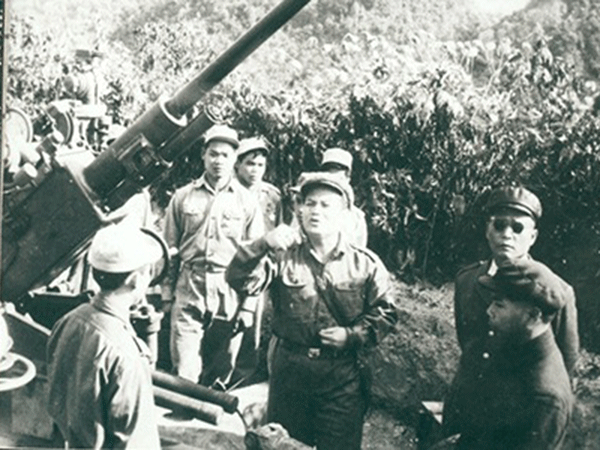
| President Kaysone was founder of the armed force that was the Lao People’s Army. (File photo Vientiane Times) |
President Kaysone Phomvihane: A timeless national hero who guided the revolutionary movement to ultimate success
Marking the 105th anniversary of the birth of President Kaysone Phomvihane (1920-1992).
Every December, as Lao people nationwide celebrate National Day and look back on the country’s long road to peace and independence, they also recall with deep gratitude the courageous and visionary leader who guided the nation through many years of hardship — President Kaysone Phomvihane.
His birthday on December 13 has become an occasion for Lao people of all ethnicities to pay tribute to his patriotism, wisdom, and lifelong devotion to the revolutionary cause.
President Kaysone, born on December 13, 1920, in Naxeng village, Savannakhet province, grew up under the loving care of his parents, Mr Louan and Mrs Dok Phomvihane.
From a young age, he was taught to be disciplined, curious, and responsible. His early education took him from Xayaphoum primary school to French-language studies in Savannakhet, before pursuing higher education in Hanoi.
As a student, he was known for reading widely, respecting his teachers, and achieving excellent grades.
The young Kaysone went to Hanoi at a time when the winds of resistance were blowing strongly across Vietnam. Inspired by the struggle for national liberation there, he joined progressive youth movements and immersed himself in political thinking.
He read Le Travail newspaper, studied Marxist-Leninist theory, and learned about the revolutionary ideas of President Ho Chi Minh. He trained in self-discipline, even practising boxing and judo as forms of self-defence.
In 1949, his talents and commitment were recognised when he was accepted as a member of the Communist Party of Indochina.
A few years later, on March 22, 1955, the Lao People’s Party was formed in Nameo village in Viengxay district, Huaphan province. This isolated area in the far north of Laos was close to the Vietnamese border and links with revolutionaries to the east were strong.
Kaysone was elected as Secretary General of the Party, a role he would hold throughout his life. He became the principal architect of Laos’ revolutionary strategy, guiding the movement from its earliest days through to its ultimate triumph.
President Kaysone laid the foundations of the Lao People’s Army and built the ideological framework of Marxist-Leninist theory in Laos.
Throughout complex periods of global politics, he remained steadfast in his study of revolutionary theory and determined in his leadership.
He declared the goal of the Lao revolution to be to propel the country along the road to socialism; a strategic direction that continues to guide Party policy today.
His leadership was especially vital during the long years of the Indochina War.
From 1964 to 1973, the remote revolutionary stronghold of Viengxay deep in the mountainous terrain of Huaphan became the Party’s command centre.
For more than a decade, the revolutionaries endured hardship and danger, but under President Kaysone’s guidance, the Party led countless operations that eventually resulted in the peaceful victory of 1975, restoring full sovereignty to Laos without bloodshed.
Among the caves of Viengxay, visitors today can still see traces of his life; the books he studied, gifts from visiting leaders of friendly countries, and the simple working space where he planned the liberation of Laos.
These remnants speak of a leader who lived modestly, worked tirelessly, and dedicated everything to ensuring Laos’ self-determination.
Although he passed away on November 21, 1992, President Kaysone’s legacy remains strong and is deeply cherished.
His revolutionary spirit continues to inspire generations of Lao people, Party members, and government officials.
He is remembered not only as the first leader of the Lao People’s Democratic Republic, but also as a patriot whose principles shaped the country’s destiny.
Today, people still make the 700-kilometre journey from Vientiane along winding mountain roads to Viengxay — a place that has become a symbol of resilience and unity.
Walking tours offers expansive views of the limestone mountains and the places where the revolutionary leaders once lived and worked. Many visitors say they leave with a deeper understanding of the sacrifices that were made in a bid to free Laos of foreign domination once and for all.
Visitors can explore the caves that were once occupied by President Kaysone, President Souphanouvong, President Nouhak Phoumsavanh, and President Khamtay Siphandone.
Each cave tells stories of determination, danger, and hope. For many Lao people, a trip to Viengxay is not just about sightseeing — it is a pilgrimage to honour the freedom they enjoy today and those who fought so hard to achieve it.
As Laos marks each anniversary of its independence and the birth of President Kaysone, the stories of his life remind us of the importance of unity, perseverance, and service to the nation.
His example remains a guiding light, reminding people from all walks of life to uphold the values that brought peace and progress to the Lao people.
President Kaysone Phomvihane was truly a great patriot, a revolutionary hero, and a leader whose legacy will forever be glorified and celebrated by the Lao nation.
By Khonesavanh Latsaphao
(Latest Update December 12, 2025)
|

