 |
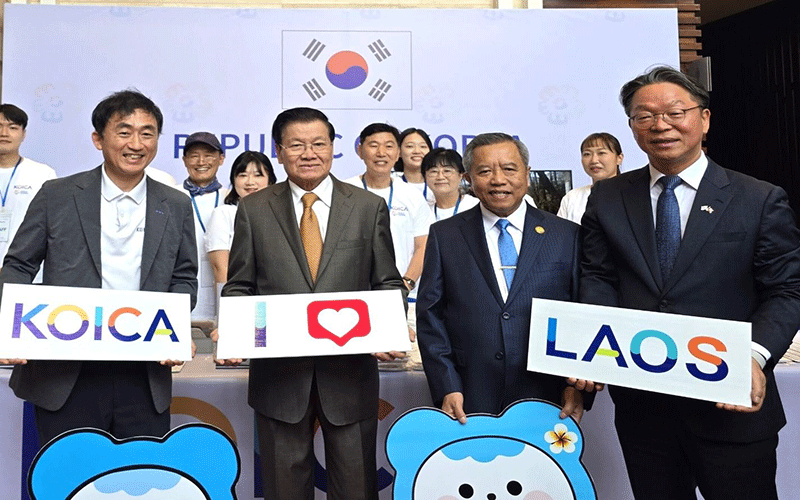
| President Thongloun Sisoulith (second left); Minister of Technology and Communications, Prof. Dr Boviengkham Vongdara (second right); Ambassador of the Republic of Korea to the Lao PDR, Mr Jung Yung-soo (right) and KOICA Lao PDR Country Director, Mr Oh Sungsoo (left), during the President’s Digital Week visit. |
30, 50, and K+HOPE
This year stands at a pivotal juncture for both the Lao People’s Democratic Republic and the Republic of Korea. Laos marks half a century since the founding of the Lao PDR, and the two countries commemorate three decades of steady and constructive diplomatic relations.
Into this landscape of anniversaries and accumulated memories steps President Thongloun Sisoulith, whose visit to Seoul carries the quiet resonance of a relationship that has matured beyond the formalities of statecraft. His presence suggests a shared intuition that the partnership now stands on the cusp of something larger.
For more than thirty years, KOICA has walked alongside Laos through a period of profound transition. Over US$230 million in cumulative assistance has been guided by Laos’s national priorities—from the 10th National Socio-Economic Development Plan to Korea’s Country Partnership Strategy.
Though often categorised as technical frameworks, these plans serve as blueprints for the rhythms of ordinary life: water that runs reliably, a mother whose health is safeguarded, a hillside that holds in the monsoon season. Under these guiding priorities, KOICA’s work has taken the shape of a long, interwoven effort to reinforce the systems that sustain Lao communities, rather than a series of detached interventions.
In rural Laos, KOICA’s presence is visible not in monuments but in the subtle transformations of village life. At the Lao–Korea Agricultural Techniques and Rural Development Service Center, improved farming methods move steadily from demonstration plots into household practice, while Saemaul pilot projects across 64 villages have delivered tangible improvements in infrastructure and livelihoods. These shifts, modest as they appear, open pathways for families to imagine a future beyond subsistence.
In health, where national development intersects most directly with everyday vulnerability, KOICA’s engagement has broadened from community-level support to institutions that shape the system itself. Nationwide nursing volunteers strengthen primary care, and the KOICA-built Children’s Hospital—the country’s first public pediatric facility—signaled a new era for child health services. KOICA is now preparing a second-phase expansion that seeks not only to enhance care but to support the well-being, growth and happiness of the children who will define Lao PDR’s future.
Human resource development has unfolded with a similarly generational cadence. At the Lao–Korea Institute for Skill Development, vocational programs in ICT, automotive technology and electricity function as a national apprenticeship, preparing young workers for a slowly diversifying economy. The institute’s elevation to a national Skill Development Institute underscores growing confidence in this trajectory and in the potential of Laos’s youth.
KOICA’s work in water and the environment responds to the realities of a changing climate. In the Nam Ngum River Basin, hydrological modeling and early-warning systems help interpret a river increasingly shaped by forces beyond national control. In urban centers, KOICA supports a more sustainable future through the Vientiane Green City Action Plan and by strengthening wastewater and fecal-sludge management in Champasak—quiet but essential foundations for environmental and public health resilience.
It is within this mosaic of long-term cooperation that K+HOPE finds its place. Often mistaken for a single UXO-related event, the initiative is better understood as an expression of solidarity—a recognition that Laos is entering a pivotal period as it drafts its next NSEDP and prepares for LDC graduation. K+HOPE signals that Korea’s role, through KOICA, extends beyond financial or technical assistance; it is to accompany Laos as it navigates a developmental threshold, sharing both the risks of transition and the hope that propels it.
The enhancement of the COPE Center, including the translation of 214 exhibits into Korean, embodies this orientation toward empathy. By inviting Korean audiences into a narrative long overlooked, the effort broadens public engagement and strengthens the human foundations of a partnership grounded not only in policy but in lived experience.
The anniversaries marked this year—30 years of diplomatic relations and 50 years of national history—hold a symmetry whose significance exceeds arithmetic. They reflect a partnership shaped by patience, continuous dialogue and a shared willingness to evolve, supported by reforms that matured across decades and cooperation resilient enough to withstand political cycles.
As Laos prepares its next NSEDP and approaches LDC graduation, a more consequential question takes shape beneath the policy discussions: who will carry the country into its next century? The answer lies not in a single project but in KOICA’s integrated approach—strengthening the human foundations that broaden the capabilities and horizons of the young Lao who will inherit that future.
Drawing on Korea’s own development experience, KOICA is uniquely positioned to help build those foundations with clarity and purpose.
President Thongloun Sisoulith’s visit to Seoul underscores how far this partnership has traveled and signals a wider chapter now within reach. His presence affirms that years of shared effort have carried both nations to a broader horizon—one where the earlier question of who will shape Laos’s next hundred years begins to meet its answer in renewed commitment. From that vantage, KOICA will continue as Lao PDR’s comprehensive partner, accompanying the country with the steadiness required to nurture the people who will write the next chapters of its history.
By KOICA Lao PDR
(Latest Update December 18, 2025)
|

