 |
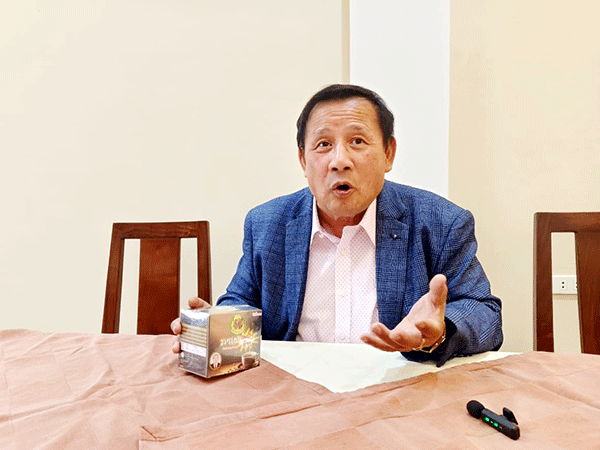
| Holding his herbal coffee, Mr Vongsack Serixay explains how he came up with the idea of the “Elephant Power” coffee brand. |
Giving back to the motherland: A Lao expat shares his vision for contribution to national development
From New York back to Vientiane, a member of the overseas Lao diaspora reflects on how identity, opportunity and policy reforms are shaping new paths of contribution to national development. His journey highlights the growing role of overseas Lao in investment, innovation and people-to-people ties as the nation marks 50 years of statehood.
When Vongsack Serixay, 70, sits at a lunch table in Vientiane surrounded by former and current diplomats, business executives, relatives and old friends, the conversation flows easily. Laughter punctuates memories of the past, while talk of opportunity and responsibility shapes the future.
For Mr Vongsack, who was born in Laos but now lives in New York, the gathering symbolises something deeply personal: the chance to give back to the country he left nearly half a century ago, and the country that still feels like home.
“I never imagined that one day I would be invited to celebrate such a historic occasion,” he says, referring to his participation in the 50th anniversary of the founding of the Lao People’s Democratic Republic on December 2.
Among more than 400 members of the Lao diaspora who were invited from around the world, his presence reflected the government’s growing effort to reconnect with overseas Lao and encourage them to contribute their knowledge, skills and capital to national development.
 |
 |
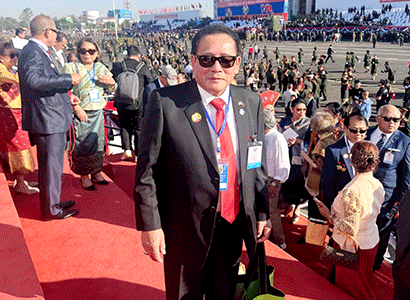
Mr Vongsack Serixay says participating in the celebration of the 50th anniversary of the Lao PDR was his greatest honour and proudest moment. |
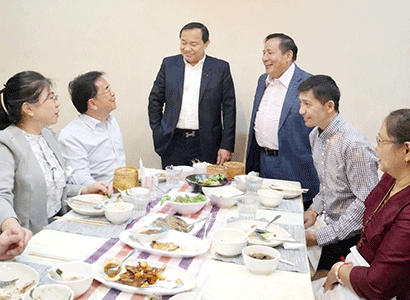
Mr Vongsack Serixay, along with guests and friends, enjoy lunch at the Soukvimarn Cuisine Lao Restaurant. |
A long road away, a steady connection home
Mr Vongsack left Laos in 1979, just four years after the Lao PDR was proclaimed. His journey took him through Thailand before he eventually reached the United States.
Like many newcomers, he moved between states, taking on various jobs before settling in New York, where he built a life and career. Today, he runs a jewellery business, specialising in design and crafting.
Despite the demands of building a new life, he never severed his ties with the Lao community there. That relationship, built quietly over decades, laid the foundation for his later engagement in strengthening connections between the Lao diaspora and their homeland.
Returning with purpose
During the early years, Mr Vongsack never thought of returning to Laos. That changed in 1992, when he made his first visit here to reunite with friends and his elder sister. The experience reshaped his perspective, thanks to the government’s policy of reunion and mobilising a joint force for national development.
“After that, I came back every year,” he said. “Sometimes twice or even three times a year.”
Over time, those visits became more than personal reunions. They became opportunities to observe Laos’ development and consider how he, as an expat, could contribute.
Two years ago, he returned at the invitation of the Lao Front for National Development, which convened a meeting of people of Lao origin now living overseas, as part of the government’s broader outreach strategy.
Encouraged by supportive Party and state policies, many overseas Lao now feel more confident about returning and investing in the country’s future.
“The government hasn’t abandoned us,” he said. “The policy is very good.”
Turning experience into enterprise
For Mr Vongsack, meaningful contribution meant more than emotional attachment; it meant creating something tangible.
That opportunity emerged unexpectedly through a traditional herbal remedy given to him by a relative in Laos. Years later, when the herbs proved effective in easing the gout that he and his nephew suffered, the experience sparked an idea.
Working with a friend in Laos, he piloted the development of a herbal coffee product inspired by Lao herbs. The project gained momentum when he connected with the former Director of the Institute of Traditional Medicine, Associate Professor Kongmany Sydara, and other Lao herbal experts.
With their guidance, the herbal coffee brand “Elephant Power” was launched, using an elephant head as its trademark and positioning itself as a sugar-free, health-focused product.
The coffee incorporates extracts of traditional and natural ingredients, including eurycoma longifolia, kaempferia parviflora, codonopsis pilosula, maca, goji berry and other supplements.
Currently produced on a small scale and available only in Laos, the product represents Mr Vongsack’s vision of promoting made-in-Laos products both at home and abroad.
Looking ahead, Mr Vongsack hopes to expand production and eventually export the coffee to the United States, particularly targeting the Lao diaspora.
To achieve this, he is seeking partners, especially those with marketing expertise, and emphasises the importance of helping farmers to cultivate plants used in traditional medicine.
He also hopes for greater coordination among Lao expats engaged in business in Laos.
“One day, I hope to ask the Lao Front for National Development to call a meeting of returning expats,” he said, referring to those doing business in Laos.
Policies opening the door
Recent policy reforms have reinforced that optimism. In 2021, the government issued Decree No. 475, allowing eligible people of Lao ethnicity and their family members to apply for long-term visas. In 2024, Decree No. 642 further permitted eligible applicants to apply for permanent residence in Laos, with benefits including exemption from entry and exit visas and the right to purchase land use rights allocated by the state.
Meeting with members of the Lao diaspora during his recent visit to the USA, Prime Minister Sonexay Siphandone described overseas Lao compatriots as “part of the national family” and a key force in national development.
Mr Vongsack welcomes the policies, while noting that further incentives, such as broader land ownership rights and special entry documents, could encourage even stronger participation.
Whether his business grows quickly or gradually, Mr Vongsack remains resolute in his goal.
“It is my dream to make a contribution to the Lao economy and promote Lao products; products of the Lao diaspora,” he said.
As the Lao PDR marks 50 years of nationhood, Mr Vongsack’s journey stands as a reminder that Laos’ development can be strengthened not only from within, but also by those who, though far from home, never stopped believing in it.
By Souksakhone Vaenkeo
(Latest Update December 24, 2025)
|

