2025 wrap-up: A year of steady change for Laos
Laos ends 2025 amid firm political stability, improved economic performance, major governance reforms, broader foreign engagement, and renewed confidence in tourism and infrastructure development, even as challenges persist, notably high public debt and labour shortages.
As the year draws to a close, 2025 stands out as a period of cautious recovery, structural reform, and groundwork laid for the country’s next stage of development.
 |
The Lao economy is projected to grow by 4.8 percent. --Photo Phoonsab Thevongsa
|
Economy shows signs of recovery
Economically, 2025 can be described as a year of gradual but tangible recovery. By year’s end, economic growth is expected to reach 4.8 percent, exceeding the 2021–2025 average of 4.24 percent. According to government reports, key growth drivers include agriculture, electricity generation, mining, the processing industry, transport, and tourism, signalling a steady rebound after years of economic headwinds.
Inflation showed marked improvement. By November, the inflation rate had fallen to 4.8 percent, marking seven consecutive months of single-digit inflation. This represents a significant turnaround from the two-digit rates recorded since May 2022, which peaked at 41.26 percent in February 2023.
Progress was also recorded in state-owned enterprise reform. The government agreed to sell up to a 49 percent stake in Lao Airlines to China’s Commercial Aircraft Corporation of China (COMAC), while shares in other state enterprises are set to be offered to private investors as part of broader efforts to improve efficiency and reduce chronic losses.
Debt servicing has improved, with public debt declining from 116 percent of gross domestic product in 2022 to 88 percent in 2025, Prime Minister Sonexay Siphandone told the National Assembly. However, international financial institutions continue to caution that Laos remains in debt distress, with the government still negotiating with major creditors to reschedule principal repayments.
Labour shortages remain another pressing challenge. Rising living costs and the weak kip—despite recent stabilisation—have encouraged labour migration abroad, leaving many domestic businesses struggling to find workers.
Major governance reforms take shape
With 2025 being the final year of the 2021-2025 National Socio-economic Development Plan and the national agenda to address economic and financial difficulties, remarkable progress has been made not only in the economic sector but also in structural reforms.
In March, the National Assembly approved sweeping administrative restructuring, reducing the number of ministries from 17 to 13 to improve efficiency and governance. The number of central government departments was cut from 158 to 124, while provincial departments declined from 574 to 502.
Another notable reform was the decision to raise the retirement age for civil servants from 60 to 65, extending the working lives of thousands of government employees and helping retain experienced personnel within the public sector.
Push for graduation from LDC status
Throughout the year, the government accelerated preparations for Laos’ graduation from Least Developed Country (LDC) status, scheduled for 2026.
Laos has met all three United Nations criteria for graduation—income level, human assets, and economic and environmental vulnerability. Laos’ gross national income (GNI) per capita is expected to reach about US$1,985 by the end of this year, surpassing the requirement of over just US$1,306. The graduation transition period from 2026 to 2029 will be guided by a Smooth Transition Strategy focusing on macroeconomic stability, trade and investment, human capital development and climate resilience.
Foreign relations broaden and deepen
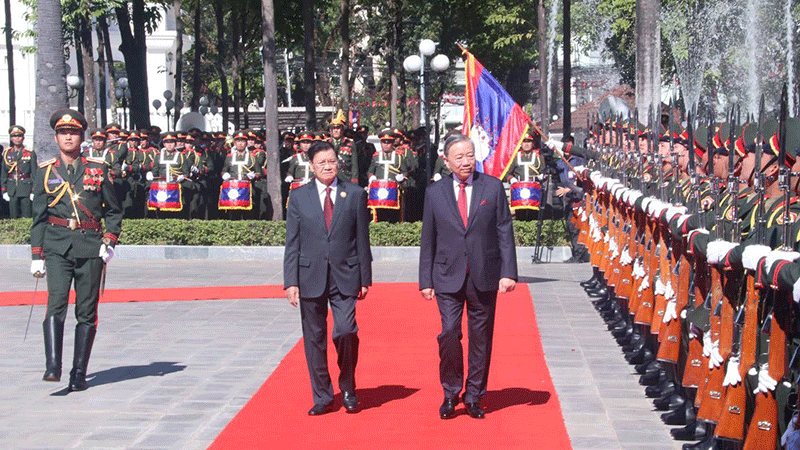 |
Party Secretary General Thongloun Sisoulith (left) and his Vietnamese counterpart, To Lam, inspect the guard of honour during the latter’s state visit to Laos earlier this month.
|
Laos achieved significant diplomatic milestones in 2025, strengthening relations with key partners across the region and beyond.
In late July, President Thongloun Sisoulith paid an official visit to Russia to mark the 65th anniversary of diplomatic relations. During the visit, the two sides signed seven cooperation agreements covering education, health security, water resource protection and legal assistance.
Laos also became a dialogue partner of the Shanghai Cooperation Organisation at its summit in Tianjin, China. The grouping includes China, Russia, India, Pakistan and Iran. Party Secretary General and President Thongloun led a high-level delegation to attend the summit at the invitation of Chinese President Xi Jinping. During the visit, he also took part in events marking the 80th anniversary of victory in the anti-fascist war and paid a working visit to China in early September.
President Thongloun later travelled to Vietnam to attend celebrations marking the 80th anniversary of Vietnam’s National Day in Hanoi, reaffirming the close ties between the two neighbouring countries.
In October, President Thongloun paid a state visit to the Democratic People’s Republic of Korea to mark 50 years of diplomatic relations. He held talks with General Secretary of the Workers’ Party of Korea and President of State Affairs of the Democratic People’s Republic of Korea (DPRK), Mr Kim Jong Un, with both sides agreeing to strengthen cooperation in Party building, education, culture and people-to-people exchanges, while maintaining regular high-level contacts.
Laos celebrated the 70th anniversary of diplomatic relations with Japan in November, highlighted by the historic visit of Princess Aiko, the daughter of Emperor Naruhito. President Thongloun said her visit reflected Japan’s high regard for bilateral ties and would further strengthen cooperation between the two countries.
In early December, Laos and Vietnam upgraded their long-standing friendly relations, special solidarity and comprehensive cooperation to a “Great Friendship, Special Solidarity, Comprehensive Cooperation and Strategic Partnership” during a state visit to Laos by the General Secretary of the Communist Party of Vietnam, To Lam.
Later in the year, Laos also upgraded relations with the Republic of Korea to a Comprehensive Partnership during an official visit by President Thongloun, marking 30 years of diplomatic ties.
Meanwhile, Laos and the United Nations celebrated 70 years of partnership, emphasising a shared commitment to youth empowerment, sustainable development, and future cooperation. Furthermore, 2025 marks the 50th anniversary of diplomatic relations between Laos and the European Union.
Land-linked vision gains momentum
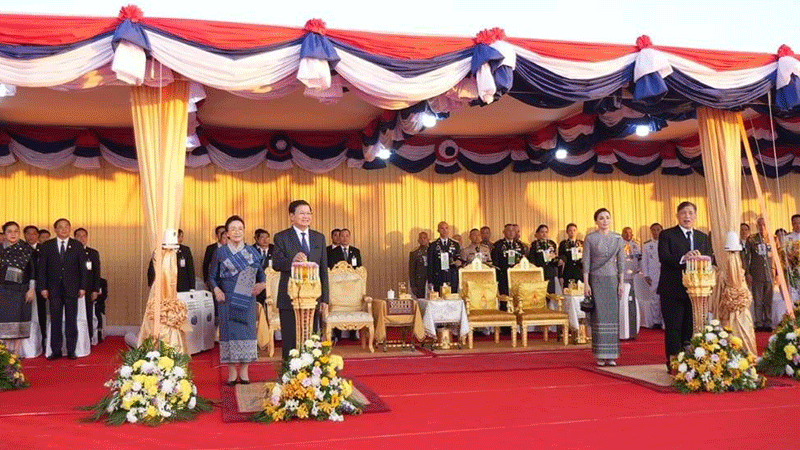 |
President Thongloun Sisoulith (left) and His Majesty King Maha Vajiralongkorn Phra Vajiraklaochaoyuhua of Thailand inaugurate the fifth Lao-Thai Friendship Bridge. --Photo Paxason Newspaper
|
Efforts to transform Laos from a landlocked to a land-linked country continued to advance. The Laos-China Railway marked its fourth anniversary, having transported more than 62.5 million passengers and over 72.5 million tonnes of freight, reinforcing Laos’ role as a regional transit hub.
Another strategic development took place in April at the Vung Ang Port in Vietnam’s central province of Ha Tinh when President Thongloun Sisoulith joined his Vietnamese counterpart Luong Cuong in launching berth No. 3 at the deepwater seaport. Vietnam has agreed that Laos will hold a 60 percent stake in the port, expanding Laos’ access to sea trade routes and regional logistics networks.
In addition, plans are progressing to build a rail link between the seaport in Vietnam and the Lao capital, Vientiane. Construction of the planned railway is scheduled to begin in 2026 and is expected to be completed by 2030.
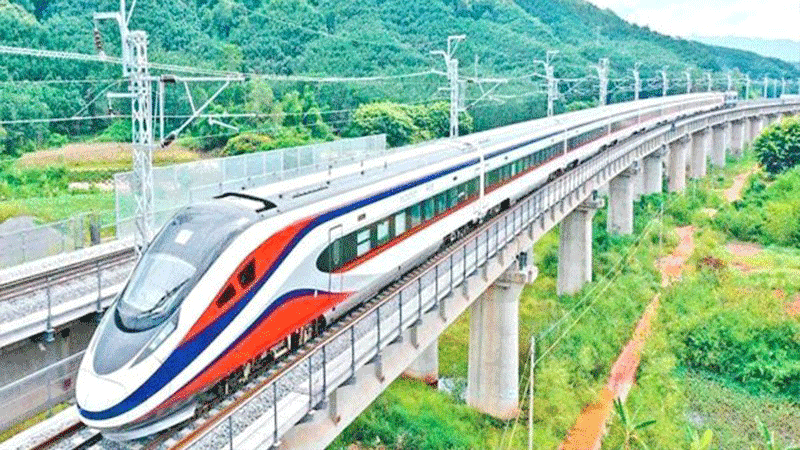 |
The Laos-China Railway advances the government’s vision of transforming Laos from a landlocked nation into a land-linked hub.
|
This year Laos and Vietnam began construction of the Vientiane-Hanoi Expressway, starting with a 203.8-km section running from Pakxan district to the Laos-Vietnam border in Xaychamphon district, Bolikhamxay province.
The Lao and Vietnamese governments have pledged to work together to ensure the expressway is completed as planned.
Most recently, the fifth Lao-Thai Friendship Bridge across the Mekong River was officially opened, linking Bolikhamxay province with Thailand’s Bueng Kan province and further strengthening regional connectivity. The bridge was inaugurated by President Thongloun Sisoulith and His Majesty King Maha Vajiralongkorn Phra Vajiraklaochaoyuhua of Thailand, with senior leaders from both countries present at the ceremony.
Tourism makes a rebound
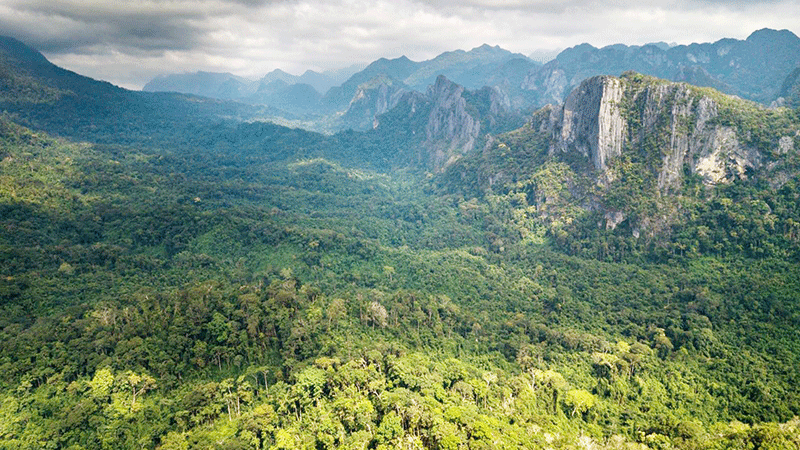 |
Hin Nam No National Park in Khammuan province was inscribed as a World Heritage Site.
|
Tourism emerged as one of the strongest performers in 2025. In the first ten months of the year, nearly 3.8 million foreign visitors arrived in Laos, a 13 percent increase year-on-year. Total arrivals are expected to exceed 4.3 million for the full year.
A major milestone came in July when the Hin Nam No National Park in Khammuan province was inscribed as a UNESCO World Heritage Site, becoming Laos’ first natural world heritage site and its fourth overall.
Landmark renewable energy projects become operational
 |
The Monsoon Wind Power Project begins operation and the export of power to Vietnam. --Photo Monsoon Wind Power Project
|
In August, the Monsoon Wind Power Project in southern Laos, the largest in Southeast Asia, began operation, marking a milestone in Asia’s clean energy transition and bolstering the Lao government’s green growth drive. This was boosted further by a 1,000-megawatt solar power plant, which was officially commissioned earlier this month in northern Oudomxay province.
BRT bus service launched
This year marked the launch of the Bus Rapid Transit (BRT) system in Vientiane, the first of its kind in Laos. The scheme is expected to transform the face of public transport, despite ongoing challenges. Heated public debate over the design of the system has led to the removal of some structures and the scheme is now under review.
A year of historic anniversaries
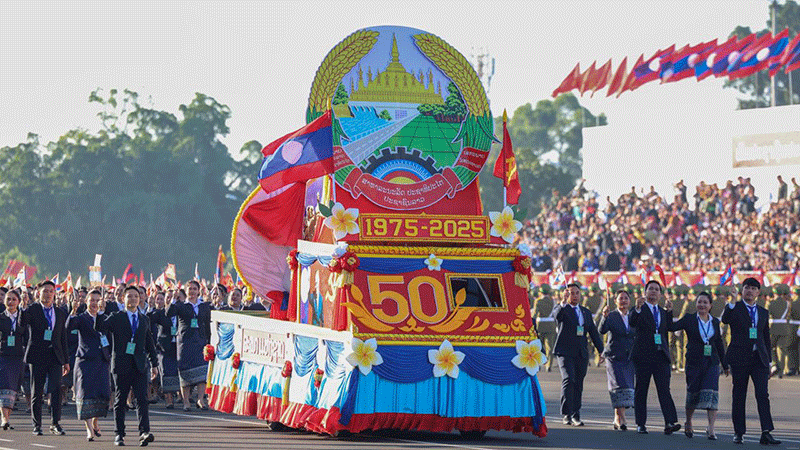 |
A grand parade marks the 50th anniversary of the founding of the Lao PDR on December 2.
|
This year was one of great historical significance, beginning with the 70th anniversary of the founding of the Lao People’s Revolutionary Party on March 22.
On December 2, the multiethnic Lao people celebrated the 50th anniversary of the founding of the Lao PDR, when a spectacular parade in Vientiane highlighted five decades of national unity, political stability, and development under the Party’s leadership.
Laos also celebrated the 105th anniversary of the birth of President Kaysone Phomvihane on December 13, honouring his contributions as a key leader of the revolution and his pioneering of several initiatives that continue to guide Laos’ development today.
Sport unites the nation
The 12th National Games, held in November at the National Stadium in Vientiane, brought together more than 4,000 athletes from across the country. Opened by President Thongloun Sisoulith, the Games promoted national unity, a healthy lifestyle, and talent development.
Looking ahead to 2026
The achievements of 2025 have laid important groundwork for 2026, a pivotal year marking both political transition and a new development phase as Laos prepares to graduate from Least Developed Country status.
The Lao People’s Revolutionary Party will hold its 12th National Congress from January 6-8. Taking place once every five years, the congress will elect members of the new Party Central Committee. Once elected, the new central committee will immediately hold a preliminary session to elect the Party Secretary General, Politburo members, and other key Party bodies.
Following the congress, a National Election is scheduled for February 22, 2026, when voters will choose their representatives as members of the National Assembly. Later, the inaugural session of the NA will elect the President and Vice President of the National Assembly, the State President and Vice Presidents, the Prime Minister, endorse the new government cabinet, and approve the five-year National Socio-economic Development Plan for 2026-2030.
As Laos moves into 2026, the year ahead represents not only a new political cycle, but also a decisive step towards long-term stability, self-reliance and sustainable progress beyond LDC status.
By Phonepaseuth Volakhoun
(Latest Update December 31, 2025)
|

